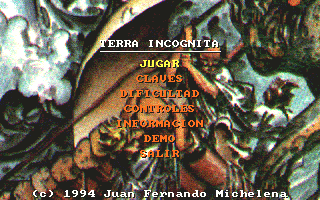
Terra Incognita
Terra Incognita drops you into the boots of an 18th-century Spanish biologist stranded on a demonic island, hurling an endless supply of hatchets at low-budget horror monsters. Developed by Juan Fernando Michelena in 1994, this obscure Argentine shareware release is a bizarre slice of South American PC history that came dangerously close to being lost forever.
Stranded at Cape Horn with a pocket full of hatchets
The story opens in January 1776, right around the founding of the Viceroyalty of the Río de la Plata. The local authorities in Buenos Aires dispatch a scientific expedition down toward the freezing waters of Cape Horn and Tierra del Fuego. Predictably for an action game from this era, the vessel wrecks in the southern Atlantic, leaving biologist Sebastián de Anchorena as the lone survivor washing ashore on an uncharted island overrun by nightmare creatures.
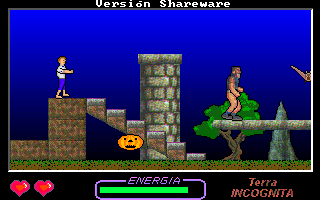
Instead of relying on scientific instruments or botanical charts, Sebastián survives by chucking heavy iron axes at anything that moves. The premise sounds like serious historical fiction right up until the moment you take your first steps along the beach and realize the monsters look less like indigenous wildlife and more like creature features from late 20th-century American low-budget cinema. It is a odd mismatch of setting and style that gives the experience a distinct flavor right away.
Simple controls and non-stop axe throwing in Terra Incognita
Playing the game today feels straightforward, though the keyboard layout shows its age. Movement relies on standard direction keys, while jumping is bound to the Up arrow or Shift, and ducking requires holding the Down arrow. Combat is mapped to Ctrl or Alt, which instantly hurls an axe straight across the screen in a flat horizontal trajectory.
Because your throw count is infinite, the core combat rhythm relies on pacing your attack button presses while managing incoming enemy hitboxes. You jump over low hazards, crouch underneath high projectiles, and keep a steady stream of flying blades moving toward the right side of the screen. The physics lack the floaty momentum of European platformers from the same period, opting instead for quick, abrupt jumps that leave very little room for mid-air adjustment.
Surviving an encounter means learning exact enemy spawn points and throwing your axes before the monsters can close the distance:
- Jumping over pit hazards with the Up arrow or Shift key while timing airborne throws.
- Crouching beneath flying projectiles using the Down arrow to stay beneath hitboxes.
- Spamming Ctrl or Alt to build a wall of flying axes against fast-approaching demons.
- Tracking incoming monster movement patterns across scrolling 2D screens.
The Argentine shareware scene and an unfinished story
During 1994, commercial game production across South America was small, making localized distribution networks vital for indie creators. Juan Fernando Michelena teamed up with Cosmos Software Argentina to publish the title through shareware channels. Rather than arriving in a glossy retail box on shop shelves, it passed through local bulletin board systems, floppy disk swaps, and utility collections.
That informal distribution method created a major preservation problem. For decades, retro gaming circles hunted for complete copies of the game, only to discover that the full commercial version seemed to have vanished into thin air. The copy circulating among collectors today is an incomplete shareware build that cuts off early, leaving later levels, boss encounters, and the ultimate resolution of Sebastián's escape lost to time.
What makes this lost MS-DOS platformer worth playing today
If you evaluate it purely alongside commercial giants from 1994 like Jazz Jackrabbit or Commander Keen, this title shows obvious technical limitations. Sound effects rely heavily on simple bleeps, sprite animation is rigid, and the level layouts suffer from repetitive tile placement. Yet there is a genuine charm to its absurd mashup of 18th-century Spanish colonial history and cheap monster movie tropes.
The total lack of a save system or mid-level checkpoints makes even a short run surprisingly tense. A single misjudged jump or an unexpected enemy spawn can wipe out your progress in seconds, forcing you to master every screen through memory and fast reflexes. Anyone who enjoys hunting down obscure PC oddities will appreciate the gritty arcade pacing and historical curiosity behind its production.
Play Terra Incognita free in your browser
You do not need an old machine or a stack of 3.5-inch floppies to explore this piece of Argentine gaming history. You can play Terra Incognita online free in your browser right here without installing extra software. Launch the game, get a feel for the jump arc, and see how many screens of demon-infested wilderness you can clear before your health bar runs dry.