
The Adventures of Maddog Williams in the Dungeons of Duridian
Building The Adventures of Maddog Williams in the Dungeons of Duridian meant taking the parser-driven exploration of Sierra titles and shoving live sword combat right into the middle of it. You play a humble shopkeeper and inventor from the seaside town of Marinor, but your biggest threat is often the race to type a command before an active scene kills you.
Why combining a text parser with active swordplay almost broke Maddog Williams
You begin your journey as Maddog Williams, an everyday inventor who gets pulled out of his coastal shop to rescue Princess Leoria, liberate King Thaylor, and bring down the villainous Evil Serak. The game asks you to explore the fantasy land of Duridian using arrow keys for movement while typing verb-noun phrases into a classic Sierra-style text parser. Standard interaction involves typing commands to inspect scenery, manage inventory items like ropes and jugs, and chat with local non-player characters.
The system reveals its rough edges the moment an action sequence triggers. Unlike traditional point-and-click or purely turn-based designs, the text engine does not freeze the action when you open the prompt. If you need to manipulate an object or unlock a door while under pressure, you must enter your text commands rapidly while the world moves around you in real time. One misplaced keystroke often forces a quick reload of your last save state just to re-type the required sequence.
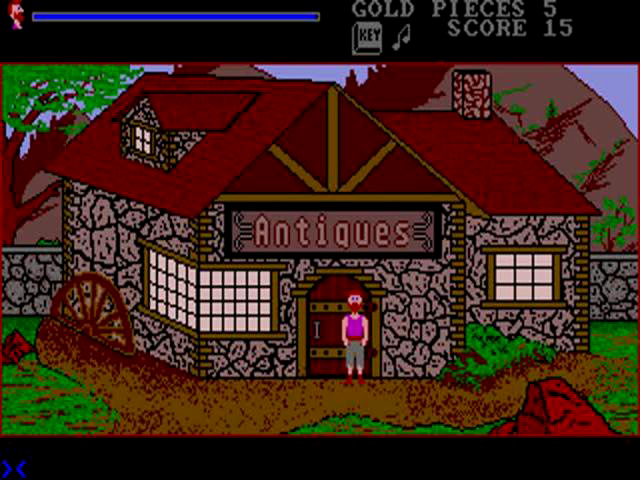
The Adventures of Maddog Williams in the Dungeons of Duridian takes Sierra's formula into real-time combat
When an armed enemy or creature intercepts you, the display shifts into a dedicated side-scrolling fighting viewport. Direct swordplay replaces puzzle-solving for the duration of the duel. You control your sword slashes and defensive maneuvers manually against whatever monster stands in your path.
The fighting system gives you a surprisingly specific set of martial options for an early 1990s hybrid:
- High and low attacks: You can target an opponent's head or legs depending on their guard.
- High and low blocks: Timed defensive parries absorb incoming weapon strikes.
- Side steps: Tactical positioning lets you retreat or close the distance across the side-scrolling arena.
- Difficulty scaling: Selecting a lower difficulty setting dampens enemy combat aggressiveness and simplifies certain puzzle requirements.
While the intent was to inject kinetic excitement into standard adventure games, combining action controls with a text-heavy interface creates noticeable friction. Managing spacing and sword swings on the keyboard right after typing commands requires quick hand repositioning. When you finally reach King Serak himself, victory depends as much on wrestling with the control layout as it does on learning enemy swing rhythms.
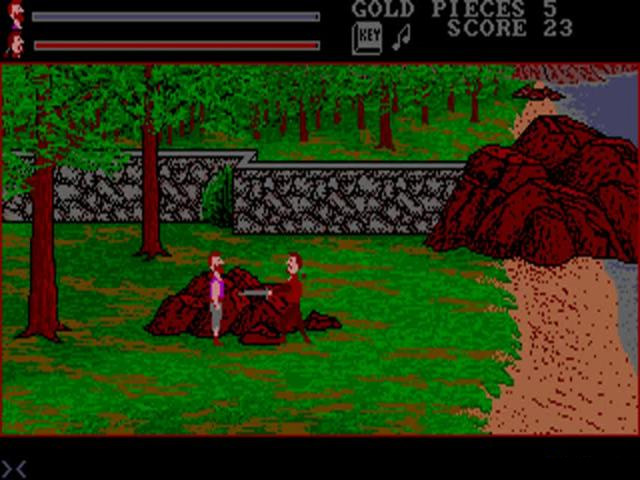
Eight chapters of charm, comedy, and punishing control friction
The campaign splits across eight non-linear quests, granting you freedom in how you tackle the kingdom's troubles. The writing leans into lighthearted humor and affable dialogue, balance-checking the brutal game-over screens with genuine wit. Bright background scenes and full MIDI sound support help give the world of Duridian a distinct personality that pulled players in despite the steep mechanical hurdles.
Gaming magazines of the era were sharply divided over the hybrid design. Amiga Computing praised the swashbuckling tone, while Germany's Amiga Joker handed down a lukewarm 44% rating, taking aim at the clumsy overlap between action scenes and typing prompts. Retrospective reviews mirror that reaction: the dialogue and scenario design earn praise, but the demand for lightning-fast typing during active hazards frustrates almost everyone who plays it today.
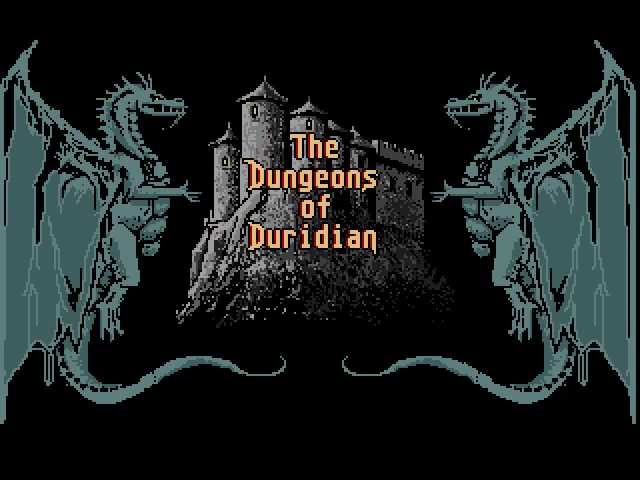
How Game Crafters turned home-grown ambition into a shareware hybrid
The project came together through the efforts of Curtis Lowe, Ron Lowe, and Tom Jensen, working under the banner of Game Crafters (credited as Iliad in some early materials). The trio built the engine after playing King's Quest III, driven to create their own spin on the animated parser genre with direct combat thrown in. Released in 1991 for the MS-DOS version alongside Atari ST and Amiga editions, it found its audience through shareware distribution channels.
Game Crafters planned a Sci-Fi follow-up titled Escape from Cylindria, intended as a spoof of Sierra's Space Quest series, but the project was shelved and never finished. Years later, in July 1996, the developers released the full registered version of Maddog's adventure for free on their official site, securing its availability for retro enthusiasts long after commercial floppy disk sales had ended.
Play The Adventures of Maddog Williams in the Dungeons of Duridian free in your browser
The combination of real-time swordfighting and traditional typing tests does not always land smoothly, but the sharp humor and ambitious structure make this release an interesting piece of early PC history. The puzzle design rewards careful inventory experimentation, provided you keep a finger resting near your save key before entering dangerous rooms.
You can play The Adventures of Maddog Williams in the Dungeons of Duridian online right now in your web browser. Everything runs directly inside your browser window with no installation required, allowing you to test your fast-typing skills against Serak's minions within seconds.