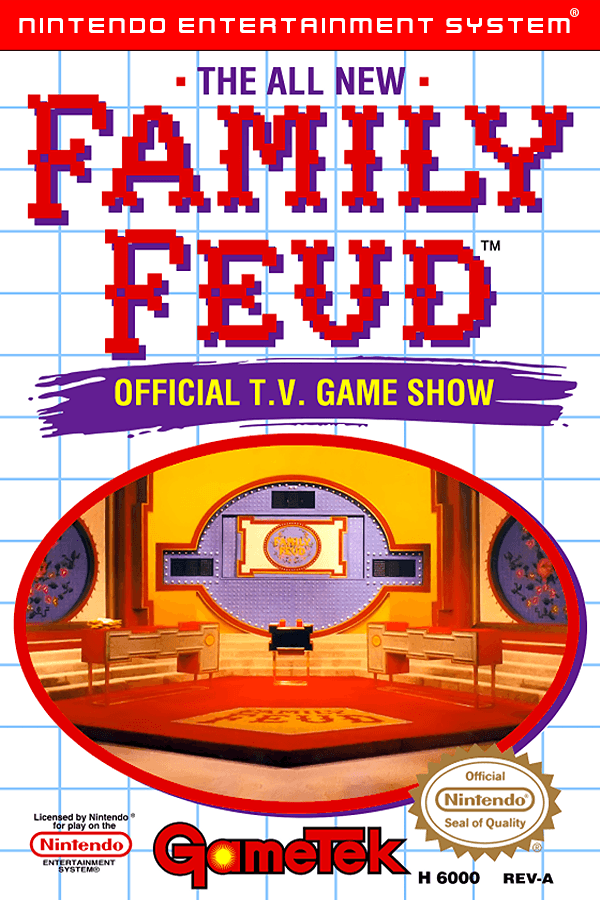

If you want to experience Ray Combs era TV trivia on vintage hardware, The All New Family Feud brings the survey-driven game show straight to 1989 PCs. It captures the structure of the television hit, though wrestling with its strict text parser will test your patience as much as your knowledge of survey answers.
Redesigning the television studio for EGA monitors
Adapting a television game show to home computers in the late eighties was always an exercise in compromise. Softie, Inc. had already tackled the license two years prior, but when the broadcast version refreshed its look and host, publisher ShareData, Inc. pushed for a updated PC release. The result was this 1989 follow-up, tailored to match the set design and pacing of the Ray Combs era.
Instead of the muddy low-resolution look of older DOS trivia titles, this release upgraded the studio presentation with extended EGA visual support. The bright blue board, the digital score counters, and the stylized family podiums look recognizably close to what viewers saw on television every weeknight. It gives the game an immediate visual identity, even if your sound hardware is limited to the chirps and clicks of the standard internal PC speaker.
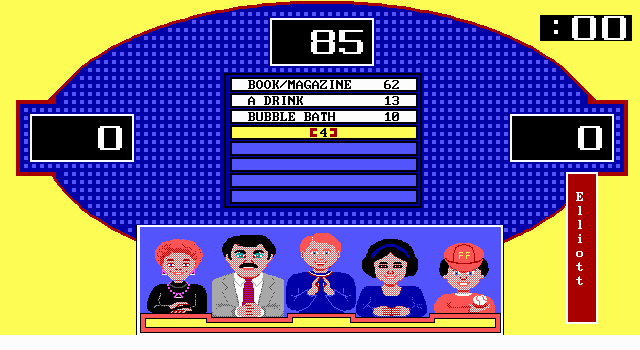
Beyond the fresh coat of paint, the core rules faithfully follow the television format. Two five-member teams face off across survey questions previously asked to a hundred random people. You guess the top answers, score points corresponding to how many surveyed participants gave that response, and try to sweep the board before stacking up three strikes.
Where The All New Family Feud loses its battle with typing
When you start a match in 1989's The All New Family Feud MS-DOS game, the biggest hurdle is not coming up with a plausible answer. It is convincing the game's strict text parser that you typed what it wants to read. If a survey question asks for a popular female singer and you type a slight variation or misspell a single letter, the game routinely penalizes you with an incorrect buzz.
This strictness creates genuine friction during match play. You might know the exact response the survey pool selected, but unless your phrasing matches the internal database entry character for character, you get hit with a strike. It turns standard trivia rounds into a guessing game of vocabulary rather than general knowledge.
The pacing between turns suffers from this design choice as well. Because every response requires manual text input and confirmation, the back and forth flow of a real game show bogs down. What should be a quick-fire round of family answers turns into a deliberate typing test punctuated by long pauses between board reveals.
Bizarre computer AI and the Fast Money rush
Playing against human opponents on a shared keyboard offers the best experience, mostly because computer-controlled families exhibit wildly unpredictable behavior. Thanks to the quirks of Softie, Inc.'s code, digital opponents alternate between unbelievable genius and absurd nonsense. One minute a computer player misses an obvious top survey response, and the next minute it types an improbably precise answer that seems impossible for an automated system to pull out.
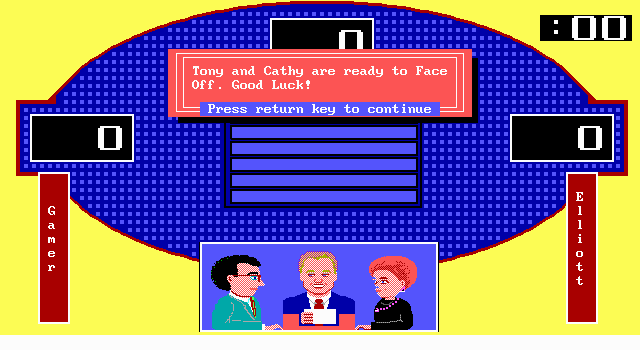
The mechanics split into distinct game phases, each bringing its own quirks:
- The Faceoff: A high-speed buzzer round where the prompt flies onto the screen so fast you barely have time to digest the prompt before the timer forces an answer.
- Main Family Rounds: Standard turn-based play where the controlling team tries to guess all hidden answers on the board while avoiding three strikes.
- Steal Attempts: If the active family hits three strikes, the opposing family gets one single text input chance to steal the banked points.
- Fast Money: The endgame bonus round where two family members rapidly answer five questions to reach a 200-point total for the grand prize.
The Fast Money segment works best in the whole package, despite the strict parser. Splitting the round between two players recreates the high pressure of the show, especially when the second player has to quickly come up with alternate responses if their first choice was already claimed.
As with many disk-based trivia titles published by ShareData, Inc., question repetition is a known limit. After a few long sessions, you will start running into familiar survey prompts, which hurts long-term replayability unless you rotate human players in and out.
Try The All New Family Feud free in your browser
As a snapshot of late-eighties TV trivia games, this computer adaptation nails the presentation while showing its age in its strict text entry. The interface looks sharp in full EGA color, and gathering a few friends around a single keyboard for Fast Money still delivers some tense fun. It sits right alongside classic educational games of the era, flaws and all.
You can play The All New Family Feud online free in your browser right now, with nothing to install and no complex setup required. Try taking control of a family team, test your luck against the survey parser, and see if you can break the 200-point barrier in Fast Money without letting the faceoff timer run out on your first try.