
If you launch The Final Battle expecting a standard dungeon crawl, you will quickly find yourself stuck in a cell, forced to check weather conditions and listen at doors to survive.
The story picks up right where Legend of the Sword left off. The villainous wizard Suzar has returned to the land of Anar, captured your party, and thrown everyone into his dungeons. You start your escape as Steroff, working to reunite your companions, recover Avar's stolen magical sword and shield, and collect six crystals of power to stop Suzar from taking complete control of the realm.
Instead of controlling a single adventurer, you manage a small team of survivors. Each companion brings a required skill to the party:
The perspective uses a diagonal-down isometric angle. Even though you navigate an environment drawn in three dimensions, your group leader never appears on the screen. The game treats the isometric map as your direct viewpoint, forcing you to align your movement using an onscreen compass and automap.
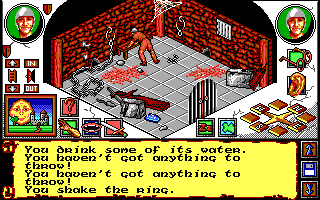
To interact with the island of Anar, you click action icons on the interface before clicking an object or target on the map. The main actions at your disposal include "inspect", "take", "drop", "use", and "listen". The "listen" command is not decorative decoration; omitting it before stepping into new areas often leads directly into lethal environmental traps.
Time and environmental changes constantly alter your options. The world runs on an internal day-and-night cycle paired with a active weather system. Every morning, you must check the daily weather forecast, as rain, storms, or clear skies actively dictate which paths remain open and which events can take place.
When Silicon Software ported the game to PC, hardware audio support was omitted entirely. The 1991 release of Silicon Software's adventure game supports CGA, EGA, and Tandy/PCjr display modes, but it includes no sound card drivers. Your adventure takes place in near total silence, broken only by standard PC speaker clicks.
Gaming magazines in 1990 and 1991 were heavily split on whether this icon system was a step forward or a tedious chore. ST Action gave the original computer release a 71%, praising the control layout as clean and accessible. However, Amiga Format scored it a 56%, arguing that the sheer impenetrability of the command system discouraged players from trying anything innovative. ST Format docked it to 52%, calling out the awkward isometric camera controls, while Power Play marked the DOS release down to 44%.
I find that the friction comes less from the icon menu itself and more from how much management it demands for simple actions. Tracking energy levels, keeping an eye on party status, checking every wall for hidden passages with Cysella, and re-checking weather shifts creates a very slow, deliberate pace. If you enjoy methodical inventory puzzles, calculating every step pays off, but moving objects with Pagan or searching room after room takes patience.
The ultimate frustration for many who stick through the entire quest is the ending. After gathering the six power crystals and overcoming Suzar, The Final Battle MS-DOS game rewards your efforts with a complete lack of a proper ending screen. You spend hours managing inventory choices and weather patterns only to hit a sudden, flat stop that feels like a massive anti-climax.
Karl Buckingham designed the overall concept and art alongside programmer Colin Mongardi and map artist Eugene Messina for publisher Personal Software Services / Mirrorsoft. It plays as an early 90s isometric party manager where you track weather and party energy alongside the usual fantasy rescue mission.
If you want to experience this specific chapter of European fantasy puzzle design without digging out old floppy disks or setting up old machine configurations, you can play The Final Battle online. You can launch The Final Battle free in your browser right here, with no setup required. Jump into Steroff's boots, remember to use the listen command before opening doors, and see if you can escape Suzar's dungeon on your first attempt.
If you launch The Final Battle expecting a standard dungeon crawl, you will quickly find yourself stuck in a cell, forced to check weather conditions and listen at doors to survive.
The story picks up right where Legend of the Sword left off. The villainous wizard Suzar has returned to the land of Anar, captured your party, and thrown everyone into his dungeons. You start your escape as Steroff, working to reunite your companions, recover Avar's stolen magical sword and shield, and collect six crystals of power to stop Suzar from taking complete control of the realm.
Instead of controlling a single adventurer, you manage a small team of survivors. Each companion brings a required skill to the party:
The perspective uses a diagonal-down isometric angle. Even though you navigate an environment drawn in three dimensions, your group leader never appears on the screen. The game treats the isometric map as your direct viewpoint, forcing you to align your movement using an onscreen compass and automap.
To interact with the island of Anar, you click action icons on the interface before clicking an object or target on the map. The main actions at your disposal include "inspect", "take", "drop", "use", and "listen". The "listen" command is not decorative decoration; omitting it before stepping into new areas often leads directly into lethal environmental traps.
Time and environmental changes constantly alter your options. The world runs on an internal day-and-night cycle paired with a active weather system. Every morning, you must check the daily weather forecast, as rain, storms, or clear skies actively dictate which paths remain open and which events can take place.
When Silicon Software ported the game to PC, hardware audio support was omitted entirely. The 1991 release of Silicon Software's adventure game supports CGA, EGA, and Tandy/PCjr display modes, but it includes no sound card drivers. Your adventure takes place in near total silence, broken only by standard PC speaker clicks.
Gaming magazines in 1990 and 1991 were heavily split on whether this icon system was a step forward or a tedious chore. ST Action gave the original computer release a 71%, praising the control layout as clean and accessible. However, Amiga Format scored it a 56%, arguing that the sheer impenetrability of the command system discouraged players from trying anything innovative. ST Format docked it to 52%, calling out the awkward isometric camera controls, while Power Play marked the DOS release down to 44%.
I find that the friction comes less from the icon menu itself and more from how much management it demands for simple actions. Tracking energy levels, keeping an eye on party status, checking every wall for hidden passages with Cysella, and re-checking weather shifts creates a very slow, deliberate pace. If you enjoy methodical inventory puzzles, calculating every step pays off, but moving objects with Pagan or searching room after room takes patience.
The ultimate frustration for many who stick through the entire quest is the ending. After gathering the six power crystals and overcoming Suzar, The Final Battle MS-DOS game rewards your efforts with a complete lack of a proper ending screen. You spend hours managing inventory choices and weather patterns only to hit a sudden, flat stop that feels like a massive anti-climax.
Karl Buckingham designed the overall concept and art alongside programmer Colin Mongardi and map artist Eugene Messina for publisher Personal Software Services / Mirrorsoft. It plays as an early 90s isometric party manager where you track weather and party energy alongside the usual fantasy rescue mission.
If you want to experience this specific chapter of European fantasy puzzle design without digging out old floppy disks or setting up old machine configurations, you can play The Final Battle online. You can launch The Final Battle free in your browser right here, with no setup required. Jump into Steroff's boots, remember to use the listen command before opening doors, and see if you can escape Suzar's dungeon on your first attempt.
How The Final Battle is played — the keys the game listens to, grouped by what they do.
Highlighted keys are mapped — hover or tap one to see what it does.
Mouse control is strongly recommended. Run with 'TFB K' command-line parameter for keyboard-only mode.
The on-screen keyboard and gamepad mapping the browser player uses on a phone, a tablet or a controller, as opposed to the real keys above. $PRO members make their own in the player and share them here; anyone can pick one to play with.
Cheat codes, console commands and memory pokes for The Final Battle — each one verified and attributed.
Sign in to submitHow The Final Battle is played — the keys the game listens to, grouped by what they do.
Highlighted keys are mapped — hover or tap one to see what it does.
Mouse control is strongly recommended. Run with 'TFB K' command-line parameter for keyboard-only mode.
The on-screen keyboard and gamepad mapping the browser player uses on a phone, a tablet or a controller, as opposed to the real keys above. $PRO members make their own in the player and share them here; anyone can pick one to play with.
Cheat codes, console commands and memory pokes for The Final Battle — each one verified and attributed.
Sign in to submit