


In The Incredible Machine, you drop bowling balls onto seesaws, light dynamite with flashlights, and use terrified mice on treadmills to turn on a household fan.
The moment Dynamix, Inc. gives you a toolbox and a blank frame, the whole premise clicks. You are not controlling a hero or walking through a map. Instead, you are placing real-world physics items on a side-view grid to trigger a chain reaction.
Every level sets a straightforward goal. You might need to drop a baseball into a wicker basket or pop a balloon floating near the ceiling. To get there, you work with a limited inventory of girders, ropes, pulleys, and boxing gloves on springs.
Pressing the start button runs the simulation in real time. Gravity takes over, ropes yank pulleys, and balls roll down steel girders. If your angles are off by a few pixels, the whole contraption grinds to an embarrassing halt.
The base game packs 87 preset puzzles, and early stages feel generous. You drop a heavy weight onto a balloon or direct a rolling bowling ball down a sloped girder. The physics engine tracks momentum, friction, and bounce with strict consistency.
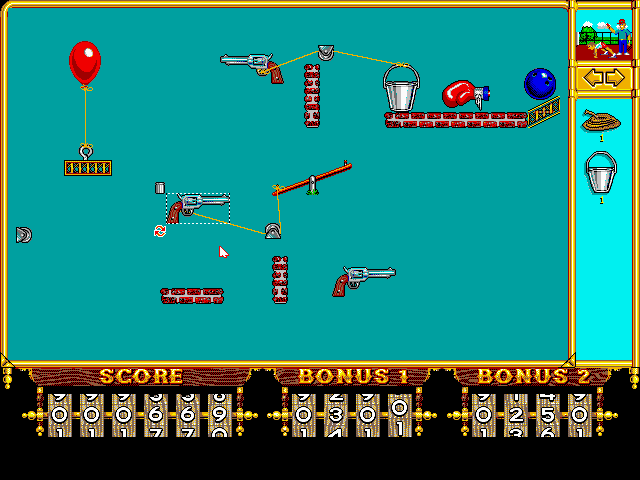
Things get wild when heat and electricity join the party. Flashlights ignite magnifying glasses, which light dynamite fuses or blast cannons into brick walls. Solar panels drive electric motors, while cats chase mice to turn generators.
Later stages twist the rules by tweaking environment settings. Certain stages lower the gravity or strip away air pressure entirely. A baseball that dropped like a stone in level five suddenly drifts gently across the screen in zero-g.
Not every puzzle lands cleanly. German gaming magazine PC Player scored it 74 out of 100 on release, with reviewer Boris Schneider pointing directly at placement precision. He was entirely right about the pixel hunting.
In mid-game levels, placing an item one spot to the left means a ball misses a seesaw bucket completely. You will spend five minutes tweaking the exact position of a single inclined plane. That trial-and-error cycle can feel rigid compared to freer alternatives like Lemmings.
There are also zero mid-level saves. The game relies on a level password system, so you have to write down codes on paper to hold your spot. Lose your password sheet, and you are replaying early levels from scratch.
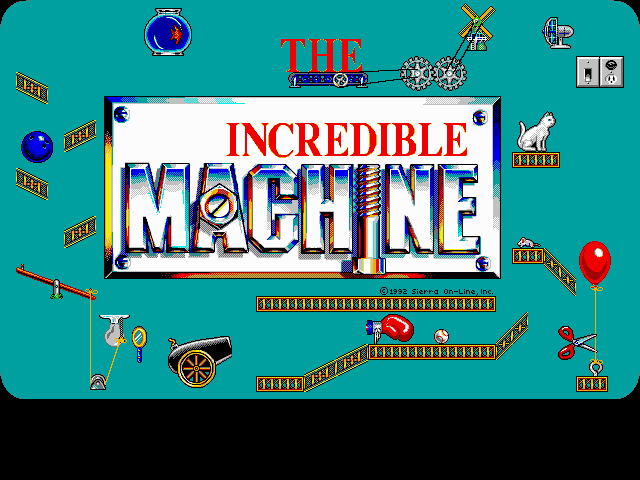
Designer Kevin Ryan actually pitched the concept to Electronic Arts back in 1984 for the Commodore 64. That build was set aside so the team could work on Arcticfox for the Amiga instead. The idea sat dormant for eight full years.
Work finally began again in spring 1992 under producer Jeffrey Tunnell. Ryan finished programming the entire software logic in just nine months on a modest budget of $36,000. Sierra On-Line, Inc. published the game in 1993 to massive sales.
The core design was so distinct that Tunnell and Chris Cole earned a US patent for its mechanics. The project launched an entire franchise, leading straight to The Even More Incredible Machine and cartoon spin-offs like Sid & Al's Incredible Toons.
Sound design plays a massive role in making collisions feel satisfying. The game supports basic PC Internal Speaker bleeps, but connecting a Sound Blaster or Roland MT-32 transforms the experience completely. Hear the distinct metallic clack of girders and the loud pop of bursting rubber.
When preset stages wear you down, the freeform mode lets you build custom contraptions without inventory restrictions. You get infinite parts, full control over gravity, and the ability to save your custom creations straight to disk.
Here is what you need to master this puzzle game today:
The original MS-DOS game holds up because it respects your logic instead of rushing your decisions. There are no countdown timers breathing down your neck, and every level offers multiple valid solutions if you get creative with momentum.
If you want to try it right now, you can play The Incredible Machine online free in your browser without dealing with vintage hardware setups. The puzzle logic remains as sharp as it was thirty years ago, and modern browsers handle the mouse clicking smoothly. Launch the simulator above, test your first pulley connection, and see how long your chain reactions last.
In The Incredible Machine, you drop bowling balls onto seesaws, light dynamite with flashlights, and use terrified mice on treadmills to turn on a household fan.
The moment Dynamix, Inc. gives you a toolbox and a blank frame, the whole premise clicks. You are not controlling a hero or walking through a map. Instead, you are placing real-world physics items on a side-view grid to trigger a chain reaction.
Every level sets a straightforward goal. You might need to drop a baseball into a wicker basket or pop a balloon floating near the ceiling. To get there, you work with a limited inventory of girders, ropes, pulleys, and boxing gloves on springs.
Pressing the start button runs the simulation in real time. Gravity takes over, ropes yank pulleys, and balls roll down steel girders. If your angles are off by a few pixels, the whole contraption grinds to an embarrassing halt.
The base game packs 87 preset puzzles, and early stages feel generous. You drop a heavy weight onto a balloon or direct a rolling bowling ball down a sloped girder. The physics engine tracks momentum, friction, and bounce with strict consistency.
Things get wild when heat and electricity join the party. Flashlights ignite magnifying glasses, which light dynamite fuses or blast cannons into brick walls. Solar panels drive electric motors, while cats chase mice to turn generators.
Later stages twist the rules by tweaking environment settings. Certain stages lower the gravity or strip away air pressure entirely. A baseball that dropped like a stone in level five suddenly drifts gently across the screen in zero-g.
Not every puzzle lands cleanly. German gaming magazine PC Player scored it 74 out of 100 on release, with reviewer Boris Schneider pointing directly at placement precision. He was entirely right about the pixel hunting.
In mid-game levels, placing an item one spot to the left means a ball misses a seesaw bucket completely. You will spend five minutes tweaking the exact position of a single inclined plane. That trial-and-error cycle can feel rigid compared to freer alternatives like Lemmings.
There are also zero mid-level saves. The game relies on a level password system, so you have to write down codes on paper to hold your spot. Lose your password sheet, and you are replaying early levels from scratch.
Designer Kevin Ryan actually pitched the concept to Electronic Arts back in 1984 for the Commodore 64. That build was set aside so the team could work on Arcticfox for the Amiga instead. The idea sat dormant for eight full years.
Work finally began again in spring 1992 under producer Jeffrey Tunnell. Ryan finished programming the entire software logic in just nine months on a modest budget of $36,000. Sierra On-Line, Inc. published the game in 1993 to massive sales.
The core design was so distinct that Tunnell and Chris Cole earned a US patent for its mechanics. The project launched an entire franchise, leading straight to The Even More Incredible Machine and cartoon spin-offs like Sid & Al's Incredible Toons.
Sound design plays a massive role in making collisions feel satisfying. The game supports basic PC Internal Speaker bleeps, but connecting a Sound Blaster or Roland MT-32 transforms the experience completely. Hear the distinct metallic clack of girders and the loud pop of bursting rubber.
When preset stages wear you down, the freeform mode lets you build custom contraptions without inventory restrictions. You get infinite parts, full control over gravity, and the ability to save your custom creations straight to disk.
Here is what you need to master this puzzle game today:
The original MS-DOS game holds up because it respects your logic instead of rushing your decisions. There are no countdown timers breathing down your neck, and every level offers multiple valid solutions if you get creative with momentum.
If you want to try it right now, you can play The Incredible Machine online free in your browser without dealing with vintage hardware setups. The puzzle logic remains as sharp as it was thirty years ago, and modern browsers handle the mouse clicking smoothly. Launch the simulator above, test your first pulley connection, and see how long your chain reactions last.
How The Incredible Machine is played — the keys the game listens to, grouped by what they do.
Highlighted keys are mapped — hover or tap one to see what it does.
Configuration, sound, and graphics modes can be changed by running INSTALL.EXE.
The on-screen keyboard and gamepad mapping the browser player uses on a phone, a tablet or a controller, as opposed to the real keys above. $PRO members make their own in the player and share them here; anyone can pick one to play with.
Cheat codes, console commands and memory pokes for The Incredible Machine — each one verified and attributed.
Sign in to submitHow The Incredible Machine is played — the keys the game listens to, grouped by what they do.
Highlighted keys are mapped — hover or tap one to see what it does.
Configuration, sound, and graphics modes can be changed by running INSTALL.EXE.
The on-screen keyboard and gamepad mapping the browser player uses on a phone, a tablet or a controller, as opposed to the real keys above. $PRO members make their own in the player and share them here; anyone can pick one to play with.
Cheat codes, console commands and memory pokes for The Incredible Machine — each one verified and attributed.
Sign in to submit