
Picking a banker from Boston gives you maximum starting cash in The Oregon Trail, but no amount of money prevents your party from collapsing from dysentery three miles outside Fort Laramie.
You begin your journey in Independence, Missouri, in the spring of 1848, facing a storefront counter and a strictly limited set of choices. Before stepping onto the trail, you select an occupation for your wagon leader. Playing as the banker gives you a lush starting budget of $1,600, whereas choosing the carpenter or farmer leaves you with significantly less cash in exchange for vague scoring bonuses at the end of the trip. Most players quickly realize that money buys ox teams, spare parts, and tons of food, making the banker the undisputed default choice for surviving the journey across 19th-century America.
Once you step out of Matt's General Store with your draft animals, clothing, box of bullets, and extra wheel axles, the core game becomes an exercise in cold inventory management. You set your travel pace to steady, strenuous, or grueling, while balancing food intake between bare, meager, and filling rations. Pushing your oxen hard gets you to landmarks like Chimney Rock and Independence Rock before winter sets in, but driving your party to exhaustion tanks their health status from good to poor in a matter of days. If you want to sample educational games that treat resource management like a matter of life and death, this title sets the template.
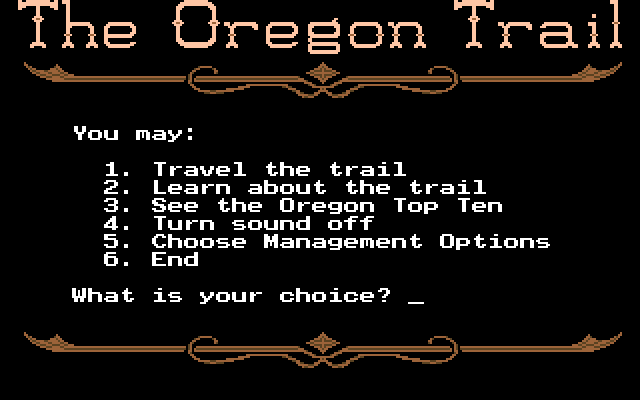
The interface relies heavily on menus and text parser prompts, asking you to weigh decisions every time you hit a landmark or an obstacle. When you reach river crossings like the Kansas River or the Snake River, you have to decide whether to ford the water, caulk the wagon box and float across, or pay a ferry fee. A bad roll of the dice in a deep river washes away hundred-pound sacks of flour, drowns precious draft animals, and sets your party back weeks.
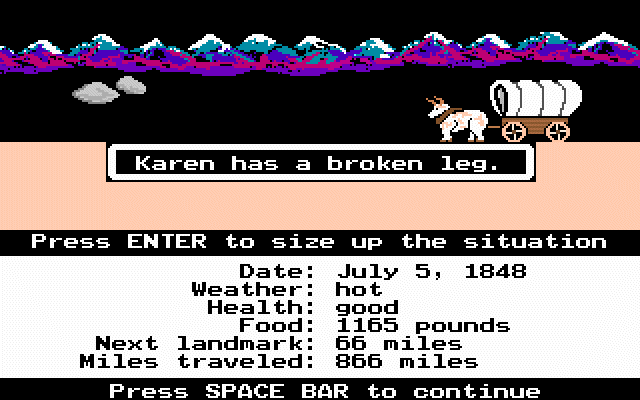
Ported to PC screens by programmer John Krenz and artist Charolyn Kapplinger, this 1990 release translates the 1985 Apple II visual design created under R. Philip Bouchard to MS-DOS machines. Compared to atmospheric VGA graphic adventures appearing on store shelves the same year, the 4-color CGA and 16-color EGA graphics look primitive. The terrain consists of sparse green lines against flat black backgrounds, and the internal PC speaker blares basic digital renditions of 19th-century folk tunes that grow grating fast.
The game breaks up text screens with action mini-games, chiefly the hunting sequence. When food runs low, you hit the spacebar to send your hunter into the woods to shoot wild game. You maneuver your green figure around rocks and trees, aiming your rifle at moving deer, bears, and squirrels. The keyboard controls feel clunky, and your hunter rotates awkwardly while wild animals dart off the edges of the frame.
The biggest absurdity in the action sequences comes down to weight limits. You can spend ten bullets firing at a buffalo, dropped in its tracks for 800 pounds of meat, only for a text box to announce that your wagon party can only carry back 100 pounds to the trail. The rest rots on the forest floor while your party's health drops back to poor three days later.
The original concept dates back to a 1971 text game designed by Don Rawitsch, Bill Heinemann, and Paul Dillenberger, and that underlying random number generator still controls your fate on DOS. You can stock six spare axles, maintain a slow pace, and keep food rations on filling, only to be hit with back-to-back catastrophes that ruin your progress. A single text box announcing a broken wagon tongue or a lost ox right before reaching Fort Hall can leave you stranded in the desert.
Diseases strike without warning and provide the game's most persistent frustration. Your party members catch measles, typhoid, cholera, and exhaustion completely at random. The famous status update You have died of dysentery became a running joke among gamers because it strikes hard and fast, often wiping out three family members in a single stretch between mountain passes.
The primary tactical defense against disease is stopping to rest for several consecutive days, consuming valuable food rations while your status slowly ticks back up to fair. Near the end of the trek, after floating your raft through the white water rapids of the Columbia River near The Dalles, reaching the Willamette Valley feels less like a strategic triumph and more like surviving a ruthless engine of probability.
The Oregon Trail MS-DOS game succeeded in classroom environments because it was easy to pick up, fast to restart, and unforgiving enough to keep players coming back to beat their high scores. Publisher MECC built an engine that forced simple survival choices onto players long before modern crafting sims populated the market. Despite the stiff hunting controls and primitive audio output, managing a pioneer party across two thousand miles of digital trail works as a tense exercise in risk management.
You can play The Oregon Trail free in your browser right here on this page, with nothing to install and no setup required. Start a fresh run as a banker, buy six yokes of oxen, load up on rifle ammunition, and see if your pioneer party can reach the Willamette River without succumbing to broken wagon axles or infectious disease.
Picking a banker from Boston gives you maximum starting cash in The Oregon Trail, but no amount of money prevents your party from collapsing from dysentery three miles outside Fort Laramie.
You begin your journey in Independence, Missouri, in the spring of 1848, facing a storefront counter and a strictly limited set of choices. Before stepping onto the trail, you select an occupation for your wagon leader. Playing as the banker gives you a lush starting budget of $1,600, whereas choosing the carpenter or farmer leaves you with significantly less cash in exchange for vague scoring bonuses at the end of the trip. Most players quickly realize that money buys ox teams, spare parts, and tons of food, making the banker the undisputed default choice for surviving the journey across 19th-century America.
Once you step out of Matt's General Store with your draft animals, clothing, box of bullets, and extra wheel axles, the core game becomes an exercise in cold inventory management. You set your travel pace to steady, strenuous, or grueling, while balancing food intake between bare, meager, and filling rations. Pushing your oxen hard gets you to landmarks like Chimney Rock and Independence Rock before winter sets in, but driving your party to exhaustion tanks their health status from good to poor in a matter of days. If you want to sample educational games that treat resource management like a matter of life and death, this title sets the template.
The interface relies heavily on menus and text parser prompts, asking you to weigh decisions every time you hit a landmark or an obstacle. When you reach river crossings like the Kansas River or the Snake River, you have to decide whether to ford the water, caulk the wagon box and float across, or pay a ferry fee. A bad roll of the dice in a deep river washes away hundred-pound sacks of flour, drowns precious draft animals, and sets your party back weeks.
Ported to PC screens by programmer John Krenz and artist Charolyn Kapplinger, this 1990 release translates the 1985 Apple II visual design created under R. Philip Bouchard to MS-DOS machines. Compared to atmospheric VGA graphic adventures appearing on store shelves the same year, the 4-color CGA and 16-color EGA graphics look primitive. The terrain consists of sparse green lines against flat black backgrounds, and the internal PC speaker blares basic digital renditions of 19th-century folk tunes that grow grating fast.
The game breaks up text screens with action mini-games, chiefly the hunting sequence. When food runs low, you hit the spacebar to send your hunter into the woods to shoot wild game. You maneuver your green figure around rocks and trees, aiming your rifle at moving deer, bears, and squirrels. The keyboard controls feel clunky, and your hunter rotates awkwardly while wild animals dart off the edges of the frame.
The biggest absurdity in the action sequences comes down to weight limits. You can spend ten bullets firing at a buffalo, dropped in its tracks for 800 pounds of meat, only for a text box to announce that your wagon party can only carry back 100 pounds to the trail. The rest rots on the forest floor while your party's health drops back to poor three days later.
The original concept dates back to a 1971 text game designed by Don Rawitsch, Bill Heinemann, and Paul Dillenberger, and that underlying random number generator still controls your fate on DOS. You can stock six spare axles, maintain a slow pace, and keep food rations on filling, only to be hit with back-to-back catastrophes that ruin your progress. A single text box announcing a broken wagon tongue or a lost ox right before reaching Fort Hall can leave you stranded in the desert.
Diseases strike without warning and provide the game's most persistent frustration. Your party members catch measles, typhoid, cholera, and exhaustion completely at random. The famous status update You have died of dysentery became a running joke among gamers because it strikes hard and fast, often wiping out three family members in a single stretch between mountain passes.
The primary tactical defense against disease is stopping to rest for several consecutive days, consuming valuable food rations while your status slowly ticks back up to fair. Near the end of the trek, after floating your raft through the white water rapids of the Columbia River near The Dalles, reaching the Willamette Valley feels less like a strategic triumph and more like surviving a ruthless engine of probability.
The Oregon Trail MS-DOS game succeeded in classroom environments because it was easy to pick up, fast to restart, and unforgiving enough to keep players coming back to beat their high scores. Publisher MECC built an engine that forced simple survival choices onto players long before modern crafting sims populated the market. Despite the stiff hunting controls and primitive audio output, managing a pioneer party across two thousand miles of digital trail works as a tense exercise in risk management.
You can play The Oregon Trail free in your browser right here on this page, with nothing to install and no setup required. Start a fresh run as a banker, buy six yokes of oxen, load up on rifle ammunition, and see if your pioneer party can reach the Willamette River without succumbing to broken wagon axles or infectious disease.
How The Oregon Trail is played — the keys the game listens to, grouped by what they do.
Highlighted keys are mapped — hover or tap one to see what it does.
The on-screen keyboard and gamepad mapping the browser player uses on a phone, a tablet or a controller, as opposed to the real keys above. $PRO members make their own in the player and share them here; anyone can pick one to play with.
Cheat codes, console commands and memory pokes for The Oregon Trail — each one verified and attributed.
Sign in to submitCheat codes, console commands and memory pokes for The Oregon Trail — each one verified and attributed.
Sign in to submit