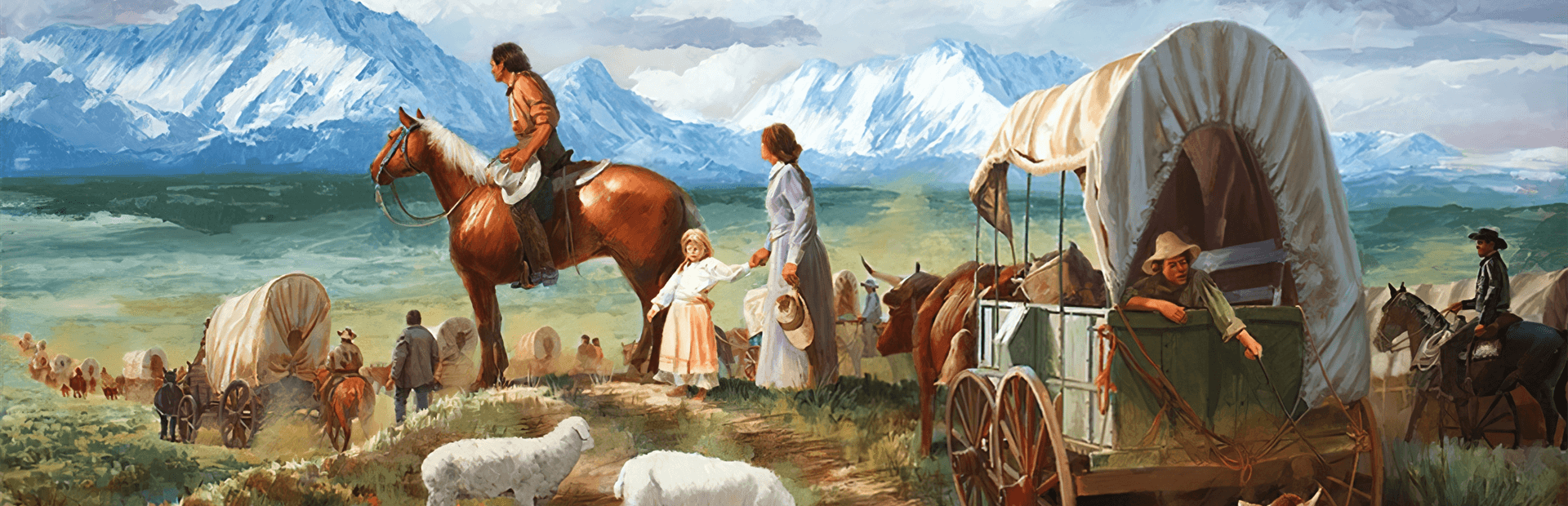
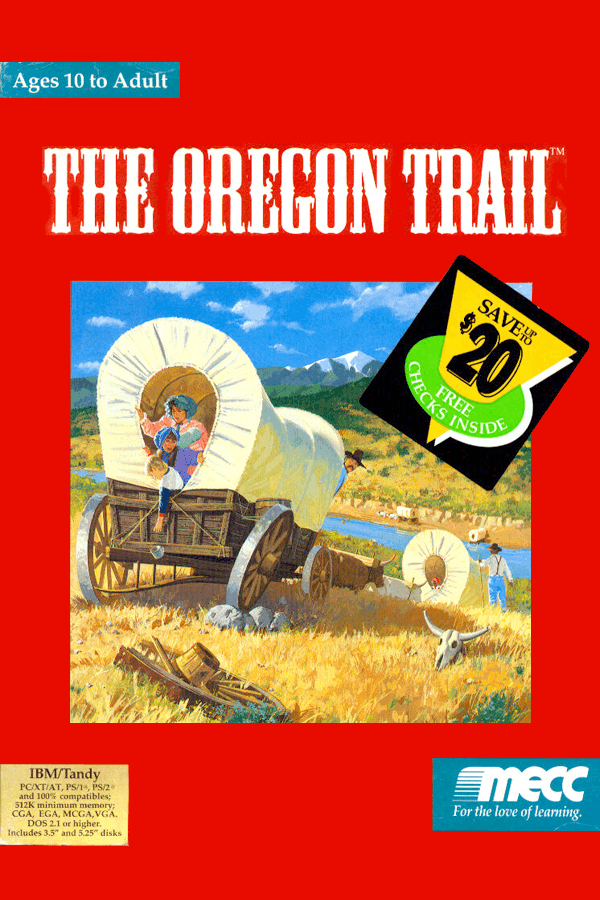

If you played earlier versions on a school Apple II, turning on The Oregon Trail Deluxe in 1992 was a shock: suddenly your pioneer trek across 1848 America had full VGA colors, digitized sound effects, and point-and-click mouse support for shooting game and floating down rivers.
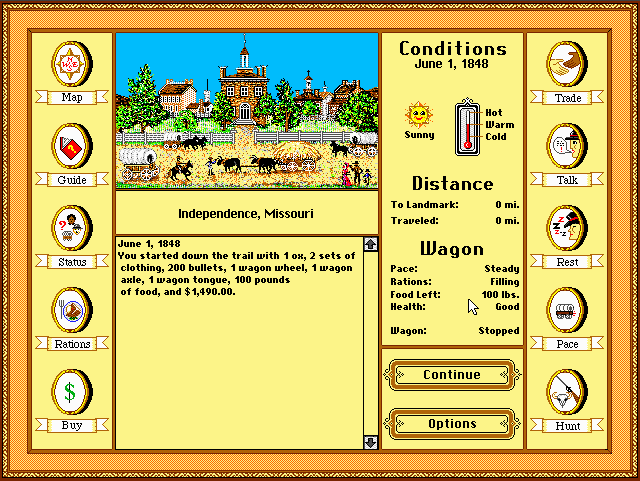
Before you take a single step toward Oregon, your survival is mostly decided in a store in Independence, Missouri. Choosing a profession sets your starting cash balance: bankers start rich, while farmers start poor but score higher point multipliers at the end of a successful run. You must balance wagon weight against essential supplies, buying draft oxen, spare wagon parts, clothing, ammunition, and both perishable and non-perishable food before setting out across two thousand miles of North American wilderness.
Once on the trail, daily travel becomes a grinding routine of resource management. You adjust your group's pacing and food rations based on weather, health, and terrain. Push your party at an grueling pace on meager rations to outrun an impending winter, and members will promptly drop sick with typhoid, cholera, or the infamous virtual dysentery. Rest too long to recover, and your supplies evaporate while the snow drifts close the mountain passes ahead.
The transition to full mouse navigation completely changes how you interact with landmark stops and river crossings. Instead of memorizing text commands or tapping arrow keys, you click through clean graphic menus to trade with non-player characters at forts, check wagon weight, or consult the trail log. The enhanced presentation brings a clear graphical interface to what was previously a dry text-and-wireframe journey.
The hunting mini-game underwent the biggest shift from its 1980s iterations. Replacing the fast keyboard-typing prompt of earlier versions, you aim a crosshair with your mouse to shoot wild game like deer, bear, and bison. However, the game enforces realistic wagon mechanics: you can shoot two thousand pounds of meat in a lavish hunting session, but your pioneers can only carry a small fraction back to the wagon before the rest spoils, wasting precious gunpowder in the process.
Even with optimal planning, this release is notoriously lethal due to heavy reliance on random occurrences. A single bad stretch of trail can hit your party with severe thunderstorms, broken wagon tongue axles, rogue snakebites, and sudden sickness all in the space of a virtual week. River crossings are particularly unforgiving, forcing you to choose between paying a ferry fee, caulking the wagon to float across, or wading through deep water that can capsize your rig and drown your oxen instantly.
One detail players always notice is that you cannot write custom epitaphs on tombstones in this MS-DOS conversion, unlike other releases. Running it on modern hardware without a CPU slowdown utility also spins the travel clock out of control, starving your entire wagon party in three real-time seconds. Throttle the cycles alongside other educational games, and the pacing gets its deliberate, tense friction back.
Developed and published by MECC (the Minnesota Educational Computing Consortium), this version expanded on the base design established in 1985 by R. Philip Bouchard and the 1991 Macintosh port. By taking advantage of 256-color VGA cards and audio boards like the Sound Blaster, MECC turned a classroom utility into a visually rich home computer product. Around the same time, MECC internal planning documents detailed an ambitious networked multiplayer concept titled Wagon Train 1848 designed for school computer labs, though its wide commercial availability remained limited.
The commercial impact of the series was massive for the publisher. By 1995, the franchise accounted for roughly one third of MECC's thirty million dollar annual revenue, eventually exceeding sixty-five million copies sold overall across its various editions. According to historic coverage on Wikipedia, the series defined an entire generation's early encounters with personal computer hardware in 1992.
The core decision loop is where the game holds up. Balancing short-term survival against long-term resource depletion is a tight, punishing puzzle that modern survival titles still copy. What hurts it is the ruthless randomness: losing an entire four-month run to three consecutive river drownings feels completely out of your hands no matter how well you plan.
You can play The Oregon Trail Deluxe free in your browser right now, with full mouse support and proper game speed already dialed in. If you want to see if your pioneer party can survive river drownings and harsh wilderness winters, jump into the driver's seat, set a moderate pace, and keep your oxen fed.
If you played earlier versions on a school Apple II, turning on The Oregon Trail Deluxe in 1992 was a shock: suddenly your pioneer trek across 1848 America had full VGA colors, digitized sound effects, and point-and-click mouse support for shooting game and floating down rivers.
Before you take a single step toward Oregon, your survival is mostly decided in a store in Independence, Missouri. Choosing a profession sets your starting cash balance: bankers start rich, while farmers start poor but score higher point multipliers at the end of a successful run. You must balance wagon weight against essential supplies, buying draft oxen, spare wagon parts, clothing, ammunition, and both perishable and non-perishable food before setting out across two thousand miles of North American wilderness.
Once on the trail, daily travel becomes a grinding routine of resource management. You adjust your group's pacing and food rations based on weather, health, and terrain. Push your party at an grueling pace on meager rations to outrun an impending winter, and members will promptly drop sick with typhoid, cholera, or the infamous virtual dysentery. Rest too long to recover, and your supplies evaporate while the snow drifts close the mountain passes ahead.
The transition to full mouse navigation completely changes how you interact with landmark stops and river crossings. Instead of memorizing text commands or tapping arrow keys, you click through clean graphic menus to trade with non-player characters at forts, check wagon weight, or consult the trail log. The enhanced presentation brings a clear graphical interface to what was previously a dry text-and-wireframe journey.
The hunting mini-game underwent the biggest shift from its 1980s iterations. Replacing the fast keyboard-typing prompt of earlier versions, you aim a crosshair with your mouse to shoot wild game like deer, bear, and bison. However, the game enforces realistic wagon mechanics: you can shoot two thousand pounds of meat in a lavish hunting session, but your pioneers can only carry a small fraction back to the wagon before the rest spoils, wasting precious gunpowder in the process.
Even with optimal planning, this release is notoriously lethal due to heavy reliance on random occurrences. A single bad stretch of trail can hit your party with severe thunderstorms, broken wagon tongue axles, rogue snakebites, and sudden sickness all in the space of a virtual week. River crossings are particularly unforgiving, forcing you to choose between paying a ferry fee, caulking the wagon to float across, or wading through deep water that can capsize your rig and drown your oxen instantly.
One detail players always notice is that you cannot write custom epitaphs on tombstones in this MS-DOS conversion, unlike other releases. Running it on modern hardware without a CPU slowdown utility also spins the travel clock out of control, starving your entire wagon party in three real-time seconds. Throttle the cycles alongside other educational games, and the pacing gets its deliberate, tense friction back.
Developed and published by MECC (the Minnesota Educational Computing Consortium), this version expanded on the base design established in 1985 by R. Philip Bouchard and the 1991 Macintosh port. By taking advantage of 256-color VGA cards and audio boards like the Sound Blaster, MECC turned a classroom utility into a visually rich home computer product. Around the same time, MECC internal planning documents detailed an ambitious networked multiplayer concept titled Wagon Train 1848 designed for school computer labs, though its wide commercial availability remained limited.
The commercial impact of the series was massive for the publisher. By 1995, the franchise accounted for roughly one third of MECC's thirty million dollar annual revenue, eventually exceeding sixty-five million copies sold overall across its various editions. According to historic coverage on Wikipedia, the series defined an entire generation's early encounters with personal computer hardware in 1992.
The core decision loop is where the game holds up. Balancing short-term survival against long-term resource depletion is a tight, punishing puzzle that modern survival titles still copy. What hurts it is the ruthless randomness: losing an entire four-month run to three consecutive river drownings feels completely out of your hands no matter how well you plan.
You can play The Oregon Trail Deluxe free in your browser right now, with full mouse support and proper game speed already dialed in. If you want to see if your pioneer party can survive river drownings and harsh wilderness winters, jump into the driver's seat, set a moderate pace, and keep your oxen fed.
How The Oregon Trail Deluxe is played — the keys the game listens to, grouped by what they do.
Highlighted keys are mapped — hover or tap one to see what it does.
The map is incomplete as no full manual or reference card listing individual keyboard shortcuts was available in the sources.
The on-screen keyboard and gamepad mapping the browser player uses on a phone, a tablet or a controller, as opposed to the real keys above. $PRO members make their own in the player and share them here; anyone can pick one to play with.
Cheat codes, console commands and memory pokes for The Oregon Trail Deluxe — each one verified and attributed.
Sign in to submitHow The Oregon Trail Deluxe is played — the keys the game listens to, grouped by what they do.
Highlighted keys are mapped — hover or tap one to see what it does.
The map is incomplete as no full manual or reference card listing individual keyboard shortcuts was available in the sources.
The on-screen keyboard and gamepad mapping the browser player uses on a phone, a tablet or a controller, as opposed to the real keys above. $PRO members make their own in the player and share them here; anyone can pick one to play with.
Cheat codes, console commands and memory pokes for The Oregon Trail Deluxe — each one verified and attributed.
Sign in to submit