
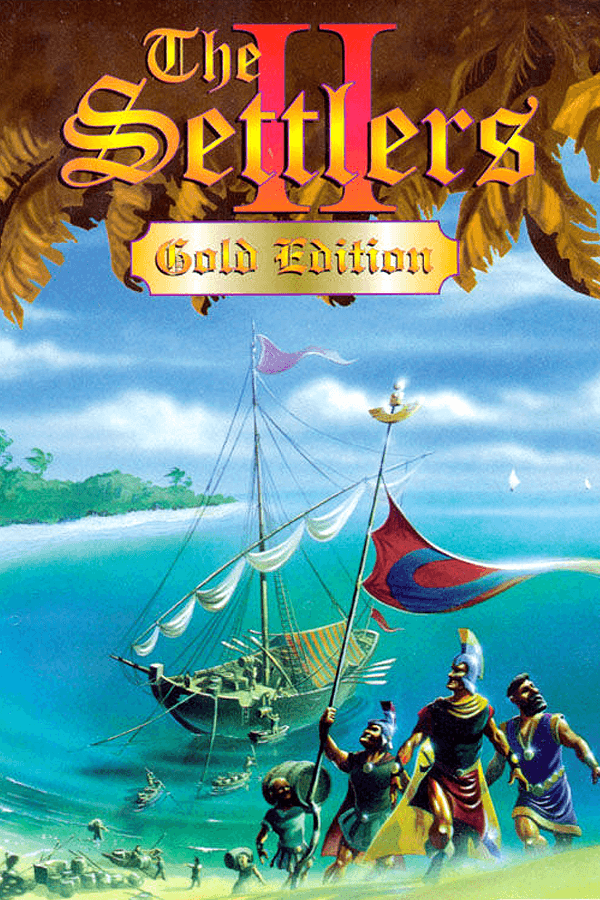

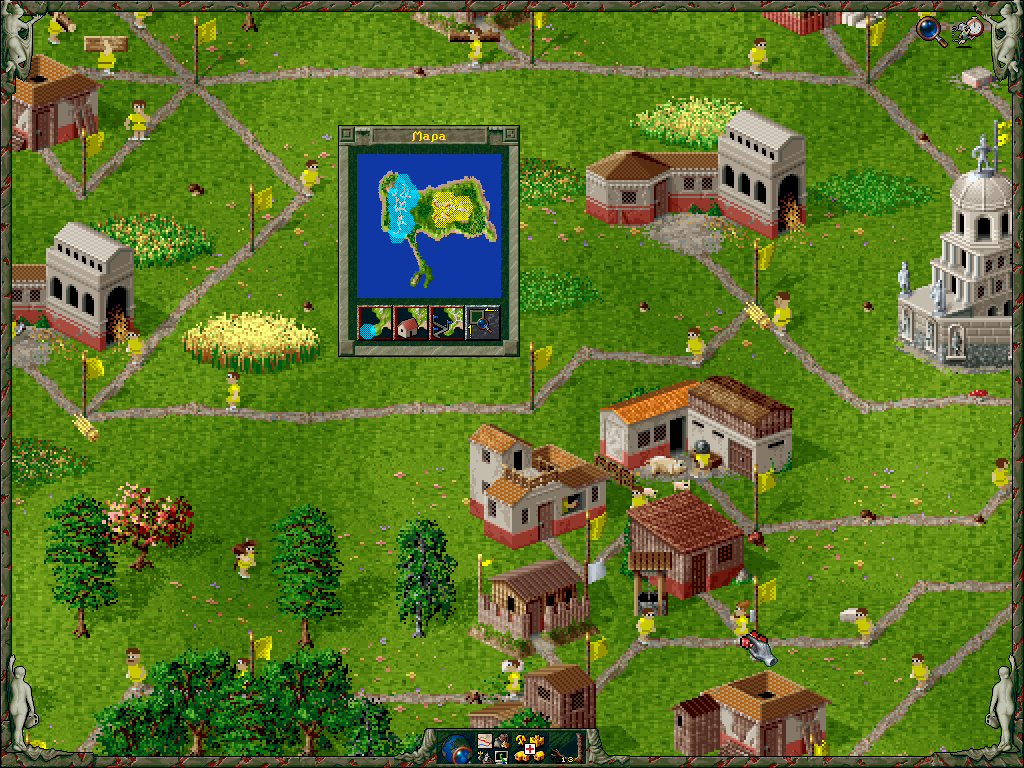
Building a thriving economy in The Settlers II: Gold Edition is less about marching armies across a map and more about making sure your stonecutters and bread bakers never run out of paved footpaths. You start with a lone main building, a handful of shipwrecked Roman survivors, and a quiet island wilderness that quickly turns into a dense spiderweb of flag-to-flag transport lines.
Most strategy titles in 1997 expected you to click directly on soldiers and march them into combat, but producer Thomas Hertzler and director Thomas Häuser built a game driven by logistics. Every stone quartered, tree felled, and iron ore mined has to move manually from worker to worker along a strict network of flag posts. If you place your flag posts too far apart or clog a single thoroughfare with too many wooden logs, your entire economy grinds to a sudden halt while carriers stand around waiting for open space.
The supply chain is deep and mercilessly interconnected. Geologists hammer at mountain slopes to drop tiny signposts marking coal, iron, or gold deposits. To keep those miners working, you must ship them fish or fresh loaves of bread from nearby bakeries, which in turn require grain from farms and water from wells. Once mined gold ore hits a mint, it turns into shiny coins that travel directly to your military structures to promote basic recruits into toughened veterans.
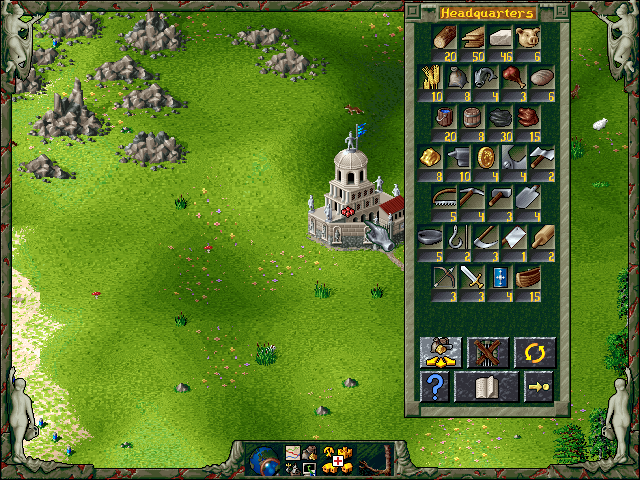
The entire game asks you to plan ahead and wait, which turns out to be both its greatest strength and its most agonizing flaw. Because goods move physical step by physical step along your customized roads, expanding your territory takes real patience. There are long stretches where you sit back for five minutes doing virtually nothing while waiting for three gold coins and four iron bars to trickle down to a single frontier watchtower.
When combat finally happens, it usually catches new players off guard because you have direct control over almost none of it. You click on an enemy military building, select how many soldiers to send from your nearest fort, and watch them march over automatically. Battles play out as simple automated fights where individual hut attacks can boil down to luck, meaning an entire border push can fail simply because your upgraded soldier lost three coin flips in a row against a basic defender.
The interface does not help much during a supply crisis either. Menu windows stack across the screen with gray panels and dense rows of icons that feel surprisingly close to filing taxes. Yet when your road network runs smoothly and your chosen culture is working every corner of the terrain, watching hundreds of small citizens clear forests and haul granite remains absurdly satisfying.
On the audio side, composer Haiko Ruttmann put together a soundtrack that sounds fantastic through a Sound Blaster 16 or Roland MT-32, though the tunes loop heavily during long scenario sessions. Blue Byte programmed the MIDI driver to send custom Roland GS reverb and chorus controllers over standard General MIDI channels. If you played the original MS-DOS version on generic synth hardware, it meant missing notes, strange synth patches, and instrument tracks playing back at incorrect volumes.
The Gold package bundled the original 10-chapter Roman campaign, starting with Chapter I: Off We Go and ending at Chapter X: The Last Gate, alongside the World Campaign continents, scenario maps from the Mission CD, a full color paper atlas, and 130 custom maps chosen from a fan competition. It also integrated a map editor for building custom desert, winter, and wasteland environments. However, clicking the cutscene button marked Intro inside the main menu of the DOS release crashes the game straight back to the command prompt, a technical oversight that caught plenty of players by surprise.
Split-screen multiplayer was another wildly ambitious experiment that few players managed to configure properly on original hardware. Playing head-to-head on one monitor required plugging two physical mice into the back of your computer tower, typically combining one PS/2 mouse with one serial COM port mouse, while both players shared a single keyboard. When it worked, it was brilliant, but getting DOS to recognize dual mouse drivers without hardware IRQ conflicts was an ordeal that sent most people straight back to single-player map scenarios.
If you enjoy slow-burn strategy tactics games where building supply chains matters more than fast reaction times, this release from Blue Byte holds up well. Its automated battle system will frustrate anyone expecting tactical unit control like Warcraft or Command & Conquer, but watching a barren island turn into a self-sustaining Roman empire never loses its pull.
You can play The Settlers II: Gold Edition free in your browser right here. There is nothing to install and no hardware configuration to wrestle with, so you can start placing your first flag posts and prospecting for gold within seconds.
Building a thriving economy in The Settlers II: Gold Edition is less about marching armies across a map and more about making sure your stonecutters and bread bakers never run out of paved footpaths. You start with a lone main building, a handful of shipwrecked Roman survivors, and a quiet island wilderness that quickly turns into a dense spiderweb of flag-to-flag transport lines.
Most strategy titles in 1997 expected you to click directly on soldiers and march them into combat, but producer Thomas Hertzler and director Thomas Häuser built a game driven by logistics. Every stone quartered, tree felled, and iron ore mined has to move manually from worker to worker along a strict network of flag posts. If you place your flag posts too far apart or clog a single thoroughfare with too many wooden logs, your entire economy grinds to a sudden halt while carriers stand around waiting for open space.
The supply chain is deep and mercilessly interconnected. Geologists hammer at mountain slopes to drop tiny signposts marking coal, iron, or gold deposits. To keep those miners working, you must ship them fish or fresh loaves of bread from nearby bakeries, which in turn require grain from farms and water from wells. Once mined gold ore hits a mint, it turns into shiny coins that travel directly to your military structures to promote basic recruits into toughened veterans.

The entire game asks you to plan ahead and wait, which turns out to be both its greatest strength and its most agonizing flaw. Because goods move physical step by physical step along your customized roads, expanding your territory takes real patience. There are long stretches where you sit back for five minutes doing virtually nothing while waiting for three gold coins and four iron bars to trickle down to a single frontier watchtower.
When combat finally happens, it usually catches new players off guard because you have direct control over almost none of it. You click on an enemy military building, select how many soldiers to send from your nearest fort, and watch them march over automatically. Battles play out as simple automated fights where individual hut attacks can boil down to luck, meaning an entire border push can fail simply because your upgraded soldier lost three coin flips in a row against a basic defender.
The interface does not help much during a supply crisis either. Menu windows stack across the screen with gray panels and dense rows of icons that feel surprisingly close to filing taxes. Yet when your road network runs smoothly and your chosen culture is working every corner of the terrain, watching hundreds of small citizens clear forests and haul granite remains absurdly satisfying.

On the audio side, composer Haiko Ruttmann put together a soundtrack that sounds fantastic through a Sound Blaster 16 or Roland MT-32, though the tunes loop heavily during long scenario sessions. Blue Byte programmed the MIDI driver to send custom Roland GS reverb and chorus controllers over standard General MIDI channels. If you played the original MS-DOS version on generic synth hardware, it meant missing notes, strange synth patches, and instrument tracks playing back at incorrect volumes.
The Gold package bundled the original 10-chapter Roman campaign, starting with Chapter I: Off We Go and ending at Chapter X: The Last Gate, alongside the World Campaign continents, scenario maps from the Mission CD, a full color paper atlas, and 130 custom maps chosen from a fan competition. It also integrated a map editor for building custom desert, winter, and wasteland environments. However, clicking the cutscene button marked Intro inside the main menu of the DOS release crashes the game straight back to the command prompt, a technical oversight that caught plenty of players by surprise.

Split-screen multiplayer was another wildly ambitious experiment that few players managed to configure properly on original hardware. Playing head-to-head on one monitor required plugging two physical mice into the back of your computer tower, typically combining one PS/2 mouse with one serial COM port mouse, while both players shared a single keyboard. When it worked, it was brilliant, but getting DOS to recognize dual mouse drivers without hardware IRQ conflicts was an ordeal that sent most people straight back to single-player map scenarios.
If you enjoy slow-burn strategy tactics games where building supply chains matters more than fast reaction times, this release from Blue Byte holds up well. Its automated battle system will frustrate anyone expecting tactical unit control like Warcraft or Command & Conquer, but watching a barren island turn into a self-sustaining Roman empire never loses its pull.
You can play The Settlers II: Gold Edition free in your browser right here. There is nothing to install and no hardware configuration to wrestle with, so you can start placing your first flag posts and prospecting for gold within seconds.
How The Settlers II: Gold Edition is played — the keys the game listens to, grouped by what they do.
Highlighted keys are mapped — hover or tap one to see what it does.
A second mouse can be used for two-player split-screen mode.
The on-screen keyboard and gamepad mapping the browser player uses on a phone, a tablet or a controller, as opposed to the real keys above. $PRO members make their own in the player and share them here; anyone can pick one to play with.
Cheat codes, console commands and memory pokes for The Settlers II: Gold Edition — each one verified and attributed.
Sign in to submitHow The Settlers II: Gold Edition is played — the keys the game listens to, grouped by what they do.
Highlighted keys are mapped — hover or tap one to see what it does.
A second mouse can be used for two-player split-screen mode.
The on-screen keyboard and gamepad mapping the browser player uses on a phone, a tablet or a controller, as opposed to the real keys above. $PRO members make their own in the player and share them here; anyone can pick one to play with.
Cheat codes, console commands and memory pokes for The Settlers II: Gold Edition — each one verified and attributed.
Sign in to submit