In The Settlers of Catan, every match comes down to board layout and dice rolls, turning hexes of lumber, brick, wool, grain, and ore into a tight race for victory points on a digitized island grid.
Dice rolls drive every hex on the island map
Klaus Teuber designed the physical tabletop rules that structure this electronic version, which means the main decisions happen right at the start of a match. You look over a randomized board made of hexagonal tiles, each showing a specific resource type and a number token ranging from two to twelve. Placing your first two settlements and roads determines your income for the rest of the game, because every turn begins with a roll of two standard six-sided dice. If a six or an eight sits on a forest tile where you built a house, you gain lumber whenever that number turns up. If your starting positions sit entirely on hard-to-roll numbers like three or eleven, your economy stalls early and stays slow.
Building costs are explicit and rigid, creating immediate choices about which direction to expand. A basic road requires one brick and one lumber, while a settlement demands lumber, brick, wool, and grain. Upgrading an existing settlement into a city takes two grain and three ore, which doubles your resource payout whenever that tile yields. Players who secure solid brick and lumber early tend to snatch up territory fast, blocking competitors from reaching high-value spots or coast ports. When wood or brick is scarce on the board layout, the entire pace slows to a crawl while everyone waits for specific dice numbers to hit.
The turn structure keeps everyone focused on card limits. Rolling a seven does not generate resources; instead, it triggers the robber piece, forcing any player holding more than seven resource cards in their hand to discard half of them immediately. The player who rolled the seven moves the robber onto any tile on the board, blocking that tile from producing resources until someone moves it away. You also get to steal one random resource card from an opponent with a settlement touching that hex. Managing your hand size so you never end a turn holding eight cards is half the strategy, especially when saving up heavy amounts of ore and grain for a city upgrade.
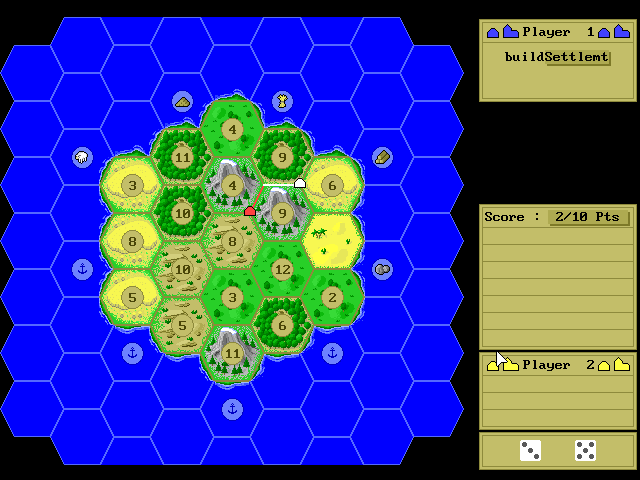
Trading with computer opponents in The Settlers of Catan
Resource shortages are built into the board by design, making trade essential to winning. When the hexes surrounding your settlements refuse to yield the wool or ore you need, you have to trade with other players or convert resources directly through bank ratios. Standard bank exchange rates require four matching resource cards for a single card of your choice, which is an expensive conversion that slows your expansion. Building a settlement along the coast to control a harbor tile lowers that ratio to three to one, or even two to one for a specific resource type like grain or ore.
In this 1996 release, trading with artificial intelligence competitors presents a predictable set of obstacles. The computer players evaluate trade proposals based on strict algorithmic thresholds rather than long-term strategic bargaining. If an opponent is close to reaching ten victory points, offering them a resource they need for a settlement usually gets rejected, but early in the match you can swap spare wood for missing brick without much fuss. The interface displays player hands and active trade windows clearly enough, though setting up complex counter-offers takes several manual button presses.
Development cards offer an alternative path to victory points when raw map expansion is blocked. For one wool, one grain, and one ore, you draw a card from the central deck. These cards fall into three main categories:
- Knight cards, which allow you to move the robber off your productive tiles and steal a resource from an opponent.
- Progress cards, which grant immediate construction of two roads or let you claim two specific resources from the bank stack.
- Direct victory point cards, which remain hidden in your hand until they give you enough points to claim an immediate win.
Navigators expansion tiles push settlements across the sea
Beyond the standard base board, this package incorporates the "Navigators" expansion material, which expands the play area beyond a single isolated landmass. Instead of working strictly within a single hex island, players can build ships along ocean paths to reach smaller outlying islands. Ships cost one lumber and one wool to build, functioning much like roads over water hexes. Discovering uncolonized island chains opens up fresh hexes of rare resources, offering a solid catch-up mechanic for anyone trapped on the main continent.
Sea routes introduce extra tactical friction when competing for territory. Opponents can cut off your naval expansion by placing settlements at key coastal intersections before your fleet reaches land. Building the longest continuous trade route across land and sea earns the Longest Road bonus card, worth two victory points. Combined with the Largest Army bonus awarded to whoever plays three knight cards first, these dynamic bonuses frequently tip the scales in tight late-game turns.
The top-down perspective keeps the full map visible, letting you monitor rival expansion paths across the entire archipelago. Because victory depends on reaching a set target of points on your turn, keeping track of open settlement sites on distant islands is just as critical as managing your local card hand.
Software limitations leave their mark on the board
As a digital translation published by Kosmos Verlag, the production focuses purely on functional board representation rather than spectacle. The visual display uses clean, flat graphics to represent the hex types, terrain graphics, and wooden-style game pieces. It fits squarely into the strategy / tactics category, delivering a faithful digital rendition of tabletop rules without adding cinematic fluff or unnecessary animations.
The mechanical execution is direct, but it carries clear period compromises. Sound support relies on basic MIDI tunes and minimal audio cues for dice rolls and resource draws, which can grow repetitive over a long four-player session. The board generator creates balanced maps overall, but computer opponents can take noticeable thinking pauses on larger water-heavy scenarios as they calculate valid ship routes and construction paths. While the overall interface works well for keeping track of cards and scores, navigating drop-down menus to initiate trades or play development cards takes a few more clicks than a modern player might expect.
Old-Games.RU scored the release at 5 out of 10 in its editorial review, while player ratings settled higher at 7.00 out of 10. The gap between those marks highlights what you get out of the software: if you want flashy visuals, the bare presentation feels Spartan, but if you want an accurate simulation of mid-nineties tabletop rules, the logic holds up firmly.
Taking your turn in The Settlers of Catan free in your browser
If you want to experience how tabletop conversions operated on desktop computers in the nineties, this adaptation delivers the raw mechanics without modification. The strategic tension comes directly from the board geometry: balancing your resource yields against the probability of dice rolls, competing for physical space along hex edges, and knowing when to convert cards at sea ports. What you get is a straightforward, dry exercise in map expansion and resource management that relies entirely on player choices and raw math rather than visual flair.
You can play The Settlers of Catan online right now inside your browser, completely free with no setup or file downloads required. Modern players usually expect automated trade suggestions and instant AI response times, but managing your hand manually in this The Settlers of Catan MS-DOS game gives you an appreciation for how closely early desktop conversions mirrored their physical board game roots. Launch the match, place your starting settlements near the highest-yield hexes, and see if you can claim ten victory points before the computer players shut down your trade routes.