


Escaping a Skynet extermination camp in 2015 Los Angeles requires quick thinking, but playing The Terminator: Future Shock in 1995 meant unlearning keyboard-only controls and wrestling with real mouse-look targeting before almost anyone else tried it.
You start as a nameless prisoner breaking out of a death camp into the gray rubble of ruined California. The first thing you notice is that key-turning feels wrong, because moving your mouse actually rotates your head in full three-dimensional space while your hand rests on WASD or the arrow keys. If you double back along the camp perimeter right after escaping, you can locate a hidden path that leads right into high-tier weapons, breaking open early combat before you ever meet John Connor.
Once you reach the Resistance, missions arrive through pre-level briefings where you talk to familiar faces like Kyle Reese to pick up military objectives. Instead of running through simple corridors, you are dropped into wide outdoor ruins, hunting through destroyed office buildings and crawling through damp sewers to bypass Skynet patrols. The sheer size of these terrain maps gives you room to pick your fights, but it also means getting lost among endless mounds of concrete dust.
combat hinges on managing a massive wheel of seventeen weapons, ranging from standard shotguns and pipe bombs to heavy plasma rifles. When a floating kamikaze drone drops out of the low-resolution fog, free aiming lets you snap your crosshair upward instantly to pop it before it detonates against your face.
Before id Software released Quake, Bethesda Softworks built a custom technology called XnGine to render true 3D environments with fully modeled polygonal enemies instead of flat cardboard sprites. Early in his career, Todd Howard worked as a designer and producer on the project, pushing the engine to handle wide open outdoor landscapes along with indoor architecture.
That engineering ambition allowed for enemy designs that felt vastly different from rival shooters in 1995. Flying Hunter-Killers circle high above city streets, bipedal laser raptors skitter across open ground, and Spiderbots rush your position down narrow corridors. You even face massive mechanical tanks and a bizarre robotic T-Rex, forcing you to constantly shift movement patterns based on what is stomping toward you.
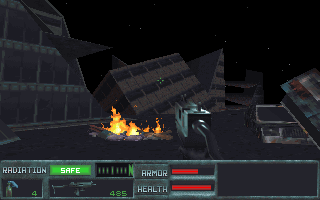
Yet the technical gamble came at a steep visual cost. Running in standard 320x200 VGA resolution, the murky gray palette washes out distant targets, making it hard to distinguish a T-800 from a broken light pole until laser fire starts clipping your shoulders.
The campaign spans seventeen linear missions, regularly breaking up foot combat by handing you the keys to heavy machinery. Certain missions put you behind the wheel of an armed jeep with a mounted cannon, while others lift you into the air piloting an Aerial Hunter-Killer. Driving across crushed cars while blasting ground forces turns the game into a chaotic arcade shooter for twenty minutes at a time.
On foot, objectives feel grounded in guerrilla military tactics rather than finding arbitrary keycards:
The largest frustration comes from progression triggers that occasionally break. If a mission completion script fails to register after you blow up your target, you are left wandering empty streets with no option but to restart the entire level. Modern control mapping can also feel sluggish and unwieldy without tweaking sensitivity files, leaving your crosshairs swimming through the mud.
Sound card support was broad, offering custom drivers for Sound Blaster, Gravis UltraSound, Roland MT-32, and General MIDI. Playing with a proper MIDI synthesizer produces deep industrial basslines that match the oppressive tone of mechanical warfare, while basic PC speakers reduce the atmosphere to tinny chirps.
Bethesda included a famous visual gag for observant players exploring the night sky. If you use free aiming to shoot directly at the moon in outdoor levels, a small red text pop-up reads "ow!" right before the moon comes crashing down out of orbit. If you just want to mess around with all seventeen guns without dying, typing DOS cheat codes opens up full god mode and instant weapon unlocks.
While the game lacked multiplayer upon release, its 1996 sequel and expansion, SkyNET, resolved two major community complaints by introducing deathmatch modes and crisp 640x480 SVGA graphics. Yet the original campaign stands on its own merits as a gritty, uncompromising mission through judgment day.
The mud-gray graphics show their age and the mission scripting can glitch out, but the gunplay keeps its edge. Mouse-look aiming while tossing satchel charges at an advancing T-800 feels just as tense now as it did on DOS.
You can play The Terminator: Future Shock MS-DOS game directly in your web browser with no downloads or complicated setup. Jump straight into the first escape level to try out the early full-3D control scheme, hunt down the hidden weapon cache outside the death camp, and see if you can take out a laser raptor before it closes the distance.
Escaping a Skynet extermination camp in 2015 Los Angeles requires quick thinking, but playing The Terminator: Future Shock in 1995 meant unlearning keyboard-only controls and wrestling with real mouse-look targeting before almost anyone else tried it.
You start as a nameless prisoner breaking out of a death camp into the gray rubble of ruined California. The first thing you notice is that key-turning feels wrong, because moving your mouse actually rotates your head in full three-dimensional space while your hand rests on WASD or the arrow keys. If you double back along the camp perimeter right after escaping, you can locate a hidden path that leads right into high-tier weapons, breaking open early combat before you ever meet John Connor.
Once you reach the Resistance, missions arrive through pre-level briefings where you talk to familiar faces like Kyle Reese to pick up military objectives. Instead of running through simple corridors, you are dropped into wide outdoor ruins, hunting through destroyed office buildings and crawling through damp sewers to bypass Skynet patrols. The sheer size of these terrain maps gives you room to pick your fights, but it also means getting lost among endless mounds of concrete dust.
combat hinges on managing a massive wheel of seventeen weapons, ranging from standard shotguns and pipe bombs to heavy plasma rifles. When a floating kamikaze drone drops out of the low-resolution fog, free aiming lets you snap your crosshair upward instantly to pop it before it detonates against your face.
Before id Software released Quake, Bethesda Softworks built a custom technology called XnGine to render true 3D environments with fully modeled polygonal enemies instead of flat cardboard sprites. Early in his career, Todd Howard worked as a designer and producer on the project, pushing the engine to handle wide open outdoor landscapes along with indoor architecture.
That engineering ambition allowed for enemy designs that felt vastly different from rival shooters in 1995. Flying Hunter-Killers circle high above city streets, bipedal laser raptors skitter across open ground, and Spiderbots rush your position down narrow corridors. You even face massive mechanical tanks and a bizarre robotic T-Rex, forcing you to constantly shift movement patterns based on what is stomping toward you.
Yet the technical gamble came at a steep visual cost. Running in standard 320x200 VGA resolution, the murky gray palette washes out distant targets, making it hard to distinguish a T-800 from a broken light pole until laser fire starts clipping your shoulders.
The campaign spans seventeen linear missions, regularly breaking up foot combat by handing you the keys to heavy machinery. Certain missions put you behind the wheel of an armed jeep with a mounted cannon, while others lift you into the air piloting an Aerial Hunter-Killer. Driving across crushed cars while blasting ground forces turns the game into a chaotic arcade shooter for twenty minutes at a time.
On foot, objectives feel grounded in guerrilla military tactics rather than finding arbitrary keycards:
The largest frustration comes from progression triggers that occasionally break. If a mission completion script fails to register after you blow up your target, you are left wandering empty streets with no option but to restart the entire level. Modern control mapping can also feel sluggish and unwieldy without tweaking sensitivity files, leaving your crosshairs swimming through the mud.
Sound card support was broad, offering custom drivers for Sound Blaster, Gravis UltraSound, Roland MT-32, and General MIDI. Playing with a proper MIDI synthesizer produces deep industrial basslines that match the oppressive tone of mechanical warfare, while basic PC speakers reduce the atmosphere to tinny chirps.
Bethesda included a famous visual gag for observant players exploring the night sky. If you use free aiming to shoot directly at the moon in outdoor levels, a small red text pop-up reads "ow!" right before the moon comes crashing down out of orbit. If you just want to mess around with all seventeen guns without dying, typing DOS cheat codes opens up full god mode and instant weapon unlocks.
While the game lacked multiplayer upon release, its 1996 sequel and expansion, SkyNET, resolved two major community complaints by introducing deathmatch modes and crisp 640x480 SVGA graphics. Yet the original campaign stands on its own merits as a gritty, uncompromising mission through judgment day.
The mud-gray graphics show their age and the mission scripting can glitch out, but the gunplay keeps its edge. Mouse-look aiming while tossing satchel charges at an advancing T-800 feels just as tense now as it did on DOS.
You can play The Terminator: Future Shock MS-DOS game directly in your web browser with no downloads or complicated setup. Jump straight into the first escape level to try out the early full-3D control scheme, hunt down the hidden weapon cache outside the death camp, and see if you can take out a laser raptor before it closes the distance.
How The Terminator: Future Shock is played — the keys the game listens to, grouped by what they do.
Highlighted keys are mapped — hover or tap one to see what it does.
Controls can be reconfigured in the in-game options menu or via SETUP.EXE. Joysticks must be calibrated before assigning movement actions.
The on-screen keyboard and gamepad mapping the browser player uses on a phone, a tablet or a controller, as opposed to the real keys above. $PRO members make their own in the player and share them here; anyone can pick one to play with.
Cheat codes, console commands and memory pokes for The Terminator: Future Shock — each one verified and attributed.
Sign in to submitHow The Terminator: Future Shock is played — the keys the game listens to, grouped by what they do.
Highlighted keys are mapped — hover or tap one to see what it does.
Controls can be reconfigured in the in-game options menu or via SETUP.EXE. Joysticks must be calibrated before assigning movement actions.
The on-screen keyboard and gamepad mapping the browser player uses on a phone, a tablet or a controller, as opposed to the real keys above. $PRO members make their own in the player and share them here; anyone can pick one to play with.
Cheat codes, console commands and memory pokes for The Terminator: Future Shock — each one verified and attributed.
Sign in to submit
