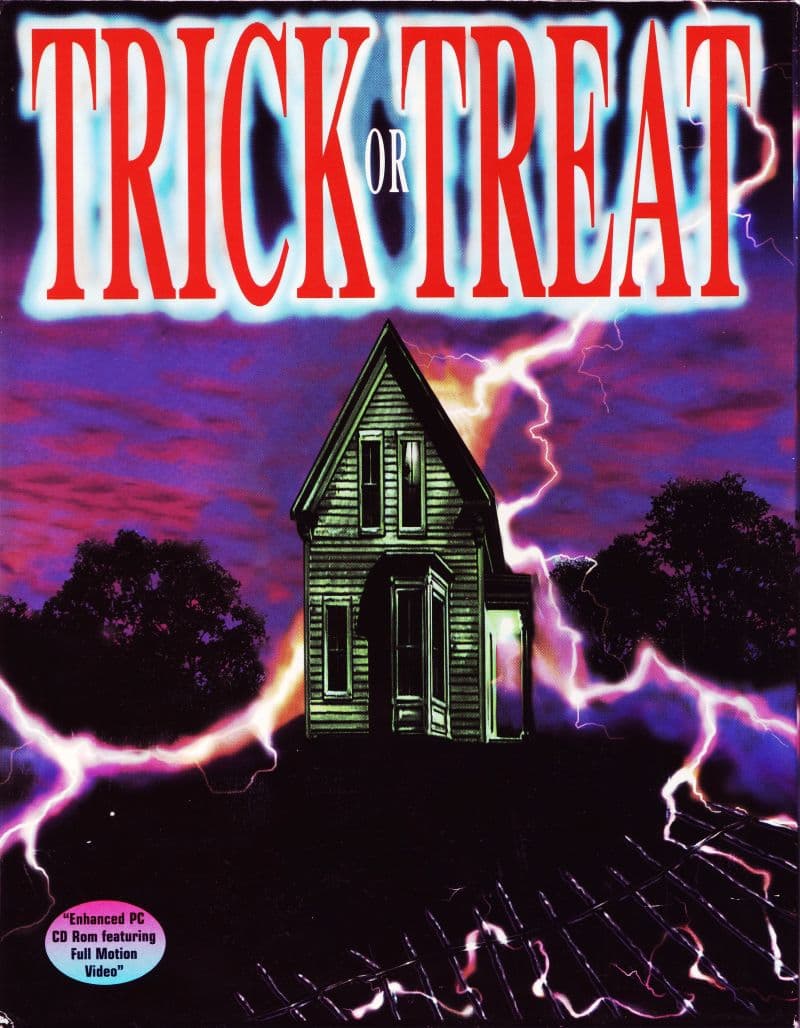
In Trick or Treat, you play an unemployed young man taking a handyman job at a care home on Halloween night, only for your car to get stolen within minutes of arriving.
Most adventure games start with a grand noble quest, but this 1994 adventure game hands you a clipboard instead. You arrive at an elderly care home in Devilsville on October 31st to start your shift. Before you even cross the threshold, the previous care assistant steals your car and leaves you stranded.
Inside, the elderly residents do not seem particularly bothered by your stolen vehicle. Instead, they demand five specific items for their upcoming Halloween party. You spend the early stage of the game wandering the halls, talking to residents, and filling those basic requests.
The plot escalates quickly once the party begins. Those seemingly frail retirees turn out to be members of a dangerous sect. They need a sacrifice and a helper to perform a voodoo ritual that will bring their dead leader back to life. You have to navigate the ceremony, survive the night, and find a way out of Devilsville alive.
The standard interface of the era relies on a permanent panel at the bottom of the screen. You get six basic verbs: talk, look, take, use, open, and close. Below those buttons sits your inventory grid, where you hold the trinkets gathered around the estate.
Progress depends entirely on inventory puzzles. You examine every room, collect loose items, and figure out which object satisfies which resident. The interaction logic is usually straightforward, but finding the interactive objects in the first place is a different story.
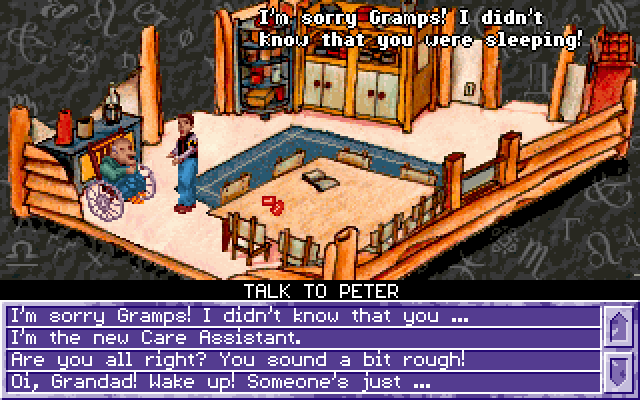
The game suffers from heavy pixel-hunting. Key items disappear into the background scenery without clear visual cues. You will often find yourself sweeping the mouse cursor across every single screen pixel by pixel just to find a tiny key or missing tool.
Spanish developer ACA Soft created the title using an engine designated as Tot. Publisher Proein Software released it locally in 1994, followed by international CD-ROM and floppy disk releases through Merit Studios a year later. Despite reaching store shelves across Europe, few players ever ran across it.
A major reason players gave up on this Trick or Treat MS-DOS game was a severe technical bug. At the start of Part 2, right as the story transitions into the ritual storyline, a progress-blocking crash bug frequently triggers. Back in 1995, reaching that crash without a patch meant your session ended right there.
Today, engine modernizations like ScummVM support the Tot engine and fix those original execution bugs. When the game actually works, you realize the story itself is quite brief. Once you know where the items are hidden, you can finish the entire story in a couple of hours.
Visually, the game looks simple compared to major 1993 and 1994 releases like Gabriel Knight or Freddy Pharkas. Backgrounds feature basic pixel art with flat lighting, and character animations are stiff. The English dialogue also suffers from awkward translation phrasing throughout the conversations.
Despite these flaws, the developers included one clever gimmick for players who reach the end screen. Finishing the story causes the game to create a personalized digital diploma text file. The game saves this file with your name inside the DIPLOMA directory using a DIP file extension.
The game scores poorly among modern retro reviews, averaging around thirty to forty percent on critic aggregates. The low scores make sense. The visual design was outdated upon release, and the pixel-hunting can test your patience. Yet the core premise of battling suburban retirees in a voodoo cult keeps it interesting for diehard fans of obscure floppy-era software.
You can play Trick or Treat online without setting up old disk images or hunting for original system files. Launching the title directly in your web browser allows you to sample this weird piece of Spanish adventure history instantly.
The low-resolution graphics and heavy pixel-hunting certainly show their age today. However, the bizarre storyline about elderly cultists makes it a fun curiosity for an evening session. You can experience Trick or Treat free in your browser right here on this page, with no installation needed, to see if you can earn your custom digital diploma.
In Trick or Treat, you play an unemployed young man taking a handyman job at a care home on Halloween night, only for your car to get stolen within minutes of arriving.
Most adventure games start with a grand noble quest, but this 1994 adventure game hands you a clipboard instead. You arrive at an elderly care home in Devilsville on October 31st to start your shift. Before you even cross the threshold, the previous care assistant steals your car and leaves you stranded.
Inside, the elderly residents do not seem particularly bothered by your stolen vehicle. Instead, they demand five specific items for their upcoming Halloween party. You spend the early stage of the game wandering the halls, talking to residents, and filling those basic requests.
The plot escalates quickly once the party begins. Those seemingly frail retirees turn out to be members of a dangerous sect. They need a sacrifice and a helper to perform a voodoo ritual that will bring their dead leader back to life. You have to navigate the ceremony, survive the night, and find a way out of Devilsville alive.
The standard interface of the era relies on a permanent panel at the bottom of the screen. You get six basic verbs: talk, look, take, use, open, and close. Below those buttons sits your inventory grid, where you hold the trinkets gathered around the estate.
Progress depends entirely on inventory puzzles. You examine every room, collect loose items, and figure out which object satisfies which resident. The interaction logic is usually straightforward, but finding the interactive objects in the first place is a different story.

The game suffers from heavy pixel-hunting. Key items disappear into the background scenery without clear visual cues. You will often find yourself sweeping the mouse cursor across every single screen pixel by pixel just to find a tiny key or missing tool.
Spanish developer ACA Soft created the title using an engine designated as Tot. Publisher Proein Software released it locally in 1994, followed by international CD-ROM and floppy disk releases through Merit Studios a year later. Despite reaching store shelves across Europe, few players ever ran across it.
A major reason players gave up on this Trick or Treat MS-DOS game was a severe technical bug. At the start of Part 2, right as the story transitions into the ritual storyline, a progress-blocking crash bug frequently triggers. Back in 1995, reaching that crash without a patch meant your session ended right there.
Today, engine modernizations like ScummVM support the Tot engine and fix those original execution bugs. When the game actually works, you realize the story itself is quite brief. Once you know where the items are hidden, you can finish the entire story in a couple of hours.
Visually, the game looks simple compared to major 1993 and 1994 releases like Gabriel Knight or Freddy Pharkas. Backgrounds feature basic pixel art with flat lighting, and character animations are stiff. The English dialogue also suffers from awkward translation phrasing throughout the conversations.

Despite these flaws, the developers included one clever gimmick for players who reach the end screen. Finishing the story causes the game to create a personalized digital diploma text file. The game saves this file with your name inside the DIPLOMA directory using a DIP file extension.
The game scores poorly among modern retro reviews, averaging around thirty to forty percent on critic aggregates. The low scores make sense. The visual design was outdated upon release, and the pixel-hunting can test your patience. Yet the core premise of battling suburban retirees in a voodoo cult keeps it interesting for diehard fans of obscure floppy-era software.
You can play Trick or Treat online without setting up old disk images or hunting for original system files. Launching the title directly in your web browser allows you to sample this weird piece of Spanish adventure history instantly.
The low-resolution graphics and heavy pixel-hunting certainly show their age today. However, the bizarre storyline about elderly cultists makes it a fun curiosity for an evening session. You can experience Trick or Treat free in your browser right here on this page, with no installation needed, to see if you can earn your custom digital diploma.
How Trick or Treat is played — the keys the game listens to, grouped by what they do.
Highlighted keys are mapped — hover or tap one to see what it does.
The player must type their name at the start, and enter a 5-digit copy protection code periodically.
The on-screen keyboard and gamepad mapping the browser player uses on a phone, a tablet or a controller, as opposed to the real keys above. $PRO members make their own in the player and share them here; anyone can pick one to play with.
Cheat codes, console commands and memory pokes for Trick or Treat — each one verified and attributed.
Sign in to submitHow Trick or Treat is played — the keys the game listens to, grouped by what they do.
Highlighted keys are mapped — hover or tap one to see what it does.
The player must type their name at the start, and enter a 5-digit copy protection code periodically.
The on-screen keyboard and gamepad mapping the browser player uses on a phone, a tablet or a controller, as opposed to the real keys above. $PRO members make their own in the player and share them here; anyone can pick one to play with.
Cheat codes, console commands and memory pokes for Trick or Treat — each one verified and attributed.
Sign in to submit