
Tunneler drops two players onto a shared keyboard to dig split-screen dirt tunnels, hunt each other down, and balance screen-peeking against a rapidly draining battery.
Most action titles from 1991 tried to push graphics cards with elaborate sprite animations and packed screens. This bare-bones action game went the opposite direction. It drops two tanks into an underground map filled with dirt and indestructible rock, then hands each player control of one side of the display.
You start at a randomly chosen home base surrounded entirely by solid earth. Your main objective is simple: carve through the soil, locate the rival player, and destroy their tank three times before they do the same to you. There are no weapon upgrades, hidden power-ups, or enemy minions waiting in the dark corners.
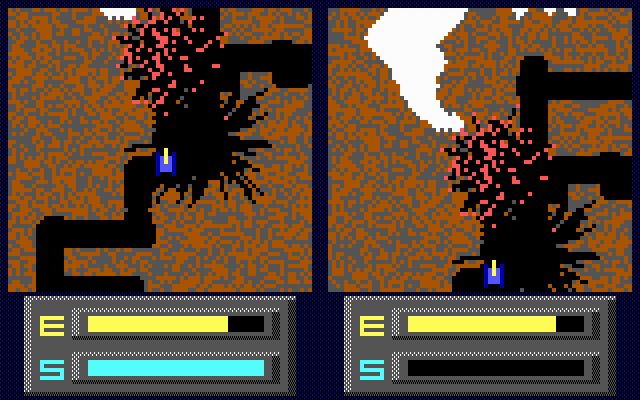
The twist comes from your tank's battery meter. Moving around drains your energy reserves slowly. Firing your main cannon drains your reserves faster. Carving through dirt drains them fastest of all. The only way to refill your shields and energy is to back out of your fresh tunnel and park back on your starting pad.
That single restriction changes everything about how you explore. Digging straight toward where you think your opponent spawned is a quick way to strand yourself deep underground with zero power. You have to plan return trips, build safe pit stops, and watch your meter constantly while pushing forward into the unknown dirt.
Because the display is split down the middle, screen-peeking is not a cheap trick. It is an intentional part of the design. You can look at your opponent's side of the monitor at any second to see what kind of dirt network they are digging.
That shared view creates an odd tactical tension. Seeing that your rival has broken into your tunnel system is easy. Figure out which direction they chose at your last intersection, however, and the picture gets messy. A smart player carves dead ends, fake corridors, and tight switchbacks just to confuse anyone watching their feed.
If you suspect your rival is closing in on your base, you can loop around and dig behind them. Because digging uses up so much juice, a tank caught far from home with a depleted battery is almost easy pickings. The player who manages their supply lines usually wins the engagement.
Once two tunnels connect, the tempo shifts instantly. A cautious excavation turns into a desperate retreat toward your home base to top off your energy before the head-to-head clash. If you run out of power mid-fight, your tank sits helpless, ready to be blown to bits by a single well-aimed shot.
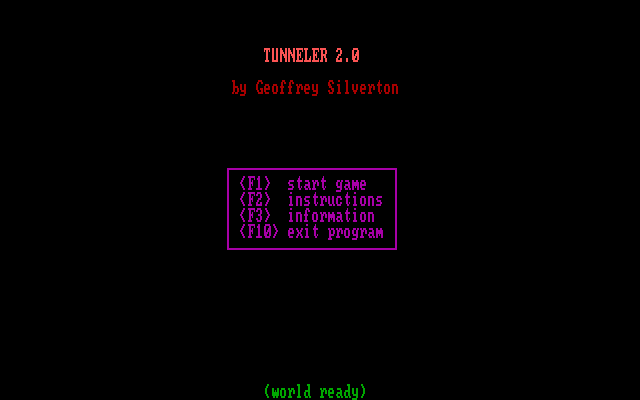
Developer Geoffrey Silverton wrote the original game in Turbo Pascal, creating a small program. Taking up roughly 20 to 25 kilobytes of space, it spread from computer to computer on single floppy disks across school computer labs and office PCs.
That compact footprint was a necessity for early hardware, but it also meant every feature had to justify its existence. You get stark, minimalist graphics that show dirt as solid blocks and tunnels as clean black paths. Contemporary players praised the visual design because fancy graphics would not have improved the core match at all.
If you want to look at the original source code today, you are out of luck. Silverton confirmed on his website FAQ that the original Pascal source code was stored on floppy disks that were lost decades ago. What survived is the compiled binary that ran on vintage MS-DOS setups, along with fan remakes created years later.
Publishing the game himself, Silverton delivered a clean, focused multiplayer experiment. It stripped away narrative fluff and menus, putting players straight into the action the second the executable loaded.
Sitting down with this Geoffrey Silverton project today highlights a couple of clear limitations. First, there is zero single-player support. If you do not have a second human sitting next to you, you cannot play a match against a computer-controlled tank.
The second issue stems from old hardware quirks. Crowding two sets of hands onto one physical keyboard often triggers key ghosting. Pressing four directional keys at once causes the PC speaker to squeak and ignores your inputs. Finding a comfortable key layout for both players takes a minute of setup before you can start digging.
The visual presentation is equally spartan. Sound effects consist of basic PC speaker clicks and rumbles, and the color palette relies on simple primary tones. Yet those rough spots fade away once a match gets competitive.
The core design holds up well because it relies on basic psychological tricks. You bait your friend into narrow traps, manage your limited power bar, and navigate blind corners in the dark while trying to read their screen out of the corner of your eye.
You can launch the classic 1991 Tunneler MS-DOS game right now without searching for vintage hardware or disk images. It offers a fast, raw competitive match that tests your nerves the moment your tunnel breaches enemy territory.
Grab a friend, set your keyboard controls, and play Tunneler online without downloading extra software. You can run Tunneler free in your browser right here. The real fun begins when you watch your rival's screen turn toward your base while your own battery meter drops into the red.
Tunneler drops two players onto a shared keyboard to dig split-screen dirt tunnels, hunt each other down, and balance screen-peeking against a rapidly draining battery.
Most action titles from 1991 tried to push graphics cards with elaborate sprite animations and packed screens. This bare-bones action game went the opposite direction. It drops two tanks into an underground map filled with dirt and indestructible rock, then hands each player control of one side of the display.
You start at a randomly chosen home base surrounded entirely by solid earth. Your main objective is simple: carve through the soil, locate the rival player, and destroy their tank three times before they do the same to you. There are no weapon upgrades, hidden power-ups, or enemy minions waiting in the dark corners.
The twist comes from your tank's battery meter. Moving around drains your energy reserves slowly. Firing your main cannon drains your reserves faster. Carving through dirt drains them fastest of all. The only way to refill your shields and energy is to back out of your fresh tunnel and park back on your starting pad.
That single restriction changes everything about how you explore. Digging straight toward where you think your opponent spawned is a quick way to strand yourself deep underground with zero power. You have to plan return trips, build safe pit stops, and watch your meter constantly while pushing forward into the unknown dirt.
Because the display is split down the middle, screen-peeking is not a cheap trick. It is an intentional part of the design. You can look at your opponent's side of the monitor at any second to see what kind of dirt network they are digging.
That shared view creates an odd tactical tension. Seeing that your rival has broken into your tunnel system is easy. Figure out which direction they chose at your last intersection, however, and the picture gets messy. A smart player carves dead ends, fake corridors, and tight switchbacks just to confuse anyone watching their feed.
If you suspect your rival is closing in on your base, you can loop around and dig behind them. Because digging uses up so much juice, a tank caught far from home with a depleted battery is almost easy pickings. The player who manages their supply lines usually wins the engagement.
Once two tunnels connect, the tempo shifts instantly. A cautious excavation turns into a desperate retreat toward your home base to top off your energy before the head-to-head clash. If you run out of power mid-fight, your tank sits helpless, ready to be blown to bits by a single well-aimed shot.

Developer Geoffrey Silverton wrote the original game in Turbo Pascal, creating a small program. Taking up roughly 20 to 25 kilobytes of space, it spread from computer to computer on single floppy disks across school computer labs and office PCs.
That compact footprint was a necessity for early hardware, but it also meant every feature had to justify its existence. You get stark, minimalist graphics that show dirt as solid blocks and tunnels as clean black paths. Contemporary players praised the visual design because fancy graphics would not have improved the core match at all.
If you want to look at the original source code today, you are out of luck. Silverton confirmed on his website FAQ that the original Pascal source code was stored on floppy disks that were lost decades ago. What survived is the compiled binary that ran on vintage MS-DOS setups, along with fan remakes created years later.
Publishing the game himself, Silverton delivered a clean, focused multiplayer experiment. It stripped away narrative fluff and menus, putting players straight into the action the second the executable loaded.
Sitting down with this Geoffrey Silverton project today highlights a couple of clear limitations. First, there is zero single-player support. If you do not have a second human sitting next to you, you cannot play a match against a computer-controlled tank.
The second issue stems from old hardware quirks. Crowding two sets of hands onto one physical keyboard often triggers key ghosting. Pressing four directional keys at once causes the PC speaker to squeak and ignores your inputs. Finding a comfortable key layout for both players takes a minute of setup before you can start digging.
The visual presentation is equally spartan. Sound effects consist of basic PC speaker clicks and rumbles, and the color palette relies on simple primary tones. Yet those rough spots fade away once a match gets competitive.
The core design holds up well because it relies on basic psychological tricks. You bait your friend into narrow traps, manage your limited power bar, and navigate blind corners in the dark while trying to read their screen out of the corner of your eye.

You can launch the classic 1991 Tunneler MS-DOS game right now without searching for vintage hardware or disk images. It offers a fast, raw competitive match that tests your nerves the moment your tunnel breaches enemy territory.
Grab a friend, set your keyboard controls, and play Tunneler online without downloading extra software. You can run Tunneler free in your browser right here. The real fun begins when you watch your rival's screen turn toward your base while your own battery meter drops into the red.
The on-screen keyboard and gamepad mapping the browser player uses on a phone, a tablet or a controller, as opposed to the real keys above. $PRO members make their own in the player and share them here; anyone can pick one to play with.
Cheat codes, console commands and memory pokes for Tunneler — each one verified and attributed.
Sign in to submitaka Tanks
The on-screen keyboard and gamepad mapping the browser player uses on a phone, a tablet or a controller, as opposed to the real keys above. $PRO members make their own in the player and share them here; anyone can pick one to play with.
Cheat codes, console commands and memory pokes for Tunneler — each one verified and attributed.
Sign in to submit