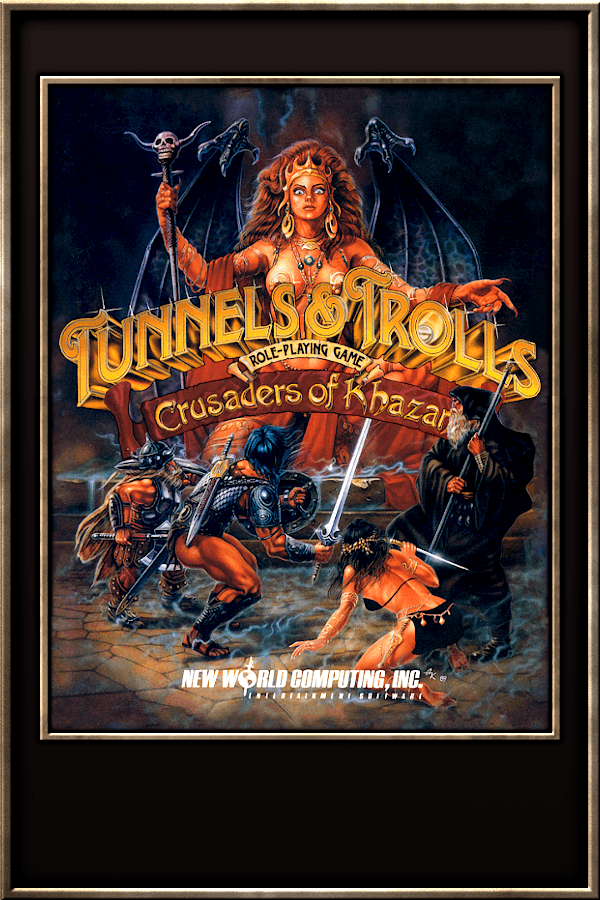
Tunnels & Trolls: Crusaders of Khazan
Bringing tabletop rules to digital screens often risks losing the dice-rolling spirit, but Tunnels & Trolls: Crusaders of Khazan attempts to translate Ken St. Andre's famed pen-and-paper system directly into a top-down digital expedition.
The messy cross-continental design behind Tunnels & Trolls: Crusaders of Khazan
A game designed in America, sent to Japan to be written for local home computers, and then brought back across the Pacific to be translated and ported to PC hardware sounds like a recipe for chaos. That is precisely how this adaptation came to exist. Tabletop creators Ken St. Andre and Liz Danforth wrote the game design alongside writer Neal Hallford under New World Computing, Inc., but the development work was shipped off to Japanese studio StarCraft, Inc., who initially coded it for hardware like the PC-88 and PC-98 before building the MS-DOS release.
When writers in North America hand design notes to coders in Tokyo, small details get lost in translation long before the code returns home. Writing in Computer Gaming World, reviewer G. Marc Clupper called out this exact friction, noting that it felt like designers and programmers never spoke to one another. The structural gap shows up everywhere from odd pacing to broken item stats. Yet, when you booted the game on an IBM PC back in 1990, hooked up a Roland MT-32 synthesizer card, and opened the big retail box with its illustrated map, clue book, and 5th Edition tabletop manual, you felt like you were sitting down for a massive fantasy campaign.
Party management and guild hopping across the Dragon Continent
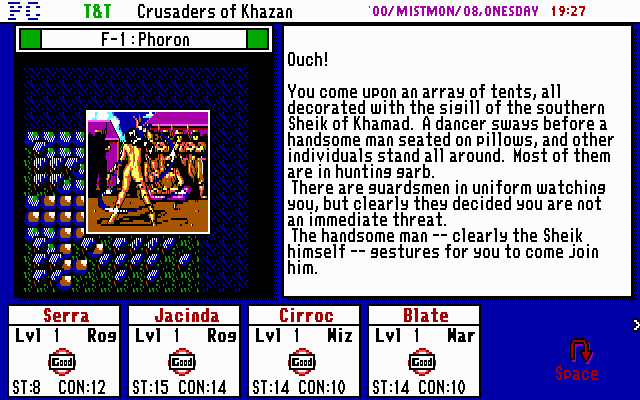
Your journey centers on a world pushed back to war. After four centuries of peace between humans and monsters on the Dragon Continent, the monster empress Lerotra'hh and her consort Khara Kang reject the peace treaty. Towns are sacked, wilderness roads become death traps, and the human population relies on you to locate and release the exiled wizard Khazan. To achieve this, you build a custom party, moving through top-down landscapes and stepping into populated hubs like the City of Gull.
Town survival depends heavily on visiting local establishments. You spend gold and manage equipment through specialized menus, following a distinct progression structure:
- Visit the Adventurer's Guild to recruit companions and expand your party strength.
- Head over to the Ironworkers Guild to purchase weapons and outfit your fighters.
- Search local taverns and guilds for mission leads and localized side quests.
- Descend into town sewers, local mines, and subterranean dungeons to collect loot and fight bosses.
The party management screen relies on a point-and-click interface spread across multiple floating windows. It gives you plenty of bookkeeping to track, but the underlying system carries serious mechanical flaws. Potions designed to permanently boost player attributes simply fail to add stats when consumed, wasting your hard-earned gold and leaving characters underpowered for late-game encounters.
Tactical combat mechanics and severe balance spikes
When party exploration shifts to combat, the display switches to an arena layout. Battle runs in turn-based steps, letting you move characters individual tiles and select attacks against groups of incoming monsters or city guards. On paper, this spatial combat offers room for tactical planning. In practice, speed calculations and damage scaling can destroy a party before you even take a turn.
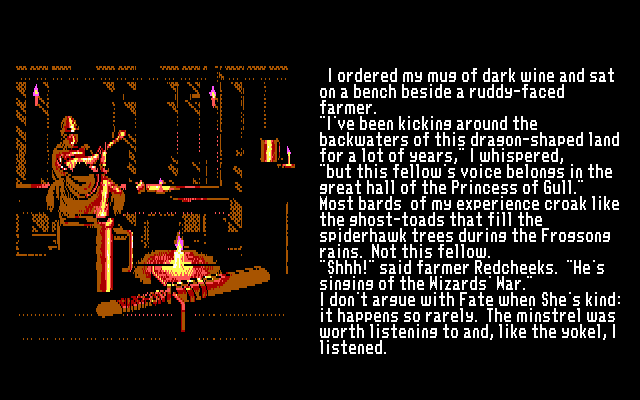
The difficulty curve does not rise smoothly; it hits like a brick wall. Mid-game bosses present mathematical hurdles that punish standard party builds. A notorious example is the confrontation against Lord Bozo, a boss backed by high-speed units that can execute full party wipes in a single combat round before your fighters get a chance to act. Scorpia, the veteran RPG columnist for Computer Gaming World, rightly slammed these brutal balance issues, noting that the title squandered its genuine potential.
Reviewers at the time held radically split opinions on the whole package. Dragon Magazine awarded it a glowing 5 out of 5 stars, drawn to its tabletop roots and narrative flavor, while White Wolf Magazine gave it a more grounded 3 out of 5, mentioning that its positives barely outpaced its flaws. Readers who ignored the manual's errata reference card quickly discovered how harsh the underlying code could be when faced with copy-protection checks or unpredictable combat math.
Why modern players struggle with the anticlimactic finish
If you survive the broken stat potions, manage to beat high-speed boss wipes, and navigate every maze in the game, the narrative climax drops the ball completely. After spending hours trying to locate and wake the wizard Khazan so he can defeat the demon queen, Khazan simply wakes up, casts a spell, and teleports your party away. You do not get a final battle against Lerotra'hh, nor do you watch your party celebrate their victory.
This abrupt conclusion leaves modern retro players disappointed. Spending twenty hours grinding through dangerous sewers and fine-tuning an adventure party only to get banished by the guy you rescued feels like a slap in the face. It reinforces the idea that the development team ran out of time or budget before finishing the final arc.
Is this classic computer role-playing adventure worth your time today?
Despite its awkward cross-Pacific production and balance issues, the game is an odd piece of tabletop conversion history for fans of vintage role-playing (RPG) games. The tabletop rules system brings a unique flavour that sets it apart from standard Dungeons & Dragons adaptations of the same period, particularly in how party options are framed. If you enjoy late-80s style DOS RPGs and do not mind taking a few unfair party wipes along the way, there is still plenty to dig into here.
You can play Tunnels & Trolls: Crusaders of Khazan free in your browser right now without installing a thing. If you want to sample what makes it so unique, load up the DOS version of Tunnels & Trolls: Crusaders of Khazan online, form a full party at the Adventurer's Guild, and explore the City of Gull before diving into the sewers to test your luck against the local monster population.