
In 1981, Apple II players stepped onto the land of Sosaria in Ultima I: The First Age of Darkness, completely unaware that a quick detour into starships and time travel would establish a template for computer role-playing games for decades to come.
By the mid-1980s, the original Apple II code of Richard Garriott's early RPG was showing its age, prompting programmer John Fachini to rebuild the entire title in assembly language for ORIGIN Systems, Inc. to target the growing IBM PC market. The 1987 release brought full EGA display support to the overworld maps, giving Sosaria crisp colors and smooth scrolling that ran far cleaner than earlier PC conversions. For PC owners who wanted an expansive fantasy adventure without wrestling with sluggish BASIC code, this revised MS-DOS game delivered an astonishingly responsive world.
You begin by creating a character named The Stranger, choosing from four races: Human, Elf, Dwarf, or the hobbit-like Bobbit. You then pick a class, split between Fighter, Cleric, Wizard, and Thief, and distribute point pools into Strength, Agility, Stamina, Charisma, Wisdom, and Intelligence. These attributes directly dictate how hard you hit, how long you survive, and whether shopkeepers charge you an arm and a leg for supplies. The core loop demands that you travel across four distinct continents, taking quests from monarchs like Lord British to raise your stats and collect vital quest items.
What sets this adventure apart from almost every other classic role-playing adventure of its decade is its wild genre mashup. You start on horseback buying leather armor and maces in medieval hamlets, but as you grow wealthier, you upgrade to phasers, hovercraft, and eventually a space shuttle. Your ultimate goal goes far beyond killing monsters in a cavern: you buy a rocket, blast into orbit, shoot down enemy fighters, rescue space princesses, and acquire a time machine. Only by traveling back 1,000 years can you confront the evil wizard Mondain and shatter his Gem of Immortality.
Managing your survival on the overworld map requires constant attention to your food supply. Every step you take across the top-down terrain consumes food, and if your rations drop to zero, your character starves to death within moments. Because town merchants are spread far apart across four separate landmasses, getting lost without a map usually means a slow death by starvation long before an enemy monster reaches you.
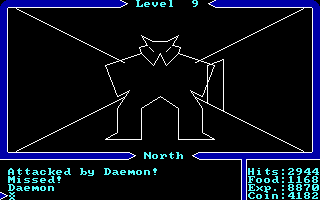
When you enter a dungeon, the perspective shifts instantly from top-down tile scrolling to a vector-style first-person grid view. Down in these dark corridors, you hunt giant rats, cyclopes, mind whippers, and gelatinous cubes while mapping out labyrinthine turns. Combat in dungeons is completely turn-based and dead simple, requiring little more than pushing the attack key and selecting a direction. There are no complex tactical maneuvers or party formations here, just a straight test of your weapon stats against the monster's health pool.
However, dungeon crawling reveals the game's single most egregious structural flaw. Due to a well-known programming bug in the DOS release, the armor you buy and equip provides absolutely zero damage protection inside dungeons. You can spend thousands of gold pieces on the finest suits of plate mail, yet a humble dungeon rat will hit you just as hard as if you were wearing plain clothes. Experienced players quickly learn to spend their hard-earned coin on food, weapons, and magic spells instead of wasting money on broken defense items.
The pacing of the journey is uneven, but it sticks in your head. The early game feels like a desperate survival sim where you grind low-level enemies near castle gates, constantly running back to town before your food counter ticks to zero. Once you secure a reliable vehicle and accumulate enough gold to bribe kings for stat upgrades, the game shifts gear dramatically into high-concept science fiction high jinks. The shift from dark fantasy to space combat is jarring, but it gives the journey an eccentric personality that late-80s competitors lacked.
Where the mechanics feel most dated is in the lack of combat strategy. Because fighting consists entirely of pressing a single button until either you or the monster dies, battles in the later stages can become tedious grinding exercises. Yet despite the repetitive key presses, the sheer speed of execution keeps things moving. Unlike other early DOS ports that run at hyper-speed on modern hardware unless choked down by CPU slow-down utilities, this release runs smoothly and predictably right out of the box.
If you have ever wanted to see where one of computer gaming's biggest sagas began, this 1987 DOS version published by ORIGIN Systems, Inc. is the best way to play the first entry. It strips away the tedious loading times of early disk drives while keeping the raw, experimental spirit of early 80s game design completely intact.
You can play Ultima I: The First Age of Darkness online free in your browser right here, with no need for emulator setups or system tweaks. Launch the game, pick a Dwarf Fighter or an Elf Wizard, and remember to buy plenty of rations at the first signpost before wandering off into the wild.
In 1981, Apple II players stepped onto the land of Sosaria in Ultima I: The First Age of Darkness, completely unaware that a quick detour into starships and time travel would establish a template for computer role-playing games for decades to come.
By the mid-1980s, the original Apple II code of Richard Garriott's early RPG was showing its age, prompting programmer John Fachini to rebuild the entire title in assembly language for ORIGIN Systems, Inc. to target the growing IBM PC market. The 1987 release brought full EGA display support to the overworld maps, giving Sosaria crisp colors and smooth scrolling that ran far cleaner than earlier PC conversions. For PC owners who wanted an expansive fantasy adventure without wrestling with sluggish BASIC code, this revised MS-DOS game delivered an astonishingly responsive world.
You begin by creating a character named The Stranger, choosing from four races: Human, Elf, Dwarf, or the hobbit-like Bobbit. You then pick a class, split between Fighter, Cleric, Wizard, and Thief, and distribute point pools into Strength, Agility, Stamina, Charisma, Wisdom, and Intelligence. These attributes directly dictate how hard you hit, how long you survive, and whether shopkeepers charge you an arm and a leg for supplies. The core loop demands that you travel across four distinct continents, taking quests from monarchs like Lord British to raise your stats and collect vital quest items.
What sets this adventure apart from almost every other classic role-playing adventure of its decade is its wild genre mashup. You start on horseback buying leather armor and maces in medieval hamlets, but as you grow wealthier, you upgrade to phasers, hovercraft, and eventually a space shuttle. Your ultimate goal goes far beyond killing monsters in a cavern: you buy a rocket, blast into orbit, shoot down enemy fighters, rescue space princesses, and acquire a time machine. Only by traveling back 1,000 years can you confront the evil wizard Mondain and shatter his Gem of Immortality.
Managing your survival on the overworld map requires constant attention to your food supply. Every step you take across the top-down terrain consumes food, and if your rations drop to zero, your character starves to death within moments. Because town merchants are spread far apart across four separate landmasses, getting lost without a map usually means a slow death by starvation long before an enemy monster reaches you.
When you enter a dungeon, the perspective shifts instantly from top-down tile scrolling to a vector-style first-person grid view. Down in these dark corridors, you hunt giant rats, cyclopes, mind whippers, and gelatinous cubes while mapping out labyrinthine turns. Combat in dungeons is completely turn-based and dead simple, requiring little more than pushing the attack key and selecting a direction. There are no complex tactical maneuvers or party formations here, just a straight test of your weapon stats against the monster's health pool.
However, dungeon crawling reveals the game's single most egregious structural flaw. Due to a well-known programming bug in the DOS release, the armor you buy and equip provides absolutely zero damage protection inside dungeons. You can spend thousands of gold pieces on the finest suits of plate mail, yet a humble dungeon rat will hit you just as hard as if you were wearing plain clothes. Experienced players quickly learn to spend their hard-earned coin on food, weapons, and magic spells instead of wasting money on broken defense items.
The pacing of the journey is uneven, but it sticks in your head. The early game feels like a desperate survival sim where you grind low-level enemies near castle gates, constantly running back to town before your food counter ticks to zero. Once you secure a reliable vehicle and accumulate enough gold to bribe kings for stat upgrades, the game shifts gear dramatically into high-concept science fiction high jinks. The shift from dark fantasy to space combat is jarring, but it gives the journey an eccentric personality that late-80s competitors lacked.
Where the mechanics feel most dated is in the lack of combat strategy. Because fighting consists entirely of pressing a single button until either you or the monster dies, battles in the later stages can become tedious grinding exercises. Yet despite the repetitive key presses, the sheer speed of execution keeps things moving. Unlike other early DOS ports that run at hyper-speed on modern hardware unless choked down by CPU slow-down utilities, this release runs smoothly and predictably right out of the box.
If you have ever wanted to see where one of computer gaming's biggest sagas began, this 1987 DOS version published by ORIGIN Systems, Inc. is the best way to play the first entry. It strips away the tedious loading times of early disk drives while keeping the raw, experimental spirit of early 80s game design completely intact.
You can play Ultima I: The First Age of Darkness online free in your browser right here, with no need for emulator setups or system tweaks. Launch the game, pick a Dwarf Fighter or an Elf Wizard, and remember to buy plenty of rations at the first signpost before wandering off into the wild.
How Ultima I: The First Age of Darkness is played — the keys the game listens to, grouped by what they do.
Highlighted keys are mapped — hover or tap one to see what it does.
Save your progress with Q and reboot using Ctrl+Alt+Del to exit. Character creation requires typing up to 14 letters.
The on-screen keyboard and gamepad mapping the browser player uses on a phone, a tablet or a controller, as opposed to the real keys above. $PRO members make their own in the player and share them here; anyone can pick one to play with.
Cheat codes, console commands and memory pokes for Ultima I: The First Age of Darkness — each one verified and attributed.
Sign in to submitHow Ultima I: The First Age of Darkness is played — the keys the game listens to, grouped by what they do.
Highlighted keys are mapped — hover or tap one to see what it does.
Save your progress with Q and reboot using Ctrl+Alt+Del to exit. Character creation requires typing up to 14 letters.
The on-screen keyboard and gamepad mapping the browser player uses on a phone, a tablet or a controller, as opposed to the real keys above. $PRO members make their own in the player and share them here; anyone can pick one to play with.
Cheat codes, console commands and memory pokes for Ultima I: The First Age of Darkness — each one verified and attributed.
Sign in to submit