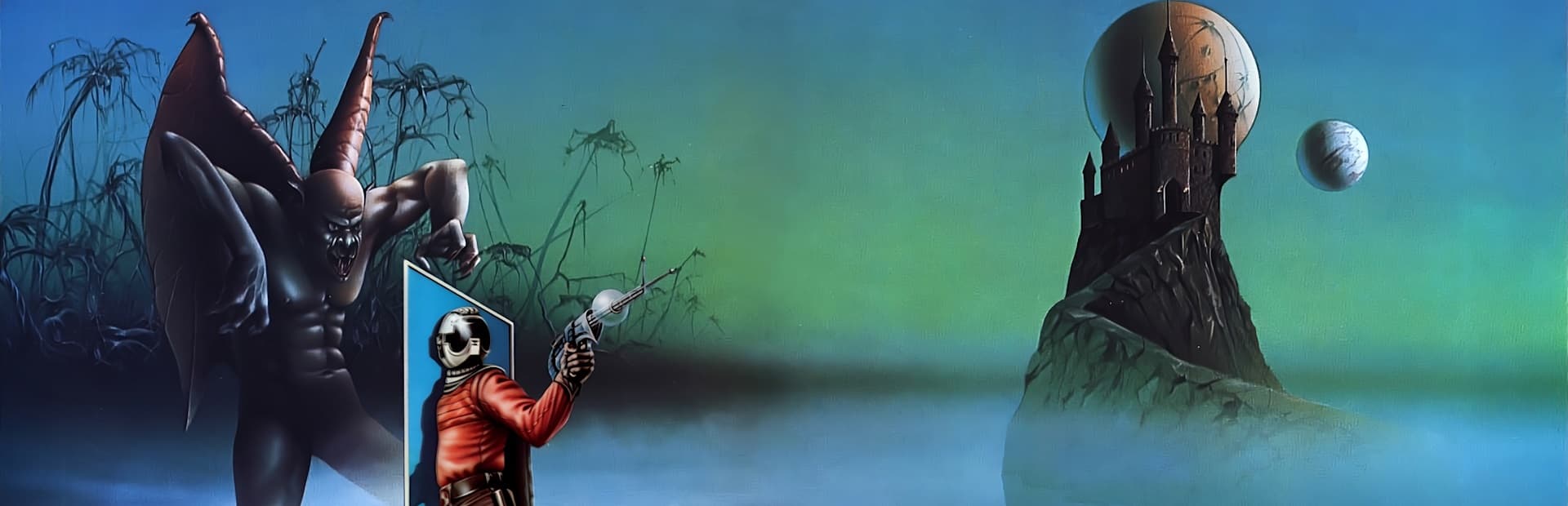
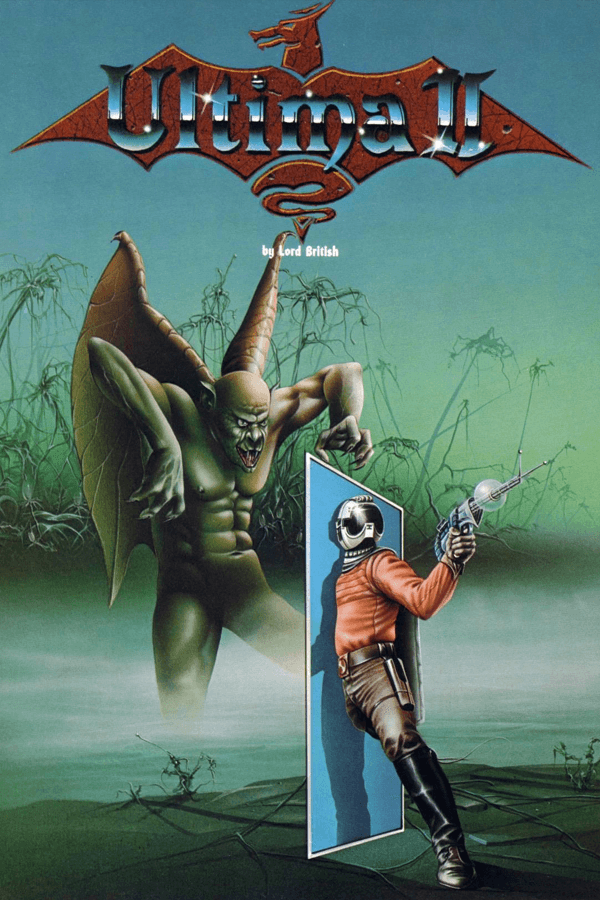
If you boot up Ultima II: The Revenge of the Enchantress expecting a gentle fantasy adventure, your hero will immediately starve to death in 1423 B.C. while an orc steals your boots.
The story kicks off right after you defeated Mondain in the first game. His lover, the evil enchantress Minax, decides to avenge him by tearing space-time apart and launching a nuclear war on Earth. Lord British summons your hero to chase her through time gates across five separate eras. You hop between Pangea, 1423 B.C., 1990 A.D., 2112 A.D., and the bizarre Time of Legends.
Where the original game relied on simple map tiles, designer Richard Garriott expanded this sequel with distinct town maps, overworld views, and dungeon corridors. The inspiration came straight from Terry Gilliam's movie Time Bandits. You wander through real-world spots like San Antonio and Great Britain before stealing a Soviet rocket ship to blast into deep space.
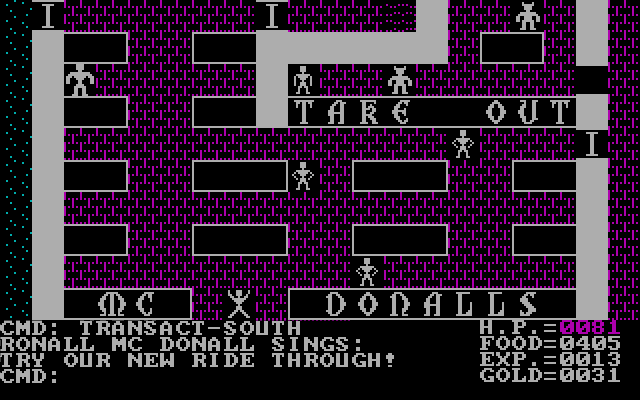
Every step you take on the map drains your food supply. If that counter hits zero, your hero collapses on the spot. In the first few minutes of this Role-playing (RPG) adventure, you learn that legitimate work pays peanuts. Orcs, thieves, and guards hound you across the top-down map while you scrape together enough gold to buy hit points from King Lord British.
Every long-time fan knows the standard trick to survive this grinding nightmare:
You also end up save-scumming constantly to steal essential keys and items from city guards. If a guard catches you, the whole town turns hostile in an instant. Balancing top-down navigation with strategic inventory management makes every voyage tense, especially when searching for the ultimate sword named Enilno, which is just the word "online" spelled backward.
Technically, this release was a massive leap forward for the series. Garriott wrote the whole codebase in assembly language rather than sluggish BASIC. That shift gave the game fast tile rendering and responsive keyboard commands. Sierra On-Line, Inc. agreed to publish the title in 1982 partly because they agreed to include a physical cloth map in every box.
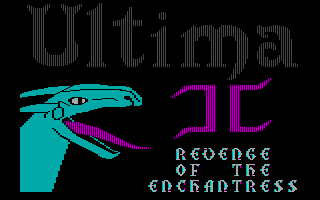
The relationship between designer and publisher quickly soured over royalty disputes regarding the Ultima II: The Revenge of the Enchantress MS-DOS game port. That friction drove Garriott to leave Sierra and establish his own company, Origin Systems. Despite the corporate drama, the game proved to be a massive commercial success, selling over 100,000 physical copies.
For all its ambitious ideas, the game carries notorious design flaws. Late-game progression demands baffling leaps of logic. To reach the final boss inside Shadowguard Castle, you must obtain an enchanted ring to bypass deadly force fields, acquire Power Armor, and navigate a maze of time doors. Contemporary coverage in Computer Gaming World praised its sheer scale, but modern retro players frequently point out how tedious the core loop becomes without a detailed walkthrough.
Worse still, unpatched disk releases contained a fatal bug. Trying to land your space rocket on Planet X or visit other solar system worlds often triggered a persistent "WRONG DISK" error that stranded players mid-run. You even find a cameo of Garriott himself hanging out on Neptune, assuming you manage to dodge the disk bugs to get there. It is a messy, uncompromising, yet fascinating chapter in computer gaming history.
This early classic sits right between simple early mainframe crawls and the sprawling open worlds that followed. The brutal survival mechanics and wild space-time mixing won't appeal to everyone, but anyone curious about early RPG history should try this piece of Lord British's work at least once.
You can play Ultima II: The Revenge of the Enchantress online right here on this page. You can jump straight into Ultima II: The Revenge of the Enchantress free in your browser with zero setup required. Try talking to the locals in Lord British's castle, grab yourself a horse, and start hoarding food before you step into your very first time door.
If you boot up Ultima II: The Revenge of the Enchantress expecting a gentle fantasy adventure, your hero will immediately starve to death in 1423 B.C. while an orc steals your boots.
The story kicks off right after you defeated Mondain in the first game. His lover, the evil enchantress Minax, decides to avenge him by tearing space-time apart and launching a nuclear war on Earth. Lord British summons your hero to chase her through time gates across five separate eras. You hop between Pangea, 1423 B.C., 1990 A.D., 2112 A.D., and the bizarre Time of Legends.
Where the original game relied on simple map tiles, designer Richard Garriott expanded this sequel with distinct town maps, overworld views, and dungeon corridors. The inspiration came straight from Terry Gilliam's movie Time Bandits. You wander through real-world spots like San Antonio and Great Britain before stealing a Soviet rocket ship to blast into deep space.
Every step you take on the map drains your food supply. If that counter hits zero, your hero collapses on the spot. In the first few minutes of this Role-playing (RPG) adventure, you learn that legitimate work pays peanuts. Orcs, thieves, and guards hound you across the top-down map while you scrape together enough gold to buy hit points from King Lord British.
Every long-time fan knows the standard trick to survive this grinding nightmare:
You also end up save-scumming constantly to steal essential keys and items from city guards. If a guard catches you, the whole town turns hostile in an instant. Balancing top-down navigation with strategic inventory management makes every voyage tense, especially when searching for the ultimate sword named Enilno, which is just the word "online" spelled backward.
Technically, this release was a massive leap forward for the series. Garriott wrote the whole codebase in assembly language rather than sluggish BASIC. That shift gave the game fast tile rendering and responsive keyboard commands. Sierra On-Line, Inc. agreed to publish the title in 1982 partly because they agreed to include a physical cloth map in every box.
The relationship between designer and publisher quickly soured over royalty disputes regarding the Ultima II: The Revenge of the Enchantress MS-DOS game port. That friction drove Garriott to leave Sierra and establish his own company, Origin Systems. Despite the corporate drama, the game proved to be a massive commercial success, selling over 100,000 physical copies.
For all its ambitious ideas, the game carries notorious design flaws. Late-game progression demands baffling leaps of logic. To reach the final boss inside Shadowguard Castle, you must obtain an enchanted ring to bypass deadly force fields, acquire Power Armor, and navigate a maze of time doors. Contemporary coverage in Computer Gaming World praised its sheer scale, but modern retro players frequently point out how tedious the core loop becomes without a detailed walkthrough.
Worse still, unpatched disk releases contained a fatal bug. Trying to land your space rocket on Planet X or visit other solar system worlds often triggered a persistent "WRONG DISK" error that stranded players mid-run. You even find a cameo of Garriott himself hanging out on Neptune, assuming you manage to dodge the disk bugs to get there. It is a messy, uncompromising, yet fascinating chapter in computer gaming history.
This early classic sits right between simple early mainframe crawls and the sprawling open worlds that followed. The brutal survival mechanics and wild space-time mixing won't appeal to everyone, but anyone curious about early RPG history should try this piece of Lord British's work at least once.
You can play Ultima II: The Revenge of the Enchantress online right here on this page. You can jump straight into Ultima II: The Revenge of the Enchantress free in your browser with zero setup required. Try talking to the locals in Lord British's castle, grab yourself a horse, and start hoarding food before you step into your very first time door.
How Ultima II: The Revenge of the Enchantress is played — the keys the game listens to, grouped by what they do.
Highlighted keys are mapped — hover or tap one to see what it does.
The game uses text inputs for typing coordinates during actions like hyperspace travel. Directional movement controls are omitted as they were not specified in the research notes.
The on-screen keyboard and gamepad mapping the browser player uses on a phone, a tablet or a controller, as opposed to the real keys above. $PRO members make their own in the player and share them here; anyone can pick one to play with.
Cheat codes, console commands and memory pokes for Ultima II: The Revenge of the Enchantress — each one verified and attributed.
Sign in to submitHow Ultima II: The Revenge of the Enchantress is played — the keys the game listens to, grouped by what they do.
Highlighted keys are mapped — hover or tap one to see what it does.
The game uses text inputs for typing coordinates during actions like hyperspace travel. Directional movement controls are omitted as they were not specified in the research notes.
The on-screen keyboard and gamepad mapping the browser player uses on a phone, a tablet or a controller, as opposed to the real keys above. $PRO members make their own in the player and share them here; anyone can pick one to play with.
Cheat codes, console commands and memory pokes for Ultima II: The Revenge of the Enchantress — each one verified and attributed.
Sign in to submit