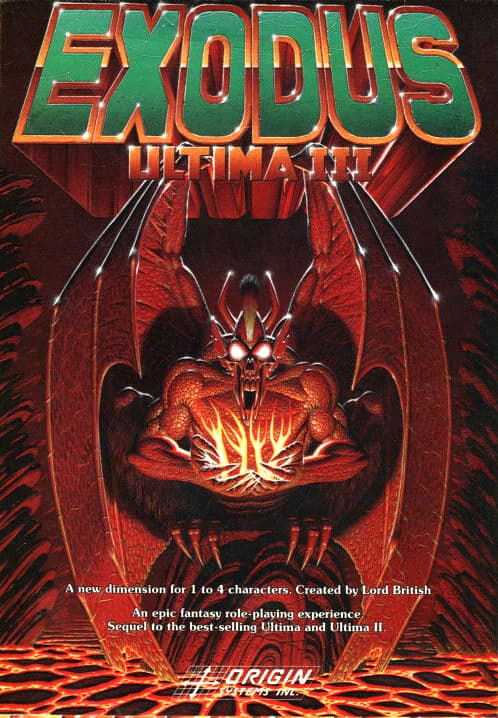
Building a party of four adventurers to hunt down the demonic offspring of Mondain and Minax, Ultima III: Exodus replaced the solitary lone hero format with tactical, party-based dungeon crawling.
Early computer games often struggled to represent a full party of adventurers. Before 1983, most role-playing games forced you to control a single lone warrior wandering a dangerous grid. Designer Richard Garriott, known to fans as Lord British, wanted to change that template by giving players control over an entire roster of heroes working together.
When the original game debuted on Apple II before moving to PC computers in 1985, it introduced a full creation system. You assemble four party members from five races, including Humans, Elves, Dwarves, Fuzzies, and Bobbits. Eleven distinct classes let you pair traditional Fighters and Wizards with specialized roles like the Lark, Illusionist, Alchemist, or Barbarian.
That balance of stats matters immediately. Every step across the fantasy landscape drains your food supply, and an improperly balanced party will starve long before reaching the first major dungeon. Balancing spellcasters who need magic points with heavy hitters who carry survival rations is the first real puzzle you face.
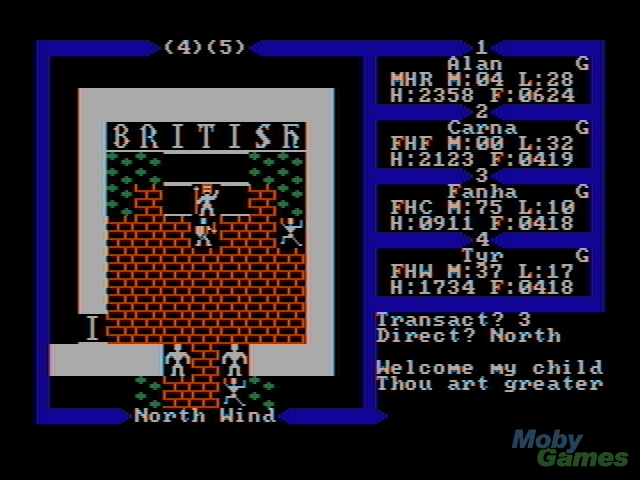
The world design mixes two distinct viewpoints to keep navigation clear. Outside in the open world, you travel across a top-down 2D scrolling map of Sosaria. You visit sprawling towns like Yew, talk to locals for clues, and seek out lost continents or hidden cities.
Dungeons drop you into a wireframe first-person 3D perspective. Stepping into the dark requires torches or magic spells to light up the corridors. Pushing forward means avoiding deadly traps built into treasure chests and solving puzzle elements hidden behind secret walls.
Combat shifts the view again to a dedicated tactical battlefield grid. When monsters attack on the overworld, the game switches to a turn-based tactical arena. You position each member individually, casting area-of-effect spells or firing arrows across the tile grid rather than simply watching text logs clear.
The early hours hit hard. Fresh characters possess minimal gold, basic weapons, and very little health. Low-level monsters can wipe out an unprepared party within three turns, forcing frequent reloads and heavy grinding just to buy basic gear.
To survive this early difficulty wall, long-time players discovered a notoriously cold-blooded strategy in the town of Yew. Unlike other settlements, Yew lacks city guards. Players frequently murder the local townspeople, gather their dropped loot, and step outside the town gate. Re-entering immediately respawns the citizens, creating an infinite supply of gold and experience.
If you play without resorting to murder rampages, you must study the physical manual carefully. The boxed release famously shipped with an ornate manual titled "Secrets of Sosaria" and a cloth map. Without reading the magic spells and item notes in that manual, knowing which command keys trigger specific actions is almost impossible.
While the design represented a massive step forward, the official port published by ORIGIN Systems, Inc. suffered from platform limitations. On IBM-compatible PCs, the game relies on four-color CGA visual modes. The stark magenta and cyan palettes make the wilderness look far harsher than it did on other microcomputers.
The lack of audio is the bigger disappointment. The original Apple II and Commodore 64 versions featured a full background soundtrack composed to set the mood in dungeons and towns. The MS-DOS port shipped completely silent, omitting background music entirely unless you install modern fan-made patches.
Timing issues also plague the unthrottled DOS executable. Running the game directly on faster PC processors causes the turn cycles to spin far too quickly, making overworld movement practically uncontrollable without slowdown utilities like DOSBox.
The interface is heavy and the learning curve is steep, but the core loop still hooks you. Tactical battle screens, open-world exploration, and party building set a template that defined computer role-playing for a decade. With so many races and classes to tweak, you can easily spend an hour just rolling a party before stepping into the first dungeon.
What plainly fails today is the clunky keystroke interface and the sheer volume of grinding required before your party becomes viable. Yet, taking a fresh party from helpless wanderers to dungeon conquerors delivers a genuine sense of achievement. Anyone interested in the origins of turn-based tactical games should spend an evening with it.
You can play Ultima III: Exodus online, free, right here in your browser, with nothing to install and no setup. Jump straight into party creation, pick your four heroes, and see how long you can survive the monsters of Sosaria.
Building a party of four adventurers to hunt down the demonic offspring of Mondain and Minax, Ultima III: Exodus replaced the solitary lone hero format with tactical, party-based dungeon crawling.
Early computer games often struggled to represent a full party of adventurers. Before 1983, most role-playing games forced you to control a single lone warrior wandering a dangerous grid. Designer Richard Garriott, known to fans as Lord British, wanted to change that template by giving players control over an entire roster of heroes working together.
When the original game debuted on Apple II before moving to PC computers in 1985, it introduced a full creation system. You assemble four party members from five races, including Humans, Elves, Dwarves, Fuzzies, and Bobbits. Eleven distinct classes let you pair traditional Fighters and Wizards with specialized roles like the Lark, Illusionist, Alchemist, or Barbarian.
That balance of stats matters immediately. Every step across the fantasy landscape drains your food supply, and an improperly balanced party will starve long before reaching the first major dungeon. Balancing spellcasters who need magic points with heavy hitters who carry survival rations is the first real puzzle you face.
The world design mixes two distinct viewpoints to keep navigation clear. Outside in the open world, you travel across a top-down 2D scrolling map of Sosaria. You visit sprawling towns like Yew, talk to locals for clues, and seek out lost continents or hidden cities.
Dungeons drop you into a wireframe first-person 3D perspective. Stepping into the dark requires torches or magic spells to light up the corridors. Pushing forward means avoiding deadly traps built into treasure chests and solving puzzle elements hidden behind secret walls.
Combat shifts the view again to a dedicated tactical battlefield grid. When monsters attack on the overworld, the game switches to a turn-based tactical arena. You position each member individually, casting area-of-effect spells or firing arrows across the tile grid rather than simply watching text logs clear.
The early hours hit hard. Fresh characters possess minimal gold, basic weapons, and very little health. Low-level monsters can wipe out an unprepared party within three turns, forcing frequent reloads and heavy grinding just to buy basic gear.
To survive this early difficulty wall, long-time players discovered a notoriously cold-blooded strategy in the town of Yew. Unlike other settlements, Yew lacks city guards. Players frequently murder the local townspeople, gather their dropped loot, and step outside the town gate. Re-entering immediately respawns the citizens, creating an infinite supply of gold and experience.
If you play without resorting to murder rampages, you must study the physical manual carefully. The boxed release famously shipped with an ornate manual titled "Secrets of Sosaria" and a cloth map. Without reading the magic spells and item notes in that manual, knowing which command keys trigger specific actions is almost impossible.
While the design represented a massive step forward, the official port published by ORIGIN Systems, Inc. suffered from platform limitations. On IBM-compatible PCs, the game relies on four-color CGA visual modes. The stark magenta and cyan palettes make the wilderness look far harsher than it did on other microcomputers.
The lack of audio is the bigger disappointment. The original Apple II and Commodore 64 versions featured a full background soundtrack composed to set the mood in dungeons and towns. The MS-DOS port shipped completely silent, omitting background music entirely unless you install modern fan-made patches.
Timing issues also plague the unthrottled DOS executable. Running the game directly on faster PC processors causes the turn cycles to spin far too quickly, making overworld movement practically uncontrollable without slowdown utilities like DOSBox.
The interface is heavy and the learning curve is steep, but the core loop still hooks you. Tactical battle screens, open-world exploration, and party building set a template that defined computer role-playing for a decade. With so many races and classes to tweak, you can easily spend an hour just rolling a party before stepping into the first dungeon.
What plainly fails today is the clunky keystroke interface and the sheer volume of grinding required before your party becomes viable. Yet, taking a fresh party from helpless wanderers to dungeon conquerors delivers a genuine sense of achievement. Anyone interested in the origins of turn-based tactical games should spend an evening with it.
You can play Ultima III: Exodus online, free, right here in your browser, with nothing to install and no setup. Jump straight into party creation, pick your four heroes, and see how long you can survive the monsters of Sosaria.
How Ultima III: Exodus is played — the keys the game listens to, grouped by what they do.
Highlighted keys are mapped — hover or tap one to see what it does.
Actions like Cast, Attack, or Transact prompt for additional directional or character inputs/typed text.
The on-screen keyboard and gamepad mapping the browser player uses on a phone, a tablet or a controller, as opposed to the real keys above. $PRO members make their own in the player and share them here; anyone can pick one to play with.
Cheat codes, console commands and memory pokes for Ultima III: Exodus — each one verified and attributed.
Sign in to submitHow Ultima III: Exodus is played — the keys the game listens to, grouped by what they do.
Highlighted keys are mapped — hover or tap one to see what it does.
Actions like Cast, Attack, or Transact prompt for additional directional or character inputs/typed text.
The on-screen keyboard and gamepad mapping the browser player uses on a phone, a tablet or a controller, as opposed to the real keys above. $PRO members make their own in the player and share them here; anyone can pick one to play with.
Cheat codes, console commands and memory pokes for Ultima III: Exodus — each one verified and attributed.
Sign in to submit