
You do not start Ultima IV: Quest of the Avatar by picking a character class from a stat table, but by sitting in a fortune teller's tent and answering ethical questions about truth, love, and courage.
Most games in the 1980s asked you to grow strong enough to murder a dark lord and loot his fortress. Designer Richard Garriott took a sharp left turn after receiving angry letters from parents about players stealing and murdering non-hostile NPCs in earlier titles. Instead of an evil overlord threatening Britannia, Lord British summons you to set a spiritual example for the entire realm.
To succeed, you must master eight separate virtues: Honesty, Compassion, Valor, Justice, Sacrifice, Honor, Spirituality, and Humility. The system monitors everything you do across the world map. If you rob a merchant, flee from a equal fight, or execute a surrendering monster, your virtue standing drops. You must actively give coin to beggars and uphold justice if you want to complete your quest.
That moral accounting turns basic exploration into a constant series of choices. You cannot simply loot every chest you find in a village because someone owns that gold. Stealing it damages your Honesty rating instantly. The goal is not collecting power for its own sake, but proving yourself worthy to enter the final chamber and claim the Codex of Ultimate Wisdom.
The core world map relies on a top-down view where you cross mountains, swamps, rivers, and ocean tiles. You manage a full party of companions recruited from towns across Britannia, representing different classes like Paladins, Bards, and Mages. Every step costs food, and if your rations hit zero, your party quickly starves to death. Managing your inventory is a constant pressure alongside combat.
Combat shifts to a tactical tile grid when hostiles attack. You trade turn-based attacks with orcs, trolls, skeletons, gazers, and sea serpents. Magic spells require a multi-step preparation process before you can cast them. You must find or buy specific reagents like Mandrake Root, Black Pearl, and Sulphurous Ash, then manually mix them in precise quantities for every single spell slot.
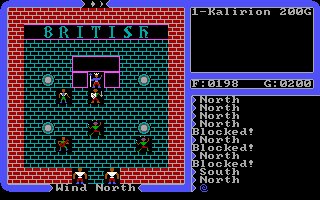
When fighting monsters, you have to be careful about how you end the battle. Taking down dragons and daemons is fine, but attacking an enemy that is retreating in fear will ruin your Valor score. The combat system enforces your spiritual goals even when you just want to clear the screen quickly.
The vision behind the system was bold, but playing the full campaign today reveals heavy mechanical friction. Keyboard controls require memorizing dozens of single-letter commands for almost every action. Pressing key combinations to search, talk, buy, or mix reagents grows tedious across a forty-hour campaign. Combat encounters spawn constantly on the overworld map, turning simple travel between cities into a slow crawl.
Spellcasting suffers the most from this strict design. Running out of a pre-mixed spell during a long fight means opening sub-menus to measure out reagents one by one. If you make a mistake in the recipe, the ingredients are wasted. Critics back in 1987 noted that this requirement turned spell management into pure busywork.
The unpatched Ultima IV: Quest of the Avatar MS-DOS game release also had a strange technical oversight. While other home computer ports had musical tracks, the original DOS version launched completely silent on internal PC speakers without supporting any sound cards. Community patches eventually fixed this by adding full music and improved visual color palettes.
To reach the ending, you must visit eight hidden shrines, learn secret runes, and recover key artifacts like the Bell of Courage, the Book of Truth, and the Candle of Love. Once you gather these items and prove your mastery over all eight virtues, the entrance to the Stygian Abyss opens. This subterranean dungeon contains eight brutal levels of monsters and environmental traps.
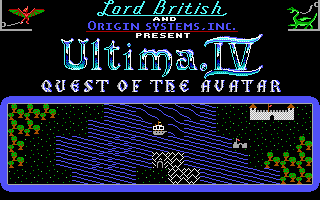
The Stygian Abyss hits unsuspecting players with a massive difficulty wall. The game disables saving entirely inside the final dungeon. A single bad combat turn or a bad resource management error at the bottom level forces you to restart the entire sequence from the surface. There is no final giant demon or boss monster waiting at the end, only a series of moral and philosophical tests based on your knowledge of the virtues.
Even with its awkward command keys and aggressive random encounters, this game reshaped Role-playing (RPG) development. ORIGIN Systems, Inc. created a world where your behavior mattered more than your sword's damage output. Computer Gaming World readers originally rated it 7.80 out of 10, praising its radical decision to focus on character ethics rather than simple dungeon crawling.
If you enjoy classic computer role-playing history, this release rewards careful note-taking and thoughtful play. You can play Ultima IV: Quest of the Avatar free in your browser right now without downloading floppy disk images or wrestling with DOS emulation scripts. Take your time during the opening gypsy quiz, keep a notebook ready for keyword clues from townspeople, and keep extra food in your pack before setting out across Britannia.
You do not start Ultima IV: Quest of the Avatar by picking a character class from a stat table, but by sitting in a fortune teller's tent and answering ethical questions about truth, love, and courage.
Most games in the 1980s asked you to grow strong enough to murder a dark lord and loot his fortress. Designer Richard Garriott took a sharp left turn after receiving angry letters from parents about players stealing and murdering non-hostile NPCs in earlier titles. Instead of an evil overlord threatening Britannia, Lord British summons you to set a spiritual example for the entire realm.
To succeed, you must master eight separate virtues: Honesty, Compassion, Valor, Justice, Sacrifice, Honor, Spirituality, and Humility. The system monitors everything you do across the world map. If you rob a merchant, flee from a equal fight, or execute a surrendering monster, your virtue standing drops. You must actively give coin to beggars and uphold justice if you want to complete your quest.
That moral accounting turns basic exploration into a constant series of choices. You cannot simply loot every chest you find in a village because someone owns that gold. Stealing it damages your Honesty rating instantly. The goal is not collecting power for its own sake, but proving yourself worthy to enter the final chamber and claim the Codex of Ultimate Wisdom.
The core world map relies on a top-down view where you cross mountains, swamps, rivers, and ocean tiles. You manage a full party of companions recruited from towns across Britannia, representing different classes like Paladins, Bards, and Mages. Every step costs food, and if your rations hit zero, your party quickly starves to death. Managing your inventory is a constant pressure alongside combat.
Combat shifts to a tactical tile grid when hostiles attack. You trade turn-based attacks with orcs, trolls, skeletons, gazers, and sea serpents. Magic spells require a multi-step preparation process before you can cast them. You must find or buy specific reagents like Mandrake Root, Black Pearl, and Sulphurous Ash, then manually mix them in precise quantities for every single spell slot.
When fighting monsters, you have to be careful about how you end the battle. Taking down dragons and daemons is fine, but attacking an enemy that is retreating in fear will ruin your Valor score. The combat system enforces your spiritual goals even when you just want to clear the screen quickly.
The vision behind the system was bold, but playing the full campaign today reveals heavy mechanical friction. Keyboard controls require memorizing dozens of single-letter commands for almost every action. Pressing key combinations to search, talk, buy, or mix reagents grows tedious across a forty-hour campaign. Combat encounters spawn constantly on the overworld map, turning simple travel between cities into a slow crawl.
Spellcasting suffers the most from this strict design. Running out of a pre-mixed spell during a long fight means opening sub-menus to measure out reagents one by one. If you make a mistake in the recipe, the ingredients are wasted. Critics back in 1987 noted that this requirement turned spell management into pure busywork.
The unpatched Ultima IV: Quest of the Avatar MS-DOS game release also had a strange technical oversight. While other home computer ports had musical tracks, the original DOS version launched completely silent on internal PC speakers without supporting any sound cards. Community patches eventually fixed this by adding full music and improved visual color palettes.
To reach the ending, you must visit eight hidden shrines, learn secret runes, and recover key artifacts like the Bell of Courage, the Book of Truth, and the Candle of Love. Once you gather these items and prove your mastery over all eight virtues, the entrance to the Stygian Abyss opens. This subterranean dungeon contains eight brutal levels of monsters and environmental traps.
The Stygian Abyss hits unsuspecting players with a massive difficulty wall. The game disables saving entirely inside the final dungeon. A single bad combat turn or a bad resource management error at the bottom level forces you to restart the entire sequence from the surface. There is no final giant demon or boss monster waiting at the end, only a series of moral and philosophical tests based on your knowledge of the virtues.
Even with its awkward command keys and aggressive random encounters, this game reshaped Role-playing (RPG) development. ORIGIN Systems, Inc. created a world where your behavior mattered more than your sword's damage output. Computer Gaming World readers originally rated it 7.80 out of 10, praising its radical decision to focus on character ethics rather than simple dungeon crawling.
If you enjoy classic computer role-playing history, this release rewards careful note-taking and thoughtful play. You can play Ultima IV: Quest of the Avatar free in your browser right now without downloading floppy disk images or wrestling with DOS emulation scripts. Take your time during the opening gypsy quiz, keep a notebook ready for keyword clues from townspeople, and keep extra food in your pack before setting out across Britannia.
How Ultima IV: Quest of the Avatar is played — the keys the game listens to, grouped by what they do.
Highlighted keys are mapped — hover or tap one to see what it does.
Game relies solely on keyboard input. Execute 'ULTIMA' to start or 'ULTIMA C' for CGA mode.
The on-screen keyboard and gamepad mapping the browser player uses on a phone, a tablet or a controller, as opposed to the real keys above. $PRO members make their own in the player and share them here; anyone can pick one to play with.
Cheat codes, console commands and memory pokes for Ultima IV: Quest of the Avatar — each one verified and attributed.
Sign in to submitHow Ultima IV: Quest of the Avatar is played — the keys the game listens to, grouped by what they do.
Highlighted keys are mapped — hover or tap one to see what it does.
Game relies solely on keyboard input. Execute 'ULTIMA' to start or 'ULTIMA C' for CGA mode.
The on-screen keyboard and gamepad mapping the browser player uses on a phone, a tablet or a controller, as opposed to the real keys above. $PRO members make their own in the player and share them here; anyone can pick one to play with.
Cheat codes, console commands and memory pokes for Ultima IV: Quest of the Avatar — each one verified and attributed.
Sign in to submit