
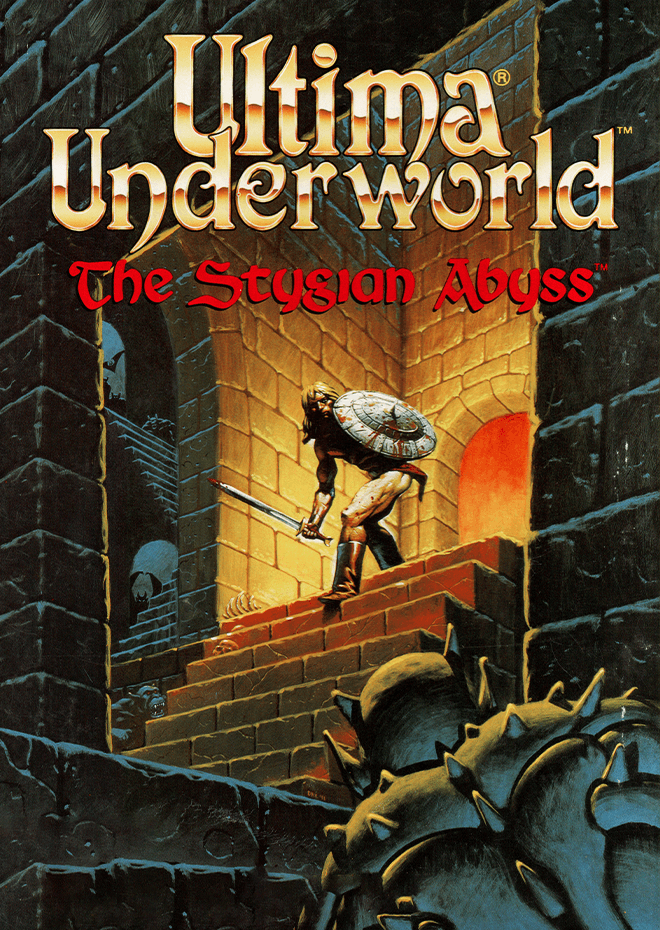

When you start Ultima Underworld: The Stygian Abyss, Baron Almric throws you straight into an eight-floor pit of darkness for a crime you did not commit. You either figure out how to swim, jump, and spellcast your way through a living dungeon, or you die alone in the dark.
Before this title appeared, first-person dungeon crawls locked you onto a rigid grid. Games like Dungeon Master or Eye of the Beholder moved your vision in ninety-degree snaps from frame to static frame. Designer Paul Neurath and programmer Doug Church at Blue Sky Productions threw out that entire paradigm. They built a custom engine that calculated sloped floors, distinct surface heights, variable light levels, and full three-axis motion before Doom was ever shown to the public.
Producer Warren Spector and publisher ORIGIN Systems, Inc. took a enormous gamble on this technology, and it fundamentally shifted how players interacted with virtual spaces. When you step up to a ledge in the Abyss, you do not just tilt forward into a flat visual slice. You pitch your viewport down to inspect the stone drops below, leap across chasms, or drop into water channels to swim against the current. It turns the dungeon into an actual environment with physical consequences rather than a maze of flat graphic wallpaper.
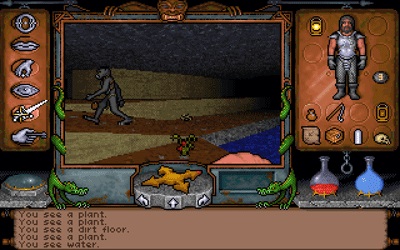
The campaign casts you as the Avatar, framed for kidnapping Baron Almric's daughter Eleanor. To clear your name, you are banished into the Great Stygian Abyss, a multi-tiered subterranean ruin that once housed an ambitious utopia founded by Sir Cabirus. The colony failed long ago, leaving behind isolated factions of goblins, outcasts, headless horrors, giant spiders, and skeletons roaming the dark. Your ultimate target is the demon boss known as the Slasher of Veils, but reaching that entity requires systematically solving the dungeon's civil and physical hurdles.
Exploration in this role-playing RPG balances strict resource maintenance against open-ended puzzle solving. Your equipment degrades as you strike monsters or take hits, torches slowly burn out, and your character suffers from hunger and fatigue. Throwing an ear of corn near a lighting source or holding it over an open flame turns it into popcorn, a small detail that illustrates how thoroughly the game treats its world as a physical sandbox. Success demands collecting the eight Talismans of Sir Cabirus, repairing a shattered blade, arranging rune stones to formulate custom spells, and even burying the bones of the ghost Garamon to speak with his spirit.
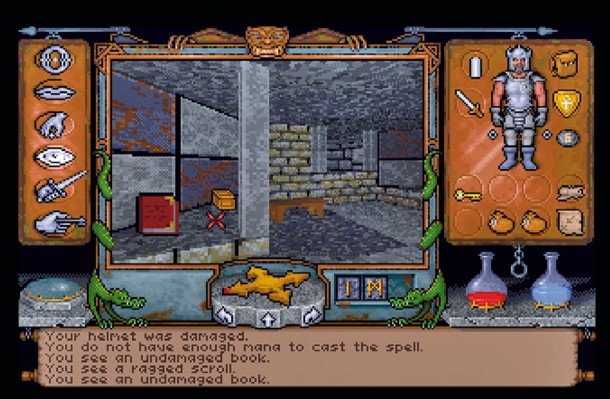
Combat runs in real time directly inside the central viewport. You draw your weapon, move the cursor over the viewing screen, and click to swing, with the position of your click determining whether you execute a thrust, slash, or overhead chop. Magic requires slotting literal stone runes into your active pouch; combining the correct glyphs creates light, levitation, or offensive fire. If you miss a key combination or misread a quest hint, you can easily end up stranded on a lower floor without food or light, forced to trade scrap metal to neutral goblins just to buy a fresh torch.
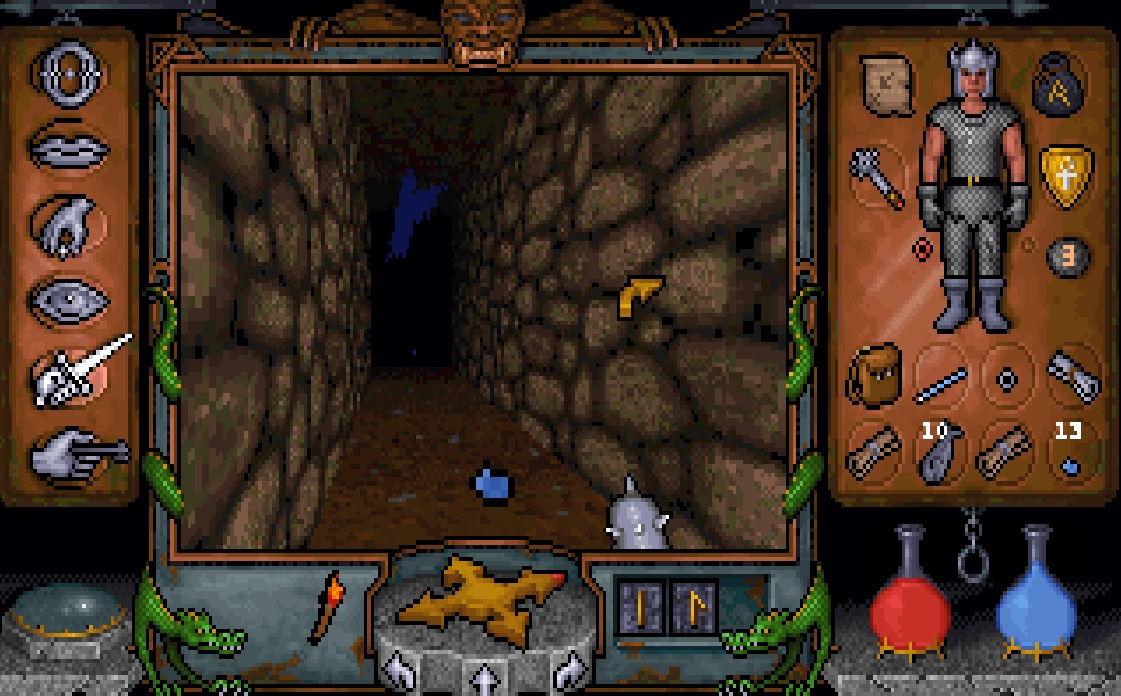
The sheer ambition of the tech stack created immediate friction on home PCs in 1992. To achieve smooth frame rates while calculating texture maps, slopes, and dynamic lighting, the developers shrunk the active 3D viewing screen to a small box in the center of your monitor. The rest of the screen area is taken up by a massive slate interface housing your inventory paper doll, active spell runes, compass, and health flasks. On a 386 processor, running the game in full detail was a brutal test that pushed hardware to its absolute limit.
The control scheme is another wall that modern players bump into immediately. Movement relied heavily on mouse drags inside the view window or arrow keys on the keyboard, long before standard WASD layouts or modern dual-analog mouselook existed. Turning your character feels slow, and swinging a weapon while trying to backpedal out of a spider's poison reach takes real physical practice. Yet the audio design gave those struggles immense atmosphere, especially if you had a Roland MT-32 or Sound Blaster card playing the low, rumbling ambient tracks that echoed through the stone halls.
Despite those hardware demands, critical acclaim was overwhelming upon release. Advanced Computer Entertainment scored it 938 out of 1000, and Computer Gaming World named it their Role-Playing Game of the Year. It eventually sold nearly 500,000 copies, proving that players were willing to struggle through tough controls and heavy hardware requirements if it meant stepping into an uncompromising, fully realized world.
To enjoy this classic now, you do not need to hunt down ancient 386 hardware or spent hours configuring autoexec files. You can play Ultima Underworld: The Stygian Abyss online, free in your browser right here. It loads directly into your window with no extra setup, allowing you to experience the deep mechanics and dense dungeon atmosphere in seconds.
When you start your first run, remember that modern FPS movement habits will get you killed early. Take a moment to adjust your mouse cursor inside the view window for fine aiming, keep a close eye on your torch meter, and start taking notes on the auto-map screen as soon as you find your first key. You can jump straight into this MS-DOS game and see how deep the abyss really goes.
When you start Ultima Underworld: The Stygian Abyss, Baron Almric throws you straight into an eight-floor pit of darkness for a crime you did not commit. You either figure out how to swim, jump, and spellcast your way through a living dungeon, or you die alone in the dark.
Before this title appeared, first-person dungeon crawls locked you onto a rigid grid. Games like Dungeon Master or Eye of the Beholder moved your vision in ninety-degree snaps from frame to static frame. Designer Paul Neurath and programmer Doug Church at Blue Sky Productions threw out that entire paradigm. They built a custom engine that calculated sloped floors, distinct surface heights, variable light levels, and full three-axis motion before Doom was ever shown to the public.
Producer Warren Spector and publisher ORIGIN Systems, Inc. took a enormous gamble on this technology, and it fundamentally shifted how players interacted with virtual spaces. When you step up to a ledge in the Abyss, you do not just tilt forward into a flat visual slice. You pitch your viewport down to inspect the stone drops below, leap across chasms, or drop into water channels to swim against the current. It turns the dungeon into an actual environment with physical consequences rather than a maze of flat graphic wallpaper.

The campaign casts you as the Avatar, framed for kidnapping Baron Almric's daughter Eleanor. To clear your name, you are banished into the Great Stygian Abyss, a multi-tiered subterranean ruin that once housed an ambitious utopia founded by Sir Cabirus. The colony failed long ago, leaving behind isolated factions of goblins, outcasts, headless horrors, giant spiders, and skeletons roaming the dark. Your ultimate target is the demon boss known as the Slasher of Veils, but reaching that entity requires systematically solving the dungeon's civil and physical hurdles.
Exploration in this role-playing RPG balances strict resource maintenance against open-ended puzzle solving. Your equipment degrades as you strike monsters or take hits, torches slowly burn out, and your character suffers from hunger and fatigue. Throwing an ear of corn near a lighting source or holding it over an open flame turns it into popcorn, a small detail that illustrates how thoroughly the game treats its world as a physical sandbox. Success demands collecting the eight Talismans of Sir Cabirus, repairing a shattered blade, arranging rune stones to formulate custom spells, and even burying the bones of the ghost Garamon to speak with his spirit.

Combat runs in real time directly inside the central viewport. You draw your weapon, move the cursor over the viewing screen, and click to swing, with the position of your click determining whether you execute a thrust, slash, or overhead chop. Magic requires slotting literal stone runes into your active pouch; combining the correct glyphs creates light, levitation, or offensive fire. If you miss a key combination or misread a quest hint, you can easily end up stranded on a lower floor without food or light, forced to trade scrap metal to neutral goblins just to buy a fresh torch.

The sheer ambition of the tech stack created immediate friction on home PCs in 1992. To achieve smooth frame rates while calculating texture maps, slopes, and dynamic lighting, the developers shrunk the active 3D viewing screen to a small box in the center of your monitor. The rest of the screen area is taken up by a massive slate interface housing your inventory paper doll, active spell runes, compass, and health flasks. On a 386 processor, running the game in full detail was a brutal test that pushed hardware to its absolute limit.
The control scheme is another wall that modern players bump into immediately. Movement relied heavily on mouse drags inside the view window or arrow keys on the keyboard, long before standard WASD layouts or modern dual-analog mouselook existed. Turning your character feels slow, and swinging a weapon while trying to backpedal out of a spider's poison reach takes real physical practice. Yet the audio design gave those struggles immense atmosphere, especially if you had a Roland MT-32 or Sound Blaster card playing the low, rumbling ambient tracks that echoed through the stone halls.
Despite those hardware demands, critical acclaim was overwhelming upon release. Advanced Computer Entertainment scored it 938 out of 1000, and Computer Gaming World named it their Role-Playing Game of the Year. It eventually sold nearly 500,000 copies, proving that players were willing to struggle through tough controls and heavy hardware requirements if it meant stepping into an uncompromising, fully realized world.
To enjoy this classic now, you do not need to hunt down ancient 386 hardware or spent hours configuring autoexec files. You can play Ultima Underworld: The Stygian Abyss online, free in your browser right here. It loads directly into your window with no extra setup, allowing you to experience the deep mechanics and dense dungeon atmosphere in seconds.
When you start your first run, remember that modern FPS movement habits will get you killed early. Take a moment to adjust your mouse cursor inside the view window for fine aiming, keep a close eye on your torch meter, and start taking notes on the auto-map screen as soon as you find your first key. You can jump straight into this MS-DOS game and see how deep the abyss really goes.
How Ultima Underworld: The Stygian Abyss is played — the keys the game listens to, grouped by what they do.
Highlighted keys are mapped — hover or tap one to see what it does.
Hotkeys cannot be rebound. Type UW to start play from DOS.
The on-screen keyboard and gamepad mapping the browser player uses on a phone, a tablet or a controller, as opposed to the real keys above. $PRO members make their own in the player and share them here; anyone can pick one to play with.
Cheat codes, console commands and memory pokes for Ultima Underworld: The Stygian Abyss — each one verified and attributed.
Sign in to submitHow Ultima Underworld: The Stygian Abyss is played — the keys the game listens to, grouped by what they do.
Highlighted keys are mapped — hover or tap one to see what it does.
Hotkeys cannot be rebound. Type UW to start play from DOS.
The on-screen keyboard and gamepad mapping the browser player uses on a phone, a tablet or a controller, as opposed to the real keys above. $PRO members make their own in the player and share them here; anyone can pick one to play with.
Cheat codes, console commands and memory pokes for Ultima Underworld: The Stygian Abyss — each one verified and attributed.
Sign in to submit