


Stepping onto the newly risen Isle of Fire in Ultima VII: The Black Gate + Forge of Virtue immediately shows how far ORIGIN Systems pushed PC hardware, pairing an unmatched virtual world with demands that famously made hard drives scream.
The moment you board the vessel to the Isle of Fire, the scale of this 1992 expansion becomes clear. Lord British and lead designer Richard Garriott built an add-on that does not merely offer extra monster corridors. It anchors itself into the core narrative of Britannia, sending the Avatar through three distinct trials at the Shrines of Truth, Love, and Courage to destroy the Dark Core of Exodus.
You meet the enigmatic mage Erethian, whose dialogue, penned by lead writer Raymond Benson, guides your quest to forge the Black Sword. Along the way, the dark tunnel within the Test of Truth presents a brutal environmental puzzle, forcing you to spot invisible fire paths across pitch-black stone. It was a steep challenge for players without access to hint books or magazine walk-throughs.
Completing these trials bestows the ultimate power fantasy. Your Strength, Intelligence, and Dexterity jump to maximum stats of 30, and you gain the Black Sword itself. Housing a bound daemon, the weapon lets you invoke outright instant kills against almost any foe in Britannia, effectively turning late-game encounters into a victory lap.
While the addition of the sword gets the headlines, long-time players often remember a far smaller metal ring with equal reverence. ORIGIN Systems, Inc. introduced the key chain item in this package, single-handedly solving the base game's most maddening design flaw. Instead of cluttering your backpack with dozens of loose keys that vanished into inventory sub-containers, every key could finally be organized in one place.
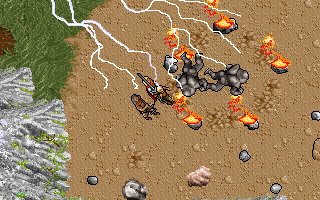
That inventory cleanup was desperately needed because managing your party in real-time combat remains notoriously chaotic. Abandoning the turn-based tactical grid of earlier entries, lead programmer Ken Demarest III implemented an automated real-time combat system. You set broad behavioral stances for your party, press the battle toggle, and watch your companions fight on autopilot while you manage items on the fly.
The real-time chaos leads to frequent friendly fire incidents and lost items, compounded by early DOS memory quirks where loose items on the ground could occasionally vanish. Yet despite the mess, watching NPCs go to sleep on schedule, cook bread, and manage day-night routines gave Britannia a living texture that few contemporary RPGs could touch.
To draw inventory windows directly onto full-screen tile graphics without loading screens, ORIGIN created the custom "Voodoo" Memory Manager. This software workaround bypassed standard DOS 640KB RAM bounds, but it created immense setup headaches. Trying to run the original disk on standard DOS setups without custom boot disks frequently led to total system locks or memory conflicts.
The original 1992 release was notoriously hard drive intensive, causing disk heads to thrash constantly as the game streamed data into memory. Reviewers at the time, such as French gaming magazine Tilt (which rated the release 19/20) and PC Games (scoring it 91%), praised the astonishing depth while noting the heavy system requirements and the steep retail price for what was a brief adventure if you had already finished the main quest.
In later years, fan projects like the Exult source port emerged to make running the game straightforward on modern systems, introducing modern inventory paper-dolls and fixing disappearing items. But back on real hardware, getting the game configured properly felt like a puzzle equal to anything inside the Shrine of Truth.
Evaluating this release today requires separating its unmatched world building from its odd mechanical decisions. The real-time combat is an unpredictable brawl, and players who prefer tight tactical control will find themselves frustrated by companions charging headlong into hazards. Furthermore, picking up this release after finishing the main storyline highlights how brief the Isle of Fire content is on its own.
What remains magnificent is the sheer density of interaction. The ability to pick up virtually any object, combine ingredients, follow NPC daily routines, and solve complex environmental riddles makes Britannia feel real in a way that modern high-definition titles rarely duplicate. This add-on established the structural blueprint for modern expansion packs, offering a concentrated dose of high-tier loot and deep lore.
Anyone who enjoys classic computer role-playing games ought to spend an evening exploring the Isle of Fire. The combination of high-stakes puzzles, rich narrative dialogue, and incredible power progression makes it an absolute high point for early nineties PC gaming.
If you want to experience this landmark RPG without wrestling with custom boot disks or memory managers, you can play Ultima VII: The Black Gate + Forge of Virtue online right now. You can run this full Ultima VII: The Black Gate + Forge of Virtue MS-DOS game free in your browser with zero installation needed.
When you start your session, board the boat to the Isle of Fire as soon as you are able, speak with Erethian, and head straight for the Shrine of Truth to experience the dark tunnel puzzle firsthand. You will instantly see why players spent decades talking about the key chain item and the Black Sword.
Stepping onto the newly risen Isle of Fire in Ultima VII: The Black Gate + Forge of Virtue immediately shows how far ORIGIN Systems pushed PC hardware, pairing an unmatched virtual world with demands that famously made hard drives scream.
The moment you board the vessel to the Isle of Fire, the scale of this 1992 expansion becomes clear. Lord British and lead designer Richard Garriott built an add-on that does not merely offer extra monster corridors. It anchors itself into the core narrative of Britannia, sending the Avatar through three distinct trials at the Shrines of Truth, Love, and Courage to destroy the Dark Core of Exodus.
You meet the enigmatic mage Erethian, whose dialogue, penned by lead writer Raymond Benson, guides your quest to forge the Black Sword. Along the way, the dark tunnel within the Test of Truth presents a brutal environmental puzzle, forcing you to spot invisible fire paths across pitch-black stone. It was a steep challenge for players without access to hint books or magazine walk-throughs.
Completing these trials bestows the ultimate power fantasy. Your Strength, Intelligence, and Dexterity jump to maximum stats of 30, and you gain the Black Sword itself. Housing a bound daemon, the weapon lets you invoke outright instant kills against almost any foe in Britannia, effectively turning late-game encounters into a victory lap.
While the addition of the sword gets the headlines, long-time players often remember a far smaller metal ring with equal reverence. ORIGIN Systems, Inc. introduced the key chain item in this package, single-handedly solving the base game's most maddening design flaw. Instead of cluttering your backpack with dozens of loose keys that vanished into inventory sub-containers, every key could finally be organized in one place.
That inventory cleanup was desperately needed because managing your party in real-time combat remains notoriously chaotic. Abandoning the turn-based tactical grid of earlier entries, lead programmer Ken Demarest III implemented an automated real-time combat system. You set broad behavioral stances for your party, press the battle toggle, and watch your companions fight on autopilot while you manage items on the fly.
The real-time chaos leads to frequent friendly fire incidents and lost items, compounded by early DOS memory quirks where loose items on the ground could occasionally vanish. Yet despite the mess, watching NPCs go to sleep on schedule, cook bread, and manage day-night routines gave Britannia a living texture that few contemporary RPGs could touch.
To draw inventory windows directly onto full-screen tile graphics without loading screens, ORIGIN created the custom "Voodoo" Memory Manager. This software workaround bypassed standard DOS 640KB RAM bounds, but it created immense setup headaches. Trying to run the original disk on standard DOS setups without custom boot disks frequently led to total system locks or memory conflicts.
The original 1992 release was notoriously hard drive intensive, causing disk heads to thrash constantly as the game streamed data into memory. Reviewers at the time, such as French gaming magazine Tilt (which rated the release 19/20) and PC Games (scoring it 91%), praised the astonishing depth while noting the heavy system requirements and the steep retail price for what was a brief adventure if you had already finished the main quest.
In later years, fan projects like the Exult source port emerged to make running the game straightforward on modern systems, introducing modern inventory paper-dolls and fixing disappearing items. But back on real hardware, getting the game configured properly felt like a puzzle equal to anything inside the Shrine of Truth.
Evaluating this release today requires separating its unmatched world building from its odd mechanical decisions. The real-time combat is an unpredictable brawl, and players who prefer tight tactical control will find themselves frustrated by companions charging headlong into hazards. Furthermore, picking up this release after finishing the main storyline highlights how brief the Isle of Fire content is on its own.
What remains magnificent is the sheer density of interaction. The ability to pick up virtually any object, combine ingredients, follow NPC daily routines, and solve complex environmental riddles makes Britannia feel real in a way that modern high-definition titles rarely duplicate. This add-on established the structural blueprint for modern expansion packs, offering a concentrated dose of high-tier loot and deep lore.
Anyone who enjoys classic computer role-playing games ought to spend an evening exploring the Isle of Fire. The combination of high-stakes puzzles, rich narrative dialogue, and incredible power progression makes it an absolute high point for early nineties PC gaming.
If you want to experience this landmark RPG without wrestling with custom boot disks or memory managers, you can play Ultima VII: The Black Gate + Forge of Virtue online right now. You can run this full Ultima VII: The Black Gate + Forge of Virtue MS-DOS game free in your browser with zero installation needed.
When you start your session, board the boat to the Isle of Fire as soon as you are able, speak with Erethian, and head straight for the Shrine of Truth to experience the dark tunnel puzzle firsthand. You will instantly see why players spent decades talking about the key chain item and the Black Sword.
How Ultima VII: The Black Gate + Forge of Virtue is played — the keys the game listens to, grouped by what they do.
Highlighted keys are mapped — hover or tap one to see what it does.
The on-screen keyboard and gamepad mapping the browser player uses on a phone, a tablet or a controller, as opposed to the real keys above. $PRO members make their own in the player and share them here; anyone can pick one to play with.
Cheat codes, console commands and memory pokes for Ultima VII: The Black Gate + Forge of Virtue — each one verified and attributed.
Sign in to submitHow Ultima VII: The Black Gate + Forge of Virtue is played — the keys the game listens to, grouped by what they do.
Highlighted keys are mapped — hover or tap one to see what it does.
The on-screen keyboard and gamepad mapping the browser player uses on a phone, a tablet or a controller, as opposed to the real keys above. $PRO members make their own in the player and share them here; anyone can pick one to play with.
Cheat codes, console commands and memory pokes for Ultima VII: The Black Gate + Forge of Virtue — each one verified and attributed.
Sign in to submit