

Stripped of your usual companions and tossed onto a dark, executioner-obsessed coast, Ultima VIII: Pagan abandons the cozy party dynamics of Britannia for solitary survival and punishing isometric dexterity checks.
You start stranded on a cold shore in the land of Pagan, ripped away from Britannia by the Guardian and left completely alone. Within minutes of wandering into the city of Tenebrae, you watch a man lose his head at the guillotine, establishing right away why this became the first entry in the series to earn a Mature rating in North America.
Unlike earlier titles where you managed an entire party, this trip is a strictly solo affair. You wander through murky streets and dark catacombs, talking to sullen locals and trying to figure out how to steal power from the four local elemental Titans so you can find a way back home.
The new 320x200 VGA isometric engine brought smooth character animation, but it also forced a heavy shift toward real-time action. Instead of pure turn-based or tactical planning, you spend hours lining up the Avatar to hop across tiny stone pedestals suspended over instant-death water.
At launch, calculating those jumps was an absolute nightmare. Input lag and awkward mouse controls meant a double-click could send your hero plunging straight into a lake, forcing players to reload a save file. The platforming was so notoriously fussy that fans mocked the game as "Super Mario Avatar" or "Super Avatar Bros." until ORIGIN Systems, Inc. released a patch that automated most jumps.
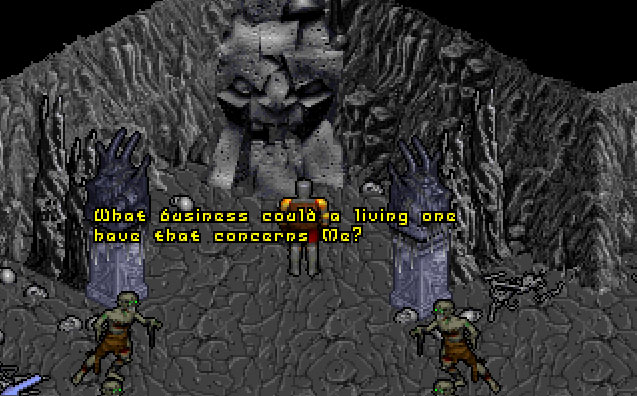
Combat relies on swinging swords or hammers in real time, but the response time feels sluggish. Enemies hit hard, and recovery animations often leave you vulnerable while trying to turn around in tight catacomb corridors.
Magic offers real variety across different schools like Necromancy, Sorcery, and Thaumaturgy, but casting spells demands extreme patience. Sorcery in particular requires you to place specific reagents and candles on the floor in precise geometric patterns before lighting them with a pumice stone, a tedious ritual when all you wanted was a quick fireball.
On original 1994 hardware, storing all those item positions across massive world zones created huge save files. Saving your game meant sitting through long disk writes on a typical 486 processor, making every jump attempt over a pit even more nerve-wracking.
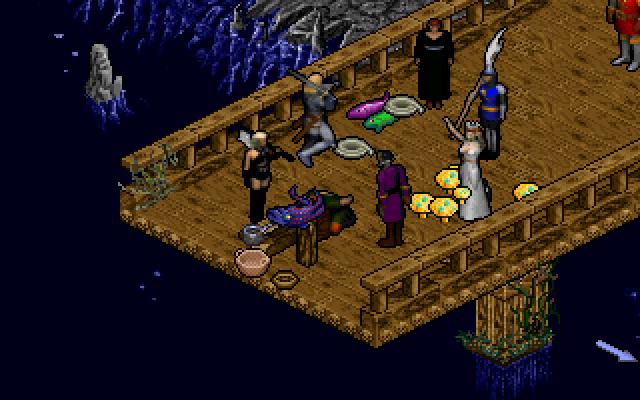
Publisher pressure forced director Mike McShaffry and lead programmer Tony Zurovec to ship before everything was ready. Whole story arcs were trimmed, leaving the narrative noticeably shorter and more linear than Ultima VII, culminating in an ending that felt unexpectedly abrupt.
An entire expansion pack named The Lost Vale was fully coded and written, complete with new areas and quests, but it was cancelled right before duplication and its assets vanished over time. What did make it out was an optional Speech Pack add-on, giving spoken voices to the Guardian and the elemental Titans over native Sound Blaster and Roland General MIDI setups.
Developers left their own strange marks in the game files too. Deep inside the assets sits a plain text file named spot, containing lead programmer Rob Corell's surreal short story about penguins living in Texas. If you want to check out this controversial chapter among Role-playing (RPG) games from 1994, playing this Ultima VIII: Pagan MS-DOS game reveals a fascinating turning point in ORIGIN's history, as detailed on its Wikipedia documentation.
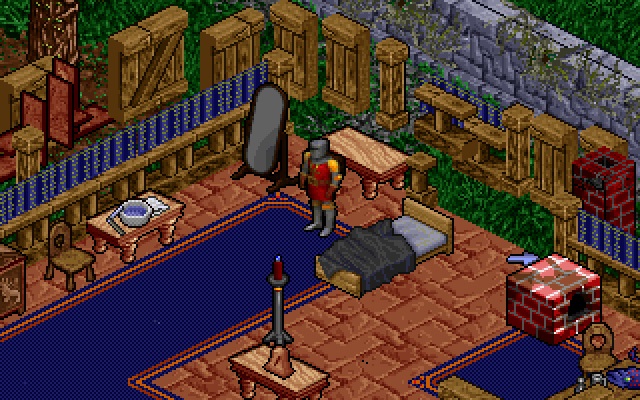
While long-time fans initially bounced off the arcade platforming and linear structure, there is a distinct, gloomy mood to Pagan's world and audio design that still draws players back today. It proved to be an ambitious experiment that pushed PC hardware to its limits, offering a darker fantasy experience than almost anything else from its year.
You can play Ultima VIII: Pagan online right now, running the complete experience with speech enabled free in your browser. Navigating the treacherous catacombs and mastering ritual magic takes only a moment to begin, with nothing to install and no extra setup required to start your exile in the land of Pagan.
Stripped of your usual companions and tossed onto a dark, executioner-obsessed coast, Ultima VIII: Pagan abandons the cozy party dynamics of Britannia for solitary survival and punishing isometric dexterity checks.
You start stranded on a cold shore in the land of Pagan, ripped away from Britannia by the Guardian and left completely alone. Within minutes of wandering into the city of Tenebrae, you watch a man lose his head at the guillotine, establishing right away why this became the first entry in the series to earn a Mature rating in North America.
Unlike earlier titles where you managed an entire party, this trip is a strictly solo affair. You wander through murky streets and dark catacombs, talking to sullen locals and trying to figure out how to steal power from the four local elemental Titans so you can find a way back home.
The new 320x200 VGA isometric engine brought smooth character animation, but it also forced a heavy shift toward real-time action. Instead of pure turn-based or tactical planning, you spend hours lining up the Avatar to hop across tiny stone pedestals suspended over instant-death water.
At launch, calculating those jumps was an absolute nightmare. Input lag and awkward mouse controls meant a double-click could send your hero plunging straight into a lake, forcing players to reload a save file. The platforming was so notoriously fussy that fans mocked the game as "Super Mario Avatar" or "Super Avatar Bros." until ORIGIN Systems, Inc. released a patch that automated most jumps.

Combat relies on swinging swords or hammers in real time, but the response time feels sluggish. Enemies hit hard, and recovery animations often leave you vulnerable while trying to turn around in tight catacomb corridors.
Magic offers real variety across different schools like Necromancy, Sorcery, and Thaumaturgy, but casting spells demands extreme patience. Sorcery in particular requires you to place specific reagents and candles on the floor in precise geometric patterns before lighting them with a pumice stone, a tedious ritual when all you wanted was a quick fireball.
On original 1994 hardware, storing all those item positions across massive world zones created huge save files. Saving your game meant sitting through long disk writes on a typical 486 processor, making every jump attempt over a pit even more nerve-wracking.

Publisher pressure forced director Mike McShaffry and lead programmer Tony Zurovec to ship before everything was ready. Whole story arcs were trimmed, leaving the narrative noticeably shorter and more linear than Ultima VII, culminating in an ending that felt unexpectedly abrupt.
An entire expansion pack named The Lost Vale was fully coded and written, complete with new areas and quests, but it was cancelled right before duplication and its assets vanished over time. What did make it out was an optional Speech Pack add-on, giving spoken voices to the Guardian and the elemental Titans over native Sound Blaster and Roland General MIDI setups.
Developers left their own strange marks in the game files too. Deep inside the assets sits a plain text file named spot, containing lead programmer Rob Corell's surreal short story about penguins living in Texas. If you want to check out this controversial chapter among Role-playing (RPG) games from 1994, playing this Ultima VIII: Pagan MS-DOS game reveals a fascinating turning point in ORIGIN's history, as detailed on its Wikipedia documentation.

While long-time fans initially bounced off the arcade platforming and linear structure, there is a distinct, gloomy mood to Pagan's world and audio design that still draws players back today. It proved to be an ambitious experiment that pushed PC hardware to its limits, offering a darker fantasy experience than almost anything else from its year.
You can play Ultima VIII: Pagan online right now, running the complete experience with speech enabled free in your browser. Navigating the treacherous catacombs and mastering ritual magic takes only a moment to begin, with nothing to install and no extra setup required to start your exile in the land of Pagan.
How Ultima VIII: Pagan is played — the keys the game listens to, grouped by what they do.
Highlighted keys are mapped — hover or tap one to see what it does.
Keyboard movement key listings are omitted in primary documentation as the game mainly relies on mouse control. Some shortcut keys require the patched version.
The on-screen keyboard and gamepad mapping the browser player uses on a phone, a tablet or a controller, as opposed to the real keys above. $PRO members make their own in the player and share them here; anyone can pick one to play with.
Cheat codes, console commands and memory pokes for Ultima VIII: Pagan — each one verified and attributed.
Sign in to submitHow Ultima VIII: Pagan is played — the keys the game listens to, grouped by what they do.
Highlighted keys are mapped — hover or tap one to see what it does.
Keyboard movement key listings are omitted in primary documentation as the game mainly relies on mouse control. Some shortcut keys require the patched version.
The on-screen keyboard and gamepad mapping the browser player uses on a phone, a tablet or a controller, as opposed to the real keys above. $PRO members make their own in the player and share them here; anyone can pick one to play with.
Cheat codes, console commands and memory pokes for Ultima VIII: Pagan — each one verified and attributed.
Sign in to submit