
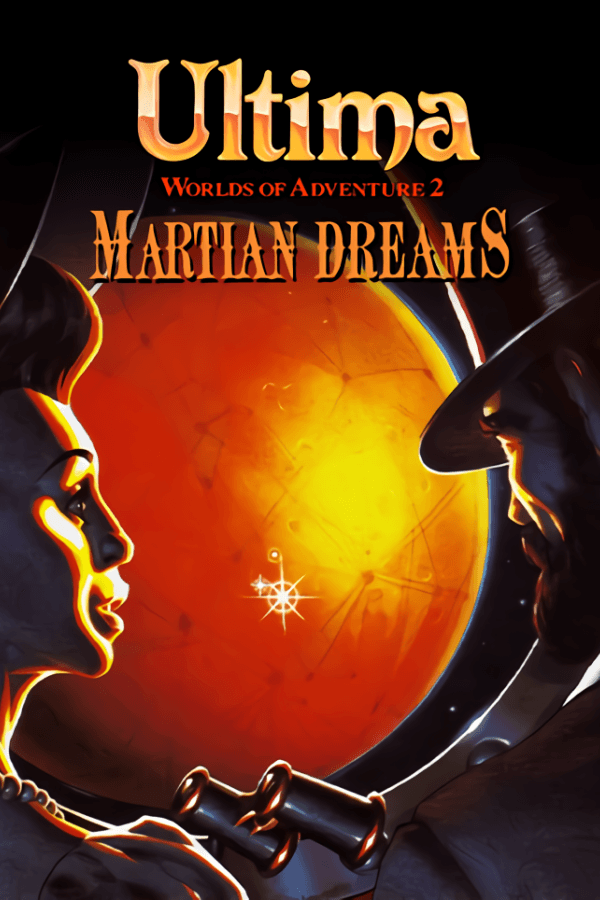

In Ultima Worlds of Adventure 2: Martian Dreams, your stats are determined by sitting on Sigmund Freud's couch for a psychiatric evaluation before flying a Victorian space cannon to Mars to rescue Nikola Tesla.
Starting a trip to Mars from a couch in 1893
The moment you launch this 1991 role-playing game, it skips the standard tavern setup for something far stranger. You play as the Avatar, whisked away to the late nineteenth century via the time-traveling Orb of the Moons. Before taking off from the 1893 World's Columbian Exposition in Chicago inside Percival Lowell's giant space shell, you sit down with Sigmund Freud. He asks you a series of psychological personality questions, using your answers to build your base attributes on his couch.
Once you make landfall on the Red Planet after a crash landing, the scope of your problem becomes obvious. A cohort of historical luminaries, including Mark Twain, Thomas Edison, and Andrew Carnegie, are marooned across the rust-red soil. Rasputin acts as the principal villain, manipulating events while you attempt to restore the Martian world power station, melt the polar ice caps with a giant solar lens to flood the ancient canals, and aid a native plant-based civilization in regaining its footing.
Ultima Worlds of Adventure 2: Martian Dreams trades swordplay for Victorian item puzzles
Producer Warren Spector and lead designer Jeff George built this spin-off on the top-down, tile-based engine of Ultima VI. Creator Richard Garriott gave Spector free rein over the fiction on one firm condition: nothing in the narrative could contradict documented real-world history. That restriction forced the design team to write around actual historical figures and nineteenth-century scientific theories rather than falling back on standard high-fantasy tropes.
Writing for Computer Gaming World, the reviewer Scorpia observed that the title felt like an adventure game dressed in a thin layer of computer role-playing mechanics, requiring intense patience and strict attention to detail. That assessment holds up. Combat against aggressive native plantimals, such as Jumping Beans and Planthers, often feels secondary, a point echoed by later reviewers who noted that fighting is largely extra weight. The real gameplay revolves around point-and-click inventory manipulation, exact text entry during conversations, glass making, using stage makeup tools, and operating retrofuturist machinery.
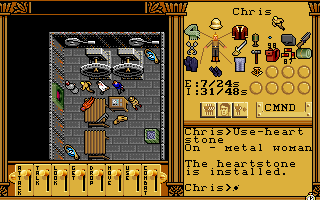
To fix the planet's broken infrastructure, you end up entering "dreamspace" using a device called the Dream Machine. Traversing these surreal dreamscapes rewards key items and information, shifting the focus further away from standard dungeon crawling toward logical environmental puzzles.
Taking notes by hand on the Red Planet
While the setting holds up, playing the game requires dealing with a clunky old interface. The control system inherits every quirk from its engine predecessor, relying on a hybrid layout of mouse clicks and hotkey commands that feel clumsy on modern hardware. There is no auto-map feature and no in-game journal tracking your active goals. If you do not write down coordinates, character hints, and mechanical instructions in a physical notebook, you will get hopelessly lost.
Traversing the landscape presents its own hurdles. Party movement is slow, and without a fast-travel network, retrieving distant quest items forces tedious treks back and forth across empty ground. Even with those drawbacks, audio design was a clear strength for ORIGIN Systems, Inc. at launch. Composer Dana Karl Glover wrote a musical score that sounded fantastic through a Roland MT-32 or LAPC-1 synthesizer card, while still offering solid support for standard AdLib and Sound Blaster boards.
The team packed the game with obscure references and subtle jokes for observant players to discover:
- A wall poster inside the Avatar's initial room displays the cover art for Ultima VI.
- Attempting repairs with Dr. Spector triggers a dry reference to Blake's 7 when he announces that he is not expendable.
- Smith the Horse makes an appearance despite the Victorian sci-fi setting.
- Explicit visual and story nods reward fans of Fritz Lang's movie Metropolis and the ruby slippers from The Wizard of Oz.
- A geological feature on the map faithfully recreates the real-life Face on Mars photo.
Why this spin-off series ground to a halt
When ORIGIN Systems, Inc. released the game, print magazine scores hit high marks. ACE handed down a 928 out of 1000 rating, praising its imaginative setup, while Zero awarded it 86 percent and German magazine ASM checked in at 83 percent. Critics recognized the sheer ambition required to marry steampunk gadgets, Victorian historical figures, and interplanetary survival in a single narrative.
Despite critical praise, retail performance was cold. The target audience for RPGs in 1991 hesitated to swap broadswords for Victorian wrenches, and sales fell well short of internal projections. Because of the commercial disappointment, ORIGIN canceled a planned third entry in the Worlds of Ultima spin-off line, which was set to focus on King Arthur's court under the title Arthurian Legends.
Fire up this Ultima Worlds of Adventure 2: Martian Dreams MS-DOS game directly in your browser
The strength of the story, the bizarre setting, and the sheer novelty of talking Mark Twain into helping you repair a Martian canal system make this game worth experiencing. Combat is easy to tolerate once you get your party equipped, though the lack of quick travel and auto-mapping means you must go into it ready to keep your own written notes. Anyone who appreciates clever puzzles and late nineteenth-century speculative fiction will find plenty to enjoy across the Red Planet's surface.
You can play Ultima Worlds of Adventure 2: Martian Dreams free in your browser right now with no setup necessary. If you want to fire up a unique MS-DOS game where Victorian history meets alien technology, click above, answer Freud's initial personality test, and keep a paper pad close by for recording coordinates.