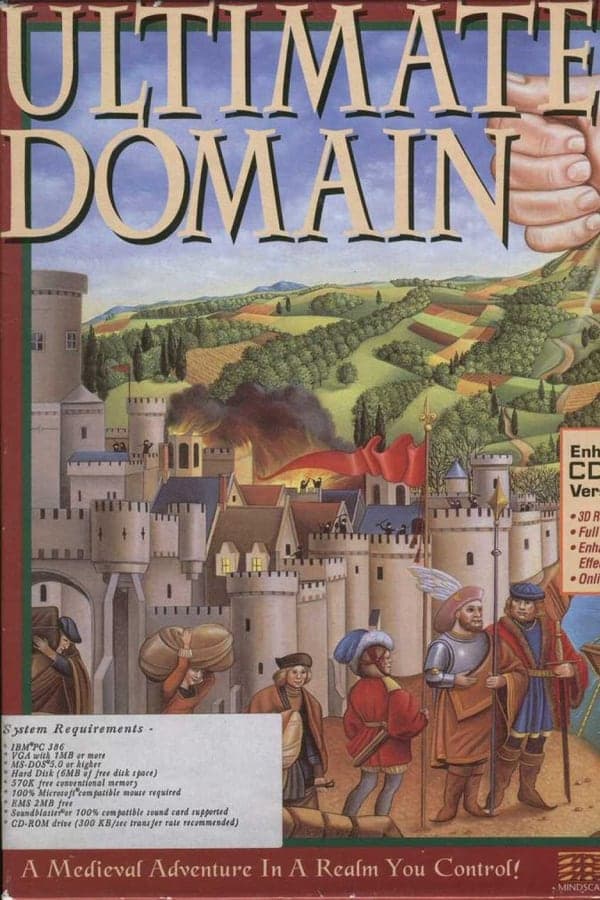
Starting a new map in Ultimate Domain drops you onto a square grid of wilderness with four humble settlers, a handful of raw materials, and the task of hunting down seven hidden jewels before your rivals do.
Managing four settlers and a massive tech tree in Ultimate Domain
You begin with a small plot of land and four villagers who need immediate orders. Assigning one person to chop wood and another to construct basic housing feels straightforward, but the calendar starts ticking from day one. When autumn arrives, timber production becomes critical, and if you fail to stockpile enough grain before winter hits, your small population starves before your town can even lay down stone roads.
The core game loop relies on a massive tree of research that unlocks over seventy distinct crafts and inventions. The breadth of progression forces you to make specific economic choices early on:
- Developing basic carpentry to construct sturdier homes and storage facilities.
- Researching agricultural tools to improve grain yields ahead of the winter season.
- Unlocking medical knowledge to keep aging villagers alive through sudden disease outbreaks.
- Engineering hot air balloons to scout enemy territories from high above the isometric grid.
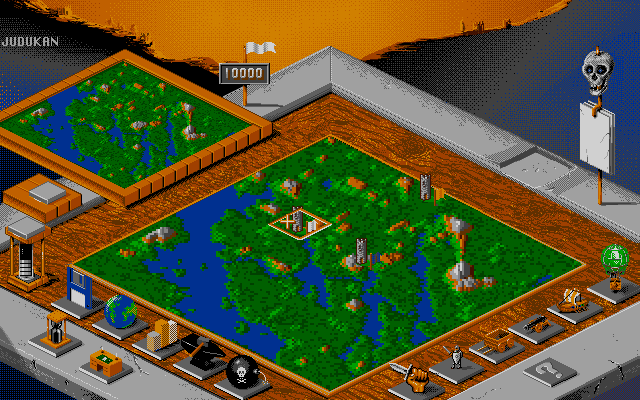
Watching your settlement grow has a quiet charm as villagers fall in love, move into houses together, have children, and eventually pass away. You spend your early hours balancing temple sacrifices to appease local spirits with visits to taverns to gather rumours about nearby jewel locations. I found that managing these micro-interactions makes the initial expansion feel rewarding, even if the world viewport itself feels somewhat cramped on screen.
Where the interface fights back against the player
The biggest hurdle in this strategy tactics title is not the threat of starving in winter, but the mechanical friction of its controls. Every building requires you to navigate multi-layered submenus to assign workers or check production stats. Changing menus often causes noticeable screen flicker, and erratic mouse sensitivity means you will accidentally select the wrong tile while trying to issue simple commands.
As your village spreads, managing individual settlers turns into a tedious chore. You spend half your time clicking through repetitive menus just to confirm that a woodcutter has resumed work after a season change. The main quest goal, which asks you to find seven of the nine magical jewels scattered across the world of Genesia, sounds like an epic adventure, but in practice it boils down to repetitive search patterns and routine bribes at local taverns.
Once your economy reaches full production, the tension drops off sharply. The early survival pressure vanishes, leaving you with a long stretch of mid-game management that feels largely repetitive. Many players who picked up this 1994 release simply stopped playing once their main town was fully fortified and automated.
From French Amiga roots to Sound Blaster digital audio
Designed by Thomas Zighem, Olivier Grassiano, and Laurent Phea at French developer Microïds, the game originally debuted on the Amiga under the title Genesia. That original edition was programmed using AMOS, a popular BASIC derivative for Commodore machines. When producer Manny J. Granillo brought the project to North America through publisher The Software Toolworks, it was rebranded as Ultimate Domain for its MS-DOS launch.
The DOS port offers full Sound Blaster digital sound support, including spoken voice lines and character audio clips if you played from the CD-ROM version. However, the game famously omitted native General MIDI support, meaning music relies entirely on FM synth or digitized audio channels. While the seasonal visual changes look detailed despite their pixelated edges, the small map window limits how much of the territory you can view without constant scrolling.
Why military combat fails to pull its weight
While the economic tree offers substantial depth, combat reveals major flaws in the game design. Computer Gaming World gave the title one out of five stars upon release, explicitly highlighting that an observant player could secure a victory without ever expanding past their starting region. The opponent computer code shows little tactical intelligence, frequently sending solitary units into danger or ignoring your territory altogether.
When armies do clash, battles resolve with minimal player input or strategic depth. Raising troops takes significant resources, but because opponent forces rarely mount organized invasions, building a standing military feels largely redundant unless you are aggressively hunting down rival settlements for jewel pieces. The imbalance between detailed civil planning and flimsy wargaming ruins the tension during late-game encounters.
How to play Ultimate Domain free in your browser today
For fans of old-school world builders, this title works best as an economic survival puzzle rather than a grand strategy game. If you approach it as a relaxed village simulator where you optimize crop cycles and research hot air balloons, there is genuine fun to be had. Just prepare yourself for stiff mouse movement and menus that require three clicks where one should have sufficed.
You can run this classic Ultimate Domain MS-DOS game straight from your web browser without installing additional software. The browser version retains the full Sound Blaster voice lines and pixelated seasonal art, letting you experiment with the seventies-strong tech tree in seconds. Fire up a session to test your agricultural planning, keep an eye on your winter grain stocks, and see if you can track down those seven elusive jewels.