
Screenshot×51d ago
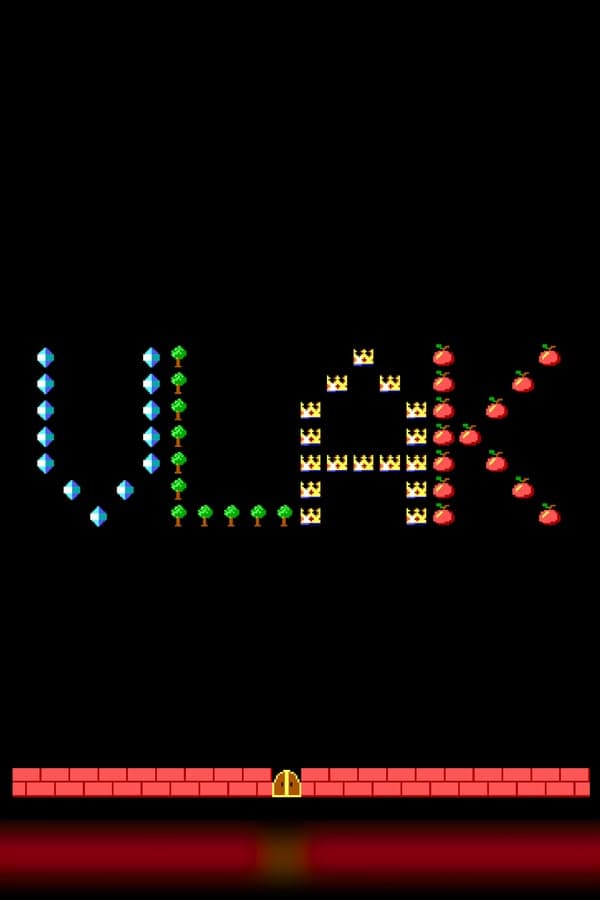
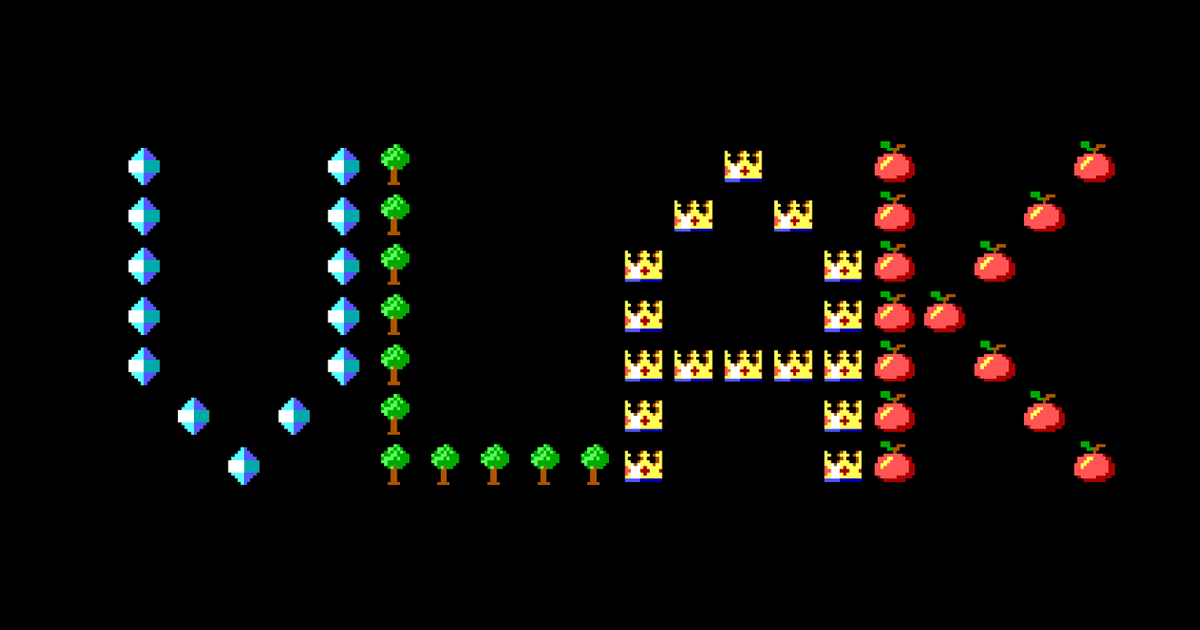
Vlak takes the familiar spatial logic of classic snake games, wraps it in bright EGA graphics, and converts a simple arcade survival loop into a rigid 50-level puzzle game.
When you start Vlak, the goal looks straightforward enough to anyone who has ever touched a PC from the early nineties. You control a small red locomotive moving across an 18x10 grid bounded by solid outer walls. Scattered across the floor are assorted objects including green apples, red cherries, cows, crowns, diamonds, cars, airplanes, and pieces of electrical equipment.
Driving over an item immediately hooks a matching wagon onto the back of your locomotive. Picking up an apple adds an open cargo car filled with fruit, collecting a cow adds a livestock car, and grabbing a diamond attaches a glittering treasure wagon. You cannot stop moving, and if your engine collides with a wall or any part of your trailing line of wagons, your run ends on the spot.
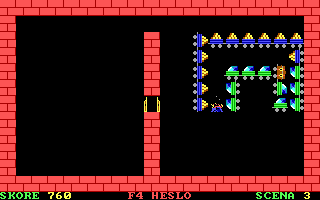
Unlike standard snake variants where items spawn randomly to stretch a continuous high-score chase, Vlak presents fixed, pre-designed stages. Once you gather every single item on the screen, a golden door opens somewhere along the border walls. Steering your engine safely through that open doorway clears the stage and grants the password for the next room.
The early levels lull you into a false sense of security. The room layout is wide open, items sit in accessible clusters, and you can pick them up in almost any order without running out of maneuvering room. You can take wide turns, loop back over empty tiles, and pull your growing train through loose figure-eights while hunting down the final crown.
By the time you hit level 15, the action game facade drops completely, revealing a uncompromising spatial logic puzzle. Narrow corridors formed by interior walls leave no room for error. Because your tail grows longer with every object gathered, picking up items in the wrong order regularly seals off your only escape route.
The primary mechanics that dictate how you approach each room come down to a few basic rules:
The solution in later stages often requires a single precise sequence. A single wrong turn into an alleyway leaves your engine facing a dead wall while your trailing wagons block the entrance behind you. There are no high scores or extra lives to manage, only an unlimited supply of attempts to crack the current layout.
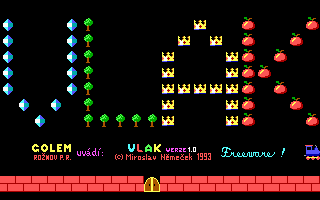
Created in 1993 by Czech programmer Ing. Miroslav Němeček, who was already known for utility software like DOS Manažer, the title achieved massive popularity without a commercial release. Distributed as freeware, the entire game compiled down to a minuscule 13 kB executable. That tiny footprint made it trivial to copy onto 3.5-inch floppy disks and share across school computer labs and home systems throughout the region.
Němeček also took the unusual step of releasing the original source code alongside the compiled game executable. Enthusiasts could study exactly how the grid movement and collision checks were built, turning the title into an educational reference point for aspiring developers as well as a popular classroom distraction.
The visual presentation relies on clean EGA tiles with distinct icons for every wagon type, keeping the board legible even when packed with forty trailing cars. Audio is stripped down to simple PC speaker clicks for movement and short chirps when picking up items or hitting a wall. While it lacks rich sound effects, the immediate response of key presses keeps the focus squarely on route planning.
The simple control scheme holds up because the challenge depends on pathfinding rather than reflexes. While modern players might miss quality-of-life additions like an undo button for missteps, the password system means you never lose major progress after a bad turn. It is a neat piece of early nineties shareware culture that rewards patience and precise movement over brute speed.
You can play Vlak free in your browser right now on this page. There is nothing to download or configure, meaning you can jump directly into the original DOS version of Vlak and test your spatial planning against all 50 rooms in a single sitting.
Vlak takes the familiar spatial logic of classic snake games, wraps it in bright EGA graphics, and converts a simple arcade survival loop into a rigid 50-level puzzle game.
When you start Vlak, the goal looks straightforward enough to anyone who has ever touched a PC from the early nineties. You control a small red locomotive moving across an 18x10 grid bounded by solid outer walls. Scattered across the floor are assorted objects including green apples, red cherries, cows, crowns, diamonds, cars, airplanes, and pieces of electrical equipment.
Driving over an item immediately hooks a matching wagon onto the back of your locomotive. Picking up an apple adds an open cargo car filled with fruit, collecting a cow adds a livestock car, and grabbing a diamond attaches a glittering treasure wagon. You cannot stop moving, and if your engine collides with a wall or any part of your trailing line of wagons, your run ends on the spot.
Unlike standard snake variants where items spawn randomly to stretch a continuous high-score chase, Vlak presents fixed, pre-designed stages. Once you gather every single item on the screen, a golden door opens somewhere along the border walls. Steering your engine safely through that open doorway clears the stage and grants the password for the next room.
The early levels lull you into a false sense of security. The room layout is wide open, items sit in accessible clusters, and you can pick them up in almost any order without running out of maneuvering room. You can take wide turns, loop back over empty tiles, and pull your growing train through loose figure-eights while hunting down the final crown.
By the time you hit level 15, the action game facade drops completely, revealing a uncompromising spatial logic puzzle. Narrow corridors formed by interior walls leave no room for error. Because your tail grows longer with every object gathered, picking up items in the wrong order regularly seals off your only escape route.
The primary mechanics that dictate how you approach each room come down to a few basic rules:
The solution in later stages often requires a single precise sequence. A single wrong turn into an alleyway leaves your engine facing a dead wall while your trailing wagons block the entrance behind you. There are no high scores or extra lives to manage, only an unlimited supply of attempts to crack the current layout.
Created in 1993 by Czech programmer Ing. Miroslav Němeček, who was already known for utility software like DOS Manažer, the title achieved massive popularity without a commercial release. Distributed as freeware, the entire game compiled down to a minuscule 13 kB executable. That tiny footprint made it trivial to copy onto 3.5-inch floppy disks and share across school computer labs and home systems throughout the region.
Němeček also took the unusual step of releasing the original source code alongside the compiled game executable. Enthusiasts could study exactly how the grid movement and collision checks were built, turning the title into an educational reference point for aspiring developers as well as a popular classroom distraction.
The visual presentation relies on clean EGA tiles with distinct icons for every wagon type, keeping the board legible even when packed with forty trailing cars. Audio is stripped down to simple PC speaker clicks for movement and short chirps when picking up items or hitting a wall. While it lacks rich sound effects, the immediate response of key presses keeps the focus squarely on route planning.
The simple control scheme holds up because the challenge depends on pathfinding rather than reflexes. While modern players might miss quality-of-life additions like an undo button for missteps, the password system means you never lose major progress after a bad turn. It is a neat piece of early nineties shareware culture that rewards patience and precise movement over brute speed.
You can play Vlak free in your browser right now on this page. There is nothing to download or configure, meaning you can jump directly into the original DOS version of Vlak and test your spatial planning against all 50 rooms in a single sitting.
How Vlak is played — the keys the game listens to, grouped by what they do.
Highlighted keys are mapped — hover or tap one to see what it does.
The on-screen keyboard and gamepad mapping the browser player uses on a phone, a tablet or a controller, as opposed to the real keys above. $PRO members make their own in the player and share them here; anyone can pick one to play with.
Cheat codes, console commands and memory pokes for Vlak — each one verified and attributed.
Sign in to submitaka Train · Vlak (Train)
How Vlak is played — the keys the game listens to, grouped by what they do.
Highlighted keys are mapped — hover or tap one to see what it does.
The on-screen keyboard and gamepad mapping the browser player uses on a phone, a tablet or a controller, as opposed to the real keys above. $PRO members make their own in the player and share them here; anyone can pick one to play with.
Cheat codes, console commands and memory pokes for Vlak — each one verified and attributed.
Sign in to submit