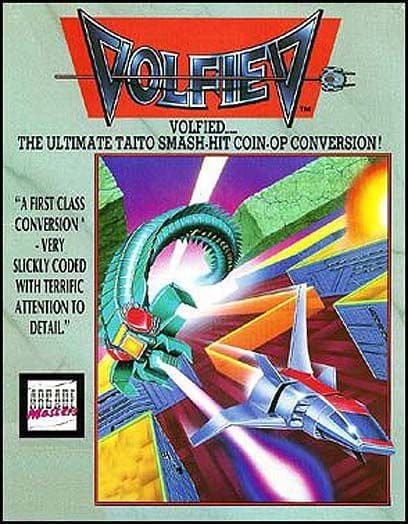
Volfied
You pilot the Monotros back to your home world in Volfied, carving away chunks of alien space to reclaim the screen while giant boss monsters hunt your vulnerable tracer line.
Cutting up the canvas in Volfied
Most arcade conversions from 1991 sold you on high concepts or loud sound effects, but this puzzle action game asks for pure spatial nerves. Designed by Fukio Mitsuji as the official arcade successor to Qix, the basic premise sounds harmlessly math-based. You sit safely on the perimeter of a rectangle, slide your ship along the border, and pull out into open space to trace shapes that claim claimed territory once you hit another edge.
The trap lies in the instant you leave safety. The moment you push out into the playfield to draw a line, your defensive shield starts ticking down. Smaller alien minions drift along predictable paths while a massive level boss patrols the center. Touch a minion, catch an energy spark traveling along your drawn line, or run out of shield timer mid-stroke, and your ship vaporizes on the spot. To finish a stage, you must claim at least 80 percent of the total area.
That high requirement changes how you think under pressure. Early on, taking small, cautious ten-percent bites from the corners feels sensible. By stage three, you realize safe cuts leave giant bosses with total control of the center, pinning you against the frame. To actually survive, you have to wait for the boss to wander into a far corner, then sprint across two-thirds of the screen to lock away half the arena in a single terrifying cut.
Power-ups, laser fire, and giant space bugs
To give you a fighting chance against its roster of 16 sci-fi backdrops, grey blocks sit scattered inside the playfield. You claim them by enclosing them inside your carved areas. Snagging an S block gives your ship a sharp speed boost, while a T block freezes enemies in place for a few crucial seconds. A P block pauses your shield timer, giving you breathing room to draw longer lines without running out of air.
Combat items turn the defensive loop inside out. Pick up an L item, and your ship gains a forward laser that lets you shoot down smaller minions while resting on the border line. A rare C block instantly clears all minor creeps on screen. Certain special red-light blocks even yield a boss weapon that lets you blow up the central alien directly, instantly completing the level regardless of your cleared percentage.
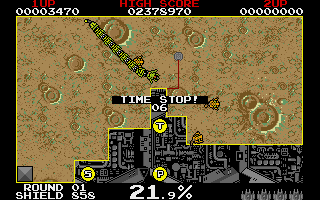
The DOS port handled by Oxford Digital Enterprises and published by Empire keeps these mechanics running at full arcade speed. The AdLib FM synth score by Hisayoshi Ogura keeps the tension high, pumping energetic synth pulses through your PC speaker or Sound Blaster card while VGA backdrops display detailed alien landscapes.
The unforgiving math of sixteen unsaved levels
While the computer conversion delivers smooth VGA graphics and clean controls, it retains every drop of arcade cruelty. Games-X magazine praised its simple concept and addictive play upon release, but noted that mastering it takes endless patience. That assessment holds true. You get three difficulty settings, but no passwords and no save files across all 16 levels.
The difficulty curve does not slope gently; it spikes like a wall. A single minor mistake on level nine sends you straight back to the starting line of that level, and running out of lives wipes your entire run. Because enemy sparks follow the exact path you are currently drawing, taking a wrong turn during a long line trace guarantees death before your ship can reach the safety of the outer boundary.
Modern players often bounce off this lack of margin for error. Barriers block line paths on later stages, forcing you into precise visual bottlenecks where pixel-perfect movement is mandatory. If you do not plan your cuts to leave yourself an emergency escape path along the new border, you will trap yourself in a corner with a boss charging straight toward you.
High score tricks and the corner exploit
Dedicated players eventually figured out how to break the game's strict scoring math. The most famous high-score trick relies on greed during the very first level. By carving tiny fractions of space and carefully herding the initial boss into a microscopic pocket, you can aim for a single final cut that takes your total cleared area to 99.9 percent, unlocking a massive special point bonus that jumpstarts your score counter.
Another classic survival strategy involves border hugging. Sitting directly on the sharp corner of a border line limits where enemy projectiles can register collisions, giving you a safe roost to study boss movement cycles before starting a long trace across the screen.
The game relies on a clear set of tactical rules:
- Watch enemy patrol loops before leaving the border, because minion spawns follow set paths.
- Prioritize Speed and Time Freeze power-ups over aggressive clear blocks on high-speed levels.
- Bait boss monsters toward one side of the screen before executing large split cuts on the opposite side.
- Avoid drawing long, rectangular boxes that leave your return vector wide open to fast sparks.
That strict logic is why Taito Corporation arcade games translated so cleanly to home computers. The MS-DOS port from 1991 is a cold test of spatial risk management, stripped of fluff and built around fast geometric decisions.
Where to play Volfied today
If you want to test your reflexes against 16 stages of alien-infested space, you can play Volfied online free in your browser right now. The sharp movement controls and crisp VGA art style hold up today, even if the absolute lack of checkpoints across a full run will test your sanity.
Load up this classic MS-DOS game directly in your window with nothing to install and no setup required. Try clearing 99 percent on stage one to trigger the high score bonus, or just see how far your line-tracing skills can carry you against the boss on level five before your shield runs out.