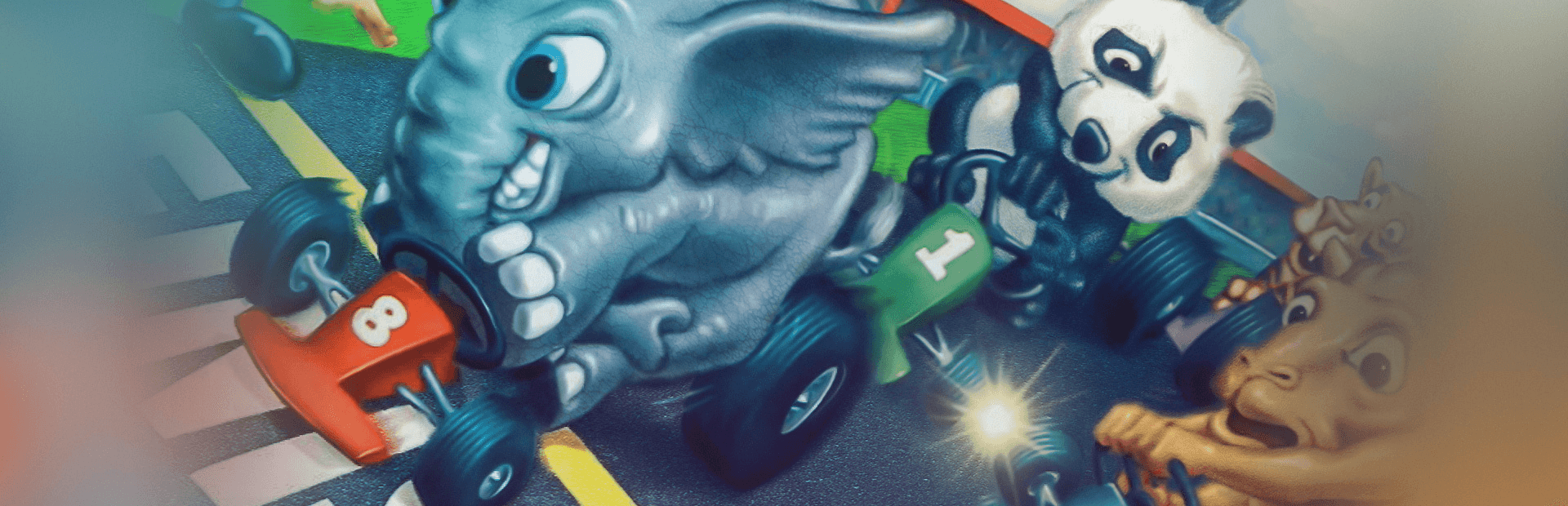
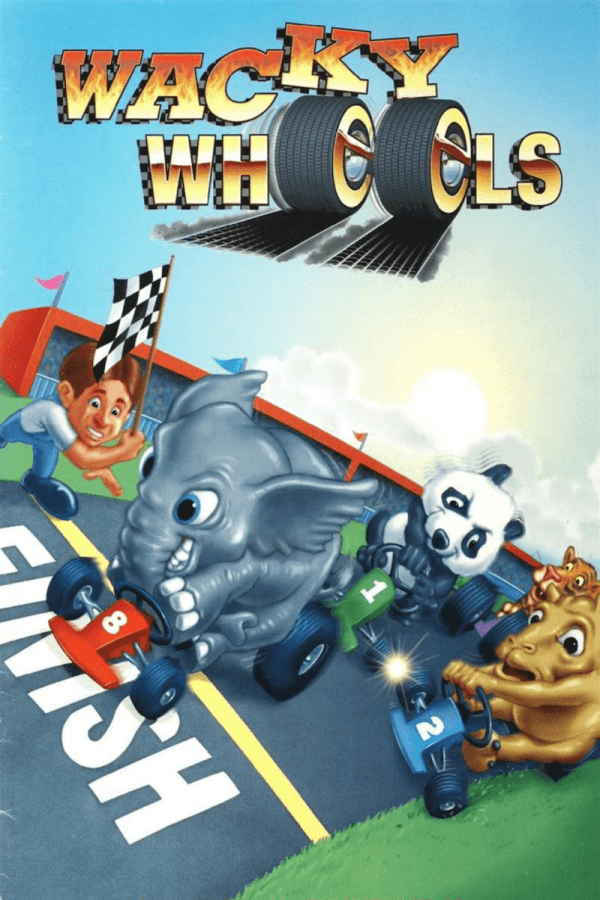

Wacky Wheels took the pseudo-3D kart racing formula, mounted eight zoo animals on noisy lawnmowers, and handed players a supply of ammo-hungry hedgehogs to shoot at their friends across a split screen.
Before standard PCs had dedicated 3D hardware or coprocessors like the Super Nintendo possessed for Mode 7 graphics, programmer Andy Edwardson built a custom rotation engine for Beavis-Soft to simulate rotating ground planes on normal x86 chips. The visual trick worked by constantly recalculating flat bitmap scale and angle line by line, giving the 1994 racing game a sense of forward momentum when PC players were starved for console-style kart racers. Coupled with crisp AdLib and Sound Blaster music by Mark Klem, launching the game felt like bringing a Super Nintendo arcade experience directly to an MS-DOS monitor.
Rather than polished professional racers, you pick from a cast of eight zoo inmates: Barney the Bear, Pegleg the Pelican, Rambo the Elephant, Sultan the Camel, Blaze the Panda, Morris the Moose, Trixie the Tiger, and Snort the Shark. Each character spins their steering wheel with frantic hand animation, sitting atop small lawnmowers that putter around themed tracks ranging from grassy fields to icy expanses. What makes the flat screen layout work is its immediacy, giving you an immediate view behind your driver while keeping track of whatever weapons are sitting on the dirt ahead.
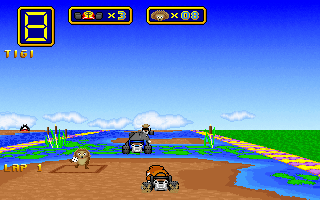
Every race centers on picking up ammo scattered along the track while keeping speed through tight turns. The core weapon system relies on hedgehogs that you collect from the track and fire straight ahead or drop behind as traps. You can gather standard hedgehogs to bounce opponents off course, or grab special power-ups to alter your attacks:
Handling in the 1994 release differs sharply from modern kart games because there is no true drift mechanic. You cannot slide around a bend while charging up a turbo boost. Instead, navigating sharp turns relies on a dedicated 90-degree handbrake button that instantly snaps your direction sideways. Mastering the handbrake is the difference between sliding smoothly into a corner or plowing at full throttle into deep water traps that drain your remaining time.
For all its personality, the game hits visual limitations quickly. The rotation engine can turn a flat surface in any direction, but it cannot raise or lower the terrain. Every course in the Bronze Wheels, Silver Wheels, and Gold Wheels cup sets is flat, leaving level design to rely entirely on water hazards, narrow passages, oil spills, and abrupt right-angle turns to create difficulty. After a few cups, the tracks start to feel mechanically similar, differing mostly in surface colors and wall textures.
Single-player racing against computer opponents can also turn repetitive once you memorize the precise line for every turn. The AI drivers do not make creative mistakes; they stick strictly to programmed paths unless you knock them off track with a well-aimed hedgehog shot. Because of this, the true life of the game belongs to its multiplayer modes, where human opponents panic under fire, mistime their handbrakes, and fall into water pits.
The backstory behind the development carries one of the most infamous production stories of the shareware era. Prior to partnering with Apogee Software and retail publisher FormGen, the developers sent an early playable demo named Wacky Kart containing full, uncompiled engine source code to Belgian publisher Copysoft. Copysoft declined to sign the game, but then allegedly used the exposed code to quickly build and release their own lookalike title, Skunny Kart, hitting the market right before Beavis-Soft could finish their project.
Despite the market confusion caused by the competing clone, Apogee distributed the shareware build of the real game far and wide across dial-up bulletin board systems. The developers even hid a dig at their competitors inside early builds. Typing the command line option /NOFUN when starting the game brought up a prompt stating it was searching your hard drive for games made by rival publisher Epic MegaGames.
The game is also packed with weird secrets that players passed around classrooms and forums. If you hold down the brake and spin your kart in a full 360-degree circle right at the starting line, the giant Dopefish from Commander Keen pops up on screen with a loud digitized burp. Players looking to break the rules could also start the game with command switches like WW TURBO or WW HOG 99 to grant unlimited ammo and supercharged speed right from the first green light.
While later 3D efforts quickly eclipsed pseudo-3D engines, this shareware classic keeps its charm through quick round times, simple handbrake physics, and chaotic two-player head-to-head battles. The Wacky Shoot-Out battle mode and target-shooting duck hunts offer a surprisingly fun break from standard lap racing when you have another player sitting next to you at the keyboard.
You can play Wacky Wheels free in your browser right now with no downloads or technical setups required. Modern players often forget to use the handbrake key and wind up crashing straight into walls on the first hairpin turn, so map your controls early, tap the brake to pivot around sharp corners, and save a couple of hedgehogs for whoever takes the lead on the final lap.
Wacky Wheels took the pseudo-3D kart racing formula, mounted eight zoo animals on noisy lawnmowers, and handed players a supply of ammo-hungry hedgehogs to shoot at their friends across a split screen.
Before standard PCs had dedicated 3D hardware or coprocessors like the Super Nintendo possessed for Mode 7 graphics, programmer Andy Edwardson built a custom rotation engine for Beavis-Soft to simulate rotating ground planes on normal x86 chips. The visual trick worked by constantly recalculating flat bitmap scale and angle line by line, giving the 1994 racing game a sense of forward momentum when PC players were starved for console-style kart racers. Coupled with crisp AdLib and Sound Blaster music by Mark Klem, launching the game felt like bringing a Super Nintendo arcade experience directly to an MS-DOS monitor.
Rather than polished professional racers, you pick from a cast of eight zoo inmates: Barney the Bear, Pegleg the Pelican, Rambo the Elephant, Sultan the Camel, Blaze the Panda, Morris the Moose, Trixie the Tiger, and Snort the Shark. Each character spins their steering wheel with frantic hand animation, sitting atop small lawnmowers that putter around themed tracks ranging from grassy fields to icy expanses. What makes the flat screen layout work is its immediacy, giving you an immediate view behind your driver while keeping track of whatever weapons are sitting on the dirt ahead.

Every race centers on picking up ammo scattered along the track while keeping speed through tight turns. The core weapon system relies on hedgehogs that you collect from the track and fire straight ahead or drop behind as traps. You can gather standard hedgehogs to bounce opponents off course, or grab special power-ups to alter your attacks:
Handling in the 1994 release differs sharply from modern kart games because there is no true drift mechanic. You cannot slide around a bend while charging up a turbo boost. Instead, navigating sharp turns relies on a dedicated 90-degree handbrake button that instantly snaps your direction sideways. Mastering the handbrake is the difference between sliding smoothly into a corner or plowing at full throttle into deep water traps that drain your remaining time.
For all its personality, the game hits visual limitations quickly. The rotation engine can turn a flat surface in any direction, but it cannot raise or lower the terrain. Every course in the Bronze Wheels, Silver Wheels, and Gold Wheels cup sets is flat, leaving level design to rely entirely on water hazards, narrow passages, oil spills, and abrupt right-angle turns to create difficulty. After a few cups, the tracks start to feel mechanically similar, differing mostly in surface colors and wall textures.
Single-player racing against computer opponents can also turn repetitive once you memorize the precise line for every turn. The AI drivers do not make creative mistakes; they stick strictly to programmed paths unless you knock them off track with a well-aimed hedgehog shot. Because of this, the true life of the game belongs to its multiplayer modes, where human opponents panic under fire, mistime their handbrakes, and fall into water pits.

The backstory behind the development carries one of the most infamous production stories of the shareware era. Prior to partnering with Apogee Software and retail publisher FormGen, the developers sent an early playable demo named Wacky Kart containing full, uncompiled engine source code to Belgian publisher Copysoft. Copysoft declined to sign the game, but then allegedly used the exposed code to quickly build and release their own lookalike title, Skunny Kart, hitting the market right before Beavis-Soft could finish their project.
Despite the market confusion caused by the competing clone, Apogee distributed the shareware build of the real game far and wide across dial-up bulletin board systems. The developers even hid a dig at their competitors inside early builds. Typing the command line option /NOFUN when starting the game brought up a prompt stating it was searching your hard drive for games made by rival publisher Epic MegaGames.
The game is also packed with weird secrets that players passed around classrooms and forums. If you hold down the brake and spin your kart in a full 360-degree circle right at the starting line, the giant Dopefish from Commander Keen pops up on screen with a loud digitized burp. Players looking to break the rules could also start the game with command switches like WW TURBO or WW HOG 99 to grant unlimited ammo and supercharged speed right from the first green light.
While later 3D efforts quickly eclipsed pseudo-3D engines, this shareware classic keeps its charm through quick round times, simple handbrake physics, and chaotic two-player head-to-head battles. The Wacky Shoot-Out battle mode and target-shooting duck hunts offer a surprisingly fun break from standard lap racing when you have another player sitting next to you at the keyboard.
You can play Wacky Wheels free in your browser right now with no downloads or technical setups required. Modern players often forget to use the handbrake key and wind up crashing straight into walls on the first hairpin turn, so map your controls early, tap the brake to pivot around sharp corners, and save a couple of hedgehogs for whoever takes the lead on the final lap.
How Wacky Wheels is played — the keys the game listens to, grouped by what they do.
Highlighted keys are mapped — hover or tap one to see what it does.
Controls cannot be changed inside the main game; remapping must be done using SETUP.EXE in the game directory.
The on-screen keyboard and gamepad mapping the browser player uses on a phone, a tablet or a controller, as opposed to the real keys above. $PRO members make their own in the player and share them here; anyone can pick one to play with.
Cheat codes, console commands and memory pokes for Wacky Wheels — each one verified and attributed.
Sign in to submitHow Wacky Wheels is played — the keys the game listens to, grouped by what they do.
Highlighted keys are mapped — hover or tap one to see what it does.
Controls cannot be changed inside the main game; remapping must be done using SETUP.EXE in the game directory.
The on-screen keyboard and gamepad mapping the browser player uses on a phone, a tablet or a controller, as opposed to the real keys above. $PRO members make their own in the player and share them here; anyone can pick one to play with.
Cheat codes, console commands and memory pokes for Wacky Wheels — each one verified and attributed.
Sign in to submit