
By tossing out cramped dungeons for an open planet full of rival alien factions, Wizardry VII: Crusaders of the Dark Savant pushed party-based RPGs into uncharted territory where other adventurers actively race you to the prize.
When designer David W. Bradley set out to write the middle chapter of his Dark Savant trilogy, the traditional dungeon crawler had hit a wall of repetition. Confining a six-character party to tight stone corridors with wireframe turns no longer felt like an epic journey. The goal was to build a persistent planetary environment where high fantasy collided directly with interstellar sci-fi, throwing swords and sorcery against starships and alien armies.
Released as an MS-DOS game, this chapter dropped players onto the uncharted world of Guardia to hunt for a cosmic relic called the Astral Dominae. If you brought over a save file from Wizardry VI: Bane of the Cosmic Forge, the story recognized your previous choices by starting your group in one of four entirely different starting locations across the planet. Fresh parties were dumped right into the action, but imported teams carried over hard-earned stats and items that changed how the opening hours played out.
The visual leap over its predecessors was immediate. Upgraded 8-bit VGA graphics filled the screen with 256 colors, rendering outdoor wilderness, stone fortresses, and strange alien architecture alongside detailed enemy portraits. Synthesizers powered by AdLib, Sound Blaster, or Roland sound cards gave the wild frontier a heavy atmosphere, punctuated by sharp audio cues during combat turns.
Guardia is not a static world waiting around for your party to solve its problems. Two major interstellar factions are locked in conflict across the map: the heavy-set, rhino-like Umpani Federation and the sinister, spider-like T'Rang. Navigating their diplomacy and taking contracts in their strongholds shapes which areas of the planet remain open to you and which turn into death traps.
The central hub of New City connects these sprawling regions to outlying places like Orkogre Castle, but you are never alone in your search for map pieces. NPC adventurer groups travel the world on their own schedules. If you take too long exploring a maze or grinding levels, rival scavengers will beat you to critical quest items, looting chest locations before you ever set foot inside.
When a key item vanishes from a dungeon chest, the game transforms into a treasure hunt across the wilderness. You have to track down the specific rival faction or wandering party that snagged the relic, open dialogue with them, or wipe them out in combat to retrieve what you need to progress. It creates a genuine sense of urgency, though it can turn an evening of play into a frantic search across vast stretches of land.
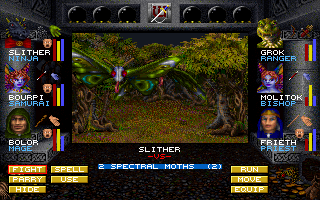
Turn-based battles hit hard right from the opening zones. Encounters against early threats like Mottle Cruds, Rattkin ambushers, Spectral Moths, and armored Gorns require careful positioning and resource management. If your spellcasters run out of stamina or spell points mid-dungeon, walking back to a safe zone through aggressive respawns becomes a bloody battle of attrition.
Character development demands heavy bookkeeping across dozens of specialized skills. A famous example is the automapping system: the game refuses to show you a detailed map of your surroundings unless at least one character in your party possesses and actively trains the Mapping skill. Forget to invest points into it, and you are left navigating blind through multi-level mazes packed with mechanical traps and riddles.
The action moves fast, but the game occasionally grinds to a halt under its own weight. Puzzles can be exceptionally opaque, requiring cryptic riddle answers or pixel-hunting for tiny mechanical triggers. The narrative delivery also puts up a fight; key lore dumps arrive as dense, overwrought prose fed to the screen one slow line at a time without an option to speed it up or skip the text.
Looking back at 1992, Wizardry VII: Crusaders of the Dark Savant was as massive as role-playing (RPG) projects got. Initial impressions in Computer Gaming World were hesitant, noting that the sheer size and brutal learning curve felt overwhelming compared to tighter dungeon crawls. However, the magazine eventually reversed course, praising its depth and naming it their Role-Playing Game of the Year.
What holds up today is the depth of party customization and the sheer satisfaction of surviving Guardia's political powder keg. What plainly does not hold up is the sheer friction of planetary travel. Trekking through massive wilderness zones between towns takes a long time, and sharp difficulty spikes can wipe out an hour of progress if you wander into a high-level territory before your party is ready.
Compared to other 1992 releases, few games offered this level of player agency over world events. Sir-tech Software, Inc. crafted a world that felt alive precisely because it was willing to punish careless play and reward methodical mapping.
If you want to sample one of the most complex party simulators ever built, you can play Wizardry VII: Crusaders of the Dark Savant online right in your browser. Roll up a fresh squad, head into New City, and test your skills against the local wildlife before a rival adventuring party snatches the best loot out from under your nose. You can jump directly into Wizardry VII: Crusaders of the Dark Savant free in your browser with no setup required.
By tossing out cramped dungeons for an open planet full of rival alien factions, Wizardry VII: Crusaders of the Dark Savant pushed party-based RPGs into uncharted territory where other adventurers actively race you to the prize.
When designer David W. Bradley set out to write the middle chapter of his Dark Savant trilogy, the traditional dungeon crawler had hit a wall of repetition. Confining a six-character party to tight stone corridors with wireframe turns no longer felt like an epic journey. The goal was to build a persistent planetary environment where high fantasy collided directly with interstellar sci-fi, throwing swords and sorcery against starships and alien armies.
Released as an MS-DOS game, this chapter dropped players onto the uncharted world of Guardia to hunt for a cosmic relic called the Astral Dominae. If you brought over a save file from Wizardry VI: Bane of the Cosmic Forge, the story recognized your previous choices by starting your group in one of four entirely different starting locations across the planet. Fresh parties were dumped right into the action, but imported teams carried over hard-earned stats and items that changed how the opening hours played out.
The visual leap over its predecessors was immediate. Upgraded 8-bit VGA graphics filled the screen with 256 colors, rendering outdoor wilderness, stone fortresses, and strange alien architecture alongside detailed enemy portraits. Synthesizers powered by AdLib, Sound Blaster, or Roland sound cards gave the wild frontier a heavy atmosphere, punctuated by sharp audio cues during combat turns.
Guardia is not a static world waiting around for your party to solve its problems. Two major interstellar factions are locked in conflict across the map: the heavy-set, rhino-like Umpani Federation and the sinister, spider-like T'Rang. Navigating their diplomacy and taking contracts in their strongholds shapes which areas of the planet remain open to you and which turn into death traps.
The central hub of New City connects these sprawling regions to outlying places like Orkogre Castle, but you are never alone in your search for map pieces. NPC adventurer groups travel the world on their own schedules. If you take too long exploring a maze or grinding levels, rival scavengers will beat you to critical quest items, looting chest locations before you ever set foot inside.
When a key item vanishes from a dungeon chest, the game transforms into a treasure hunt across the wilderness. You have to track down the specific rival faction or wandering party that snagged the relic, open dialogue with them, or wipe them out in combat to retrieve what you need to progress. It creates a genuine sense of urgency, though it can turn an evening of play into a frantic search across vast stretches of land.
Turn-based battles hit hard right from the opening zones. Encounters against early threats like Mottle Cruds, Rattkin ambushers, Spectral Moths, and armored Gorns require careful positioning and resource management. If your spellcasters run out of stamina or spell points mid-dungeon, walking back to a safe zone through aggressive respawns becomes a bloody battle of attrition.
Character development demands heavy bookkeeping across dozens of specialized skills. A famous example is the automapping system: the game refuses to show you a detailed map of your surroundings unless at least one character in your party possesses and actively trains the Mapping skill. Forget to invest points into it, and you are left navigating blind through multi-level mazes packed with mechanical traps and riddles.
The action moves fast, but the game occasionally grinds to a halt under its own weight. Puzzles can be exceptionally opaque, requiring cryptic riddle answers or pixel-hunting for tiny mechanical triggers. The narrative delivery also puts up a fight; key lore dumps arrive as dense, overwrought prose fed to the screen one slow line at a time without an option to speed it up or skip the text.
Looking back at 1992, Wizardry VII: Crusaders of the Dark Savant was as massive as role-playing (RPG) projects got. Initial impressions in Computer Gaming World were hesitant, noting that the sheer size and brutal learning curve felt overwhelming compared to tighter dungeon crawls. However, the magazine eventually reversed course, praising its depth and naming it their Role-Playing Game of the Year.
What holds up today is the depth of party customization and the sheer satisfaction of surviving Guardia's political powder keg. What plainly does not hold up is the sheer friction of planetary travel. Trekking through massive wilderness zones between towns takes a long time, and sharp difficulty spikes can wipe out an hour of progress if you wander into a high-level territory before your party is ready.
Compared to other 1992 releases, few games offered this level of player agency over world events. Sir-tech Software, Inc. crafted a world that felt alive precisely because it was willing to punish careless play and reward methodical mapping.
If you want to sample one of the most complex party simulators ever built, you can play Wizardry VII: Crusaders of the Dark Savant online right in your browser. Roll up a fresh squad, head into New City, and test your skills against the local wildlife before a rival adventuring party snatches the best loot out from under your nose. You can jump directly into Wizardry VII: Crusaders of the Dark Savant free in your browser with no setup required.
How Wizardry VII: Crusaders of the Dark Savant is played — the keys the game listens to, grouped by what they do.
Highlighted keys are mapped — hover or tap one to see what it does.
Copy-protection manual check occurs at startup and save; modern digital releases allow bypassing it by pressing Enter.
The on-screen keyboard and gamepad mapping the browser player uses on a phone, a tablet or a controller, as opposed to the real keys above. $PRO members make their own in the player and share them here; anyone can pick one to play with.
Cheat codes, console commands and memory pokes for Wizardry VII: Crusaders of the Dark Savant — each one verified and attributed.
Sign in to submitHow Wizardry VII: Crusaders of the Dark Savant is played — the keys the game listens to, grouped by what they do.
Highlighted keys are mapped — hover or tap one to see what it does.
Copy-protection manual check occurs at startup and save; modern digital releases allow bypassing it by pressing Enter.
The on-screen keyboard and gamepad mapping the browser player uses on a phone, a tablet or a controller, as opposed to the real keys above. $PRO members make their own in the player and share them here; anyone can pick one to play with.
Cheat codes, console commands and memory pokes for Wizardry VII: Crusaders of the Dark Savant — each one verified and attributed.
Sign in to submit