If you drop down the chimney into Zork I: The Great Underground Empire, your main goal is simple: carry twenty stolen treasures back to a trophy case while avoiding a murderous thief.
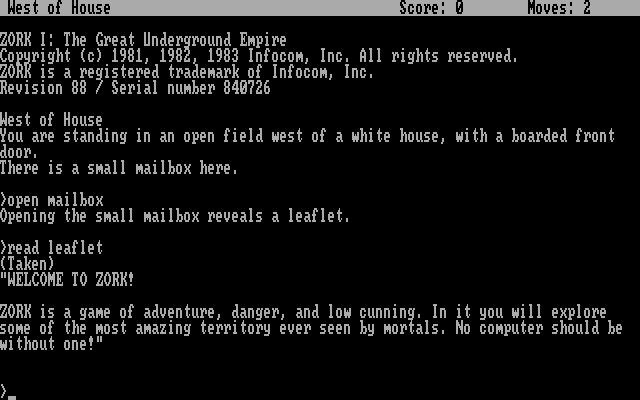
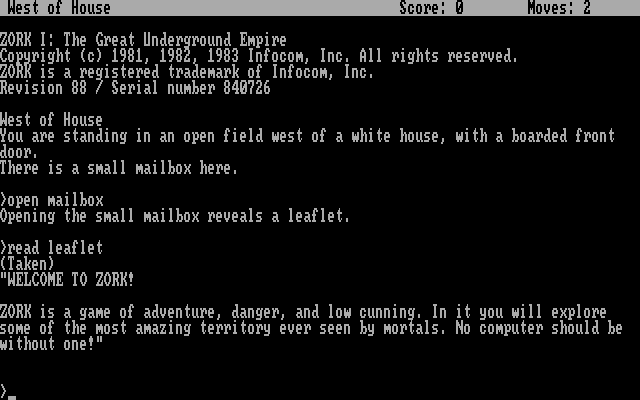
You begin in an open field west of a white house with a boarded front door and a small brass mailbox. There are no maps on screen, no health bars, and no visual icons to guide you. Everything about the world comes to you through clean, plain paragraphs of text.
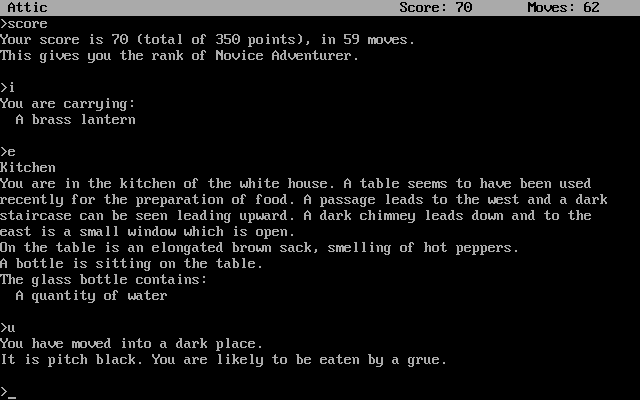
To move around, you type compass directions like north or east. You open the mailbox, grab the small leaflet inside, slide through a window, and step down into the pitch black below. That is where the real game begins, and where you quickly learn that darkness is lethal.
Your primary goal in this adventure is to haul treasures back to the trophy case in the living room. You carry a brass lantern to survive dark rooms, but its battery decays with every move you make. If your light dies while you are stuck in the subterranean passages, a grue eats you immediately.
Back between 1977 and 1979, four students at MIT named Tim Anderson, Marc Blank, Bruce Daniels, and Dave Lebling built the original code on a DEC PDP-10 mainframe computer. They took inspiration from Colossal Cave Adventure, but they wanted something far more responsive. When they ported the game to microcomputers, they split the massive mainframe program into three distinct chapters.
To fit that huge world into limited machine memory, the team wrote a custom programming language called ZIL, the Zork Implementation Language. That code ran inside a virtual software engine called the Z-machine. This architecture allowed Infocom, Inc. to translate their games to various early computers without rebuilding the entire system from scratch every time.
The parser was the true technical breakthrough for this 1982 release. Earlier text games demanded strict two-word commands like "take sword" or "go north". Infocom built an engine that understood complex inputs like "take all treasures except the lamp" or "attack troll with sword". When you typed something silly, the parser cracked dry, sarcastic jokes back at you.
The core design relies on clever environmental puzzles. You inspect Flood Control Dam #3, work out how to control the water levels with tools, and uncover hidden routes beneath the riverbed. Puzzles reward careful reading, lateral thinking, and careful inventory tracking.
However, the game can feel completely unforgiving. You must manage a tight weight limit, meaning you constantly drop items and backtrack across long distances. Worse yet, two persistent figures wander the underworld: a hostile troll guarding a passage, and a wandering Thief who snatches your hard-won loot right out of your hands.
The most notorious obstacle is the maze of twisting passages. Infocom designed self-looping rooms where heading north and then south does not return you to your starting location. Mapping these corridors requires dropping distinct items on the ground to track where each exit actually leads.
By the late 1980s, the game had sold roughly 400,000 copies, making it a massive commercial success for Infocom, Inc. and proving that text interface games had broad commercial appeal. It launched a famous trilogy, followed directly by Zork II: The Wizard of Frobozz and Zork III: The Dungeon Master.
For modern players, the interface presents a steep learning curve. Typing commands without visual hints feels unusual to anyone raised on mouse clicks or gamepad menus. Furthermore, saving your progress in modern browser setups can occasionally glitch if the emulator hangs, so taking notes by hand remains good practice.
Despite those old frustrations, the razor-sharp writing still bites. The text builds real tension when your light source flickers, and cracking a multi-step mechanical puzzle feels well earned. If you care about written puzzles, you ought to play it yourself.
You can read more about Zork history on Wikipedia, or you can start playing this classic MS-DOS game right now. You can play Zork I: The Great Underground Empire free in your browser right here on this page, with no downloads needed. Try opening the mailbox, taking the leaflet, and climbing down into the basement cellar to see how far you can get before your lantern burns out.
If you drop down the chimney into Zork I: The Great Underground Empire, your main goal is simple: carry twenty stolen treasures back to a trophy case while avoiding a murderous thief.
You begin in an open field west of a white house with a boarded front door and a small brass mailbox. There are no maps on screen, no health bars, and no visual icons to guide you. Everything about the world comes to you through clean, plain paragraphs of text.
To move around, you type compass directions like north or east. You open the mailbox, grab the small leaflet inside, slide through a window, and step down into the pitch black below. That is where the real game begins, and where you quickly learn that darkness is lethal.
Your primary goal in this adventure is to haul treasures back to the trophy case in the living room. You carry a brass lantern to survive dark rooms, but its battery decays with every move you make. If your light dies while you are stuck in the subterranean passages, a grue eats you immediately.
Back between 1977 and 1979, four students at MIT named Tim Anderson, Marc Blank, Bruce Daniels, and Dave Lebling built the original code on a DEC PDP-10 mainframe computer. They took inspiration from Colossal Cave Adventure, but they wanted something far more responsive. When they ported the game to microcomputers, they split the massive mainframe program into three distinct chapters.
To fit that huge world into limited machine memory, the team wrote a custom programming language called ZIL, the Zork Implementation Language. That code ran inside a virtual software engine called the Z-machine. This architecture allowed Infocom, Inc. to translate their games to various early computers without rebuilding the entire system from scratch every time.
The parser was the true technical breakthrough for this 1982 release. Earlier text games demanded strict two-word commands like "take sword" or "go north". Infocom built an engine that understood complex inputs like "take all treasures except the lamp" or "attack troll with sword". When you typed something silly, the parser cracked dry, sarcastic jokes back at you.
The core design relies on clever environmental puzzles. You inspect Flood Control Dam #3, work out how to control the water levels with tools, and uncover hidden routes beneath the riverbed. Puzzles reward careful reading, lateral thinking, and careful inventory tracking.
However, the game can feel completely unforgiving. You must manage a tight weight limit, meaning you constantly drop items and backtrack across long distances. Worse yet, two persistent figures wander the underworld: a hostile troll guarding a passage, and a wandering Thief who snatches your hard-won loot right out of your hands.
The most notorious obstacle is the maze of twisting passages. Infocom designed self-looping rooms where heading north and then south does not return you to your starting location. Mapping these corridors requires dropping distinct items on the ground to track where each exit actually leads.
By the late 1980s, the game had sold roughly 400,000 copies, making it a massive commercial success for Infocom, Inc. and proving that text interface games had broad commercial appeal. It launched a famous trilogy, followed directly by Zork II: The Wizard of Frobozz and Zork III: The Dungeon Master.
For modern players, the interface presents a steep learning curve. Typing commands without visual hints feels unusual to anyone raised on mouse clicks or gamepad menus. Furthermore, saving your progress in modern browser setups can occasionally glitch if the emulator hangs, so taking notes by hand remains good practice.
Despite those old frustrations, the razor-sharp writing still bites. The text builds real tension when your light source flickers, and cracking a multi-step mechanical puzzle feels well earned. If you care about written puzzles, you ought to play it yourself.
You can read more about Zork history on Wikipedia, or you can start playing this classic MS-DOS game right now. You can play Zork I: The Great Underground Empire free in your browser right here on this page, with no downloads needed. Try opening the mailbox, taking the leaflet, and climbing down into the basement cellar to see how far you can get before your lantern burns out.
How Zork I: The Great Underground Empire is played — the keys the game listens to, grouped by what they do.
Highlighted keys are mapped — hover or tap one to see what it does.
The game is a text adventure using typed natural-language text commands.
The on-screen keyboard and gamepad mapping the browser player uses on a phone, a tablet or a controller, as opposed to the real keys above. $PRO members make their own in the player and share them here; anyone can pick one to play with.
Cheat codes, console commands and memory pokes for Zork I: The Great Underground Empire — each one verified and attributed.
Sign in to submitHow Zork I: The Great Underground Empire is played — the keys the game listens to, grouped by what they do.
Highlighted keys are mapped — hover or tap one to see what it does.
The game is a text adventure using typed natural-language text commands.
The on-screen keyboard and gamepad mapping the browser player uses on a phone, a tablet or a controller, as opposed to the real keys above. $PRO members make their own in the player and share them here; anyone can pick one to play with.
Cheat codes, console commands and memory pokes for Zork I: The Great Underground Empire — each one verified and attributed.
Sign in to submit