A homebrew project is porting Resident Evil 2 to the Nintendo DS
A homebrew project named Resident Evil 2: Deadly Science is attempting to squeeze Capcom's two-disc PlayStation survival horror classic onto the original dual-screen Nintendo DS.
 Andy
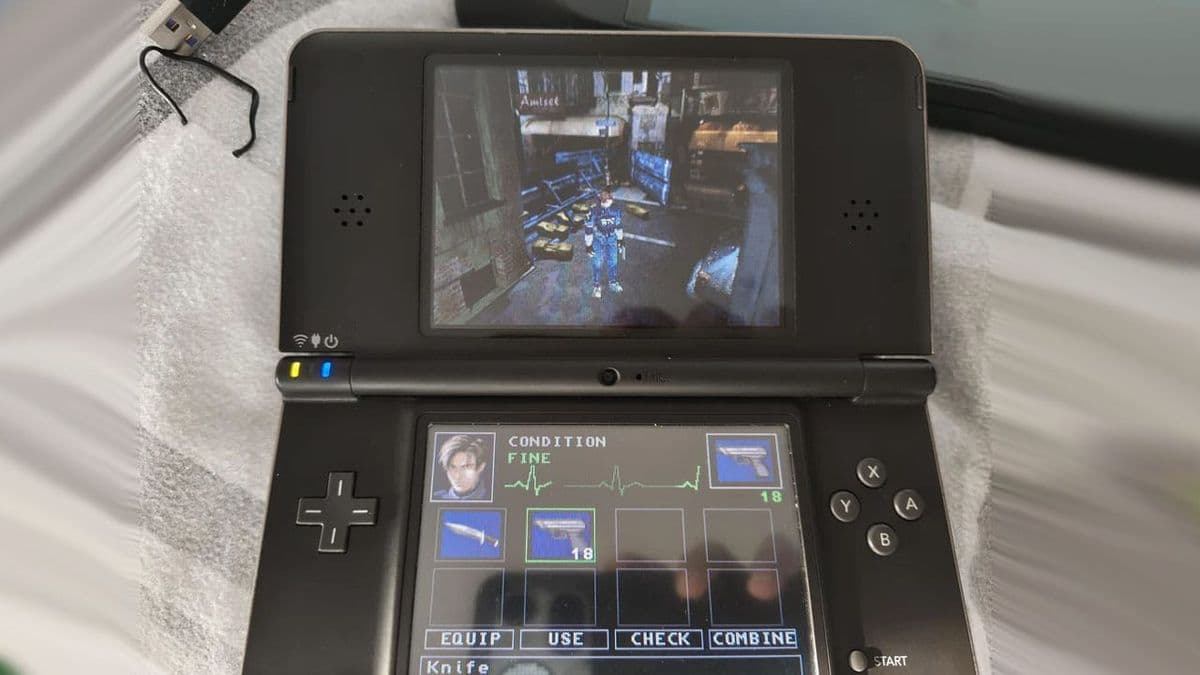
An ambitious homebrew project is porting a full resident evil 2 nintendo ds build that runs Capcom's 1998 survival horror game directly on original handheld hardware. With all 125 rooms from Leon's first PlayStation disc converted into a native dual-screen engine, you can already fight zombies in the Raccoon City police station on a DSi XL.
Leon's side of resident evil 2 nintendo ds works right now
Homebrew developers do strange things with vintage code. As reported by Retro Dodo, a team is converting the original PlayStation release of Resident Evil 2 into a native executable for Nintendo's handheld. The engine recreates game rules, room transitions, and collision geometry from scratch rather than relying on heavy emulation.
You start as Leon S. Kennedy on disc one. Every room, staircase, and locked door from that initial disc is already functional in the test builds. You can search desks for handgun bullets, dodge zombies in narrow hallways, and save your progress at typewriters using ink ribbons.
I always enjoy watching late-90s games pushed onto hardware that was never supposed to run them. The engine reads background art, collision maps, and script opcodes pulled directly from a legitimate PAL disc dump. The result feels surprisingly authentic when held in two hands, right down to the original enemy placement and door animations.
Reverse engineering tools meet modern helper AI
Building a native port for a dual-screen portable with 4MB of RAM requires systematic code disassembly. The developers assemble the project using Reverse Engineer Anything utilities to analyze the original PS1 binary inside Ghidra. They pair those analysis files with the AI utility Claude Code to speed up routine C reimplementations.
Human coders still review every line to ensure the game logic behaves like Capcom intended. If you ever spent an entire afternoon wrestling with Sound Blaster IRQ settings and config.sys files just to get audio in a DOS game, setting up the build environment shouldn't scare you off. The process relies on standard cross-compilation routines rather than mysterious magic.
To compile a playable ROM file, you need a small set of open tools:
- Windows Subsystem for Linux or a native Linux environment
- A C compiler configured with devkitARM and libnds
- Python 3 and FFmpeg development packages
- A clean ISO image from a legitimate PAL copy of the game
Once you run the conversion scripts, your computer processes the disc assets in a few minutes. The software outputs a standalone NDS file that boots in handheld emulators or flash cartridges.
What breaks when you squeeze PlayStation data onto a cartridge
Shrinking a 600MB disc down for portable storage demands aggressive file handling. The current build sits at 300MB, with the developers hoping to keep the completed file under 512MB. That size limit matters because it matches the ceiling of physical Nintendo DS memory cards.
Because the conversion remains work in progress, you'll hit rough edges during play. You can see through transparent walls in specific hallways, and background music becomes scratchy inside the police precinct. Audio distortion crops up when multiple sound channels overlap during chaotic firefights.
Cutscenes present another technical barrier. Only the opening two FMV sequences play correctly so far, while later video files drop out or skip entirely. Secondary monsters like Lickers and boss encounters also lack complete logic loops in the present code repository.
Putting two screens and an inventory to work
The layout choices make this project feel tailored for the target handheld. The upper screen handles 3D character models and pre-rendered background imagery. The lower touchscreen displays your current health status, active equipment, and room maps.
This division cleanups the presentation compared to older console ports. In typical resident evil 2 nintendo ds gameplay sessions, you combine herbs or check ammunition counts without hiding incoming threats. You tap the lower panel to rotate key items, keeping the tension on the main display unbroken.
The control scheme adapts smoothly to directional pads. Traditional tank controls suit digital buttons, so moving Leon feels sharp. You raise your firearm with a shoulder button, pivot to face approaching threats, and drop zombies before they close the distance.
Compile the ROM yourself or wait for Claire
Claire's campaign remains completely unplayable in current code. The team focused entirely on Leon's scenario to stabilize basic engine features, leaving half the story unmapped. If you want to experience both sides of the Raccoon City outbreak today, you still need original discs or modern PC re-releases.
Anyone searching for a unique resident evil 2 nintendo ds retro game experiment can test the software today. The project repository contains no proprietary Capcom graphics or sound files. You must supply your own disc image to extract the required assets legally.
If you have a disc image and a working copy of Windows Subsystem for Linux, you can grab the build tools off GitHub right now. The source code receives frequent fixes, with new commits addressing audio playback and geometry glitches each week. Grab your flash card, extract your tracks, and see how much horror fits inside 300 megabytes.
Source: Retro Dodo