
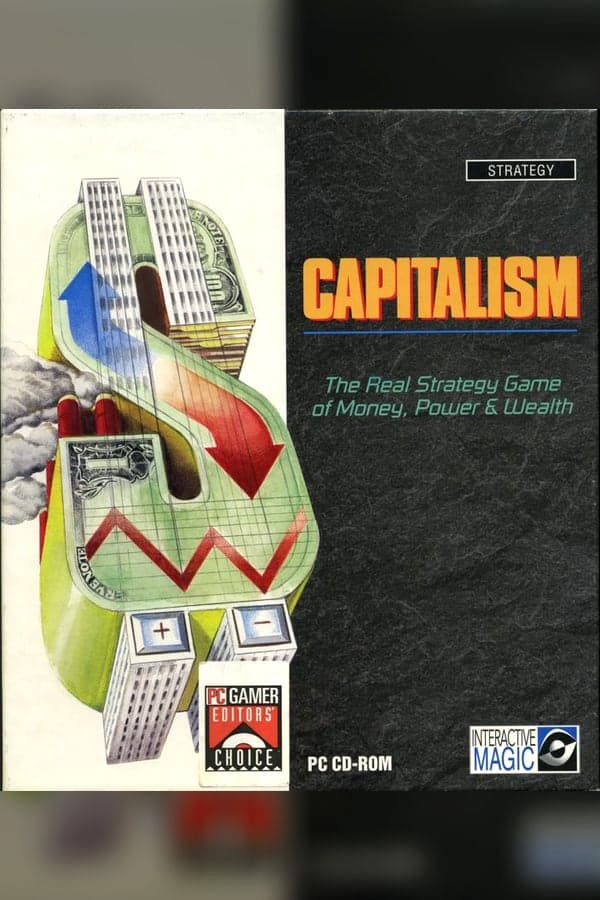
In Capitalism, you do not command armies or build fantasy kingdoms; you spend your starting corporate capital buying farmland, setting up logging operations, and driving regional retail rivals into bankruptcy.
Most real-time strategy games released in 1995 asked you to gather wood and gold so you could pump out soldiers. Enlight designer Trevor Chan took that same top-down real-time structure and threw away the military framing entirely. In this DOS release, your grid-based map is filled with real cities, land plots, and consumer markets that react directly to supply, demand, and public brand awareness.
You begin an open-ended scenario with up to $200,000,000 in capital, or you pick a structured challenge with tight deadlines like cornering a regional consumer market. Drop a logging camp next to a timber reserve, wire up a factory floor to process paper, and send the finished product straight to your own department store counters. If your retail price is too high or your quality slips below imported goods, stock sits on shelves while your cash reserves bleed out to pay land leases and employee overhead.
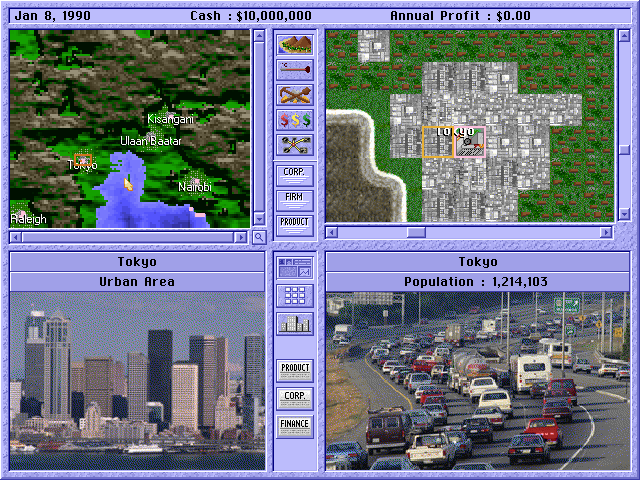
The operational depth in this Interactive Magic release was virtually unmatched among strategy games of the era. You manage internal layout blocks for every facility you construct, linking purchasing slots to production lines and sales counters. Leaving a gap in your supply line breaks the whole chain, leaving your stores empty while hungry competitors sweep in to capture the market.
The simulation engine models production cost curves, technological advantages, and competitive input monopolies with zero mercy. If a rival corporation secures all local iron mines, your appliance factories are stuck paying inflated import fees for raw materials. To counter them, you have to pump cash into Research & Development centers to engineer superior product quality, or target their company on the stock exchange for a hostile takeover.
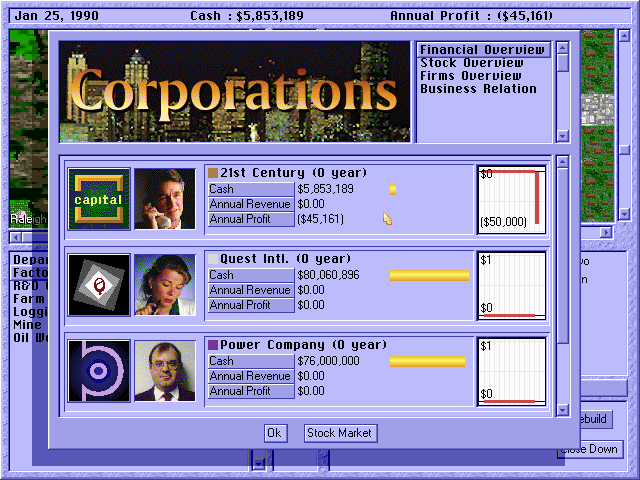
Manipulating stock is where the game turns ruthless. You can issue extra stock to fund aggressive factory expansion, payout steady dividends to keep shareholders happy, or quietly buy up shares in a rival who overextended their credit line. Once you acquire a controlling majority, you can liquidate their assets or align their manufacturing capacity to serve your own supply network.
Reviews at the time were sharply split over this density. Computer Gaming World praised it as an unmatched business simulation, while famously joking that it was so complicated it should ship with a free MBA in every box. Magazines like PC Gamer UK awarded it an 89% score for its realism, but outlets like PC Review handed down a 5/10, baffled by the sheer volume of spreadsheets and economic mechanics thrown at the player right from the start.
If you jumped straight into a complex game without reading, this title could feel downright hostile. Critical reviews on sites like Squakenet pointed out that very little on the interface was self-explanatory, leaving unguided players staring at falling revenue graphs without understanding why their stores were failing. The thick manual was mandatory reading if you wanted to survive your first trading quarter without total liquidation.
To help players get over that wall, the developers built a guided interactive teaching module that went on to win PC Gamer's Special Achievement in Tutorial Design award in 1995. Rather than dumping raw text screens on you, the tutorial walked you step by step through setting up raw material supply lines, setting retail pricing, and running effective advertising campaigns. That focus on practical instruction helped turn a potentially dry spreadsheet simulator into a game you could spend entire weekends mastering.
The game sounded surprisingly rich on standard sound cards from that time. Running on a Sound Blaster 16 or Gravis UltraSound, the General MIDI audio tracks gave corporate expansion a subtle, jaunty rhythm, while digital audio clicks and interface chimes gave every bought property plot a satisfying weight.
The sheer detail of Trevor Chan's economic model caught attention far beyond traditional gaming circles. Major news outlets like CNN, CNBC, BusinessWeek, and The Discovery Channel ran features on the title, with Discovery quipping about replacing expensive university tuition with a software box. Higher-education institutions like Harvard Business School and Stanford University eventually adopted the game to illustrate principles of leadership, market competition, and supply chain management in their classrooms.
While later releases expanded the concept, this original 1995 1995 release contains the purest iteration of the formula. The game forces you to plan long-term strategic investments while constantly rebalancing short-term retail prices, punishing reckless expansion immediately while rewarding deliberate market consolidation.
You do not need to hunt down vintage PC hardware, manage drive mounts, or tweak configuration files to wrestle with this classic business simulator today. You can play Capitalism free in your browser right now, with full real-time simulation speeds and audio ready to run from the moment you click.
If you want to experience the retail battlefield for yourself, jump into a custom scenario, set your initial capital high, and try setting up a simple farm-to-shelf dairy empire in your first city. You will quickly see why this deep balance-sheet RTS became a legend among corporate simulation fans.
In Capitalism, you do not command armies or build fantasy kingdoms; you spend your starting corporate capital buying farmland, setting up logging operations, and driving regional retail rivals into bankruptcy.
Most real-time strategy games released in 1995 asked you to gather wood and gold so you could pump out soldiers. Enlight designer Trevor Chan took that same top-down real-time structure and threw away the military framing entirely. In this DOS release, your grid-based map is filled with real cities, land plots, and consumer markets that react directly to supply, demand, and public brand awareness.
You begin an open-ended scenario with up to $200,000,000 in capital, or you pick a structured challenge with tight deadlines like cornering a regional consumer market. Drop a logging camp next to a timber reserve, wire up a factory floor to process paper, and send the finished product straight to your own department store counters. If your retail price is too high or your quality slips below imported goods, stock sits on shelves while your cash reserves bleed out to pay land leases and employee overhead.
The operational depth in this Interactive Magic release was virtually unmatched among strategy games of the era. You manage internal layout blocks for every facility you construct, linking purchasing slots to production lines and sales counters. Leaving a gap in your supply line breaks the whole chain, leaving your stores empty while hungry competitors sweep in to capture the market.
The simulation engine models production cost curves, technological advantages, and competitive input monopolies with zero mercy. If a rival corporation secures all local iron mines, your appliance factories are stuck paying inflated import fees for raw materials. To counter them, you have to pump cash into Research & Development centers to engineer superior product quality, or target their company on the stock exchange for a hostile takeover.
Manipulating stock is where the game turns ruthless. You can issue extra stock to fund aggressive factory expansion, payout steady dividends to keep shareholders happy, or quietly buy up shares in a rival who overextended their credit line. Once you acquire a controlling majority, you can liquidate their assets or align their manufacturing capacity to serve your own supply network.
Reviews at the time were sharply split over this density. Computer Gaming World praised it as an unmatched business simulation, while famously joking that it was so complicated it should ship with a free MBA in every box. Magazines like PC Gamer UK awarded it an 89% score for its realism, but outlets like PC Review handed down a 5/10, baffled by the sheer volume of spreadsheets and economic mechanics thrown at the player right from the start.
If you jumped straight into a complex game without reading, this title could feel downright hostile. Critical reviews on sites like Squakenet pointed out that very little on the interface was self-explanatory, leaving unguided players staring at falling revenue graphs without understanding why their stores were failing. The thick manual was mandatory reading if you wanted to survive your first trading quarter without total liquidation.
To help players get over that wall, the developers built a guided interactive teaching module that went on to win PC Gamer's Special Achievement in Tutorial Design award in 1995. Rather than dumping raw text screens on you, the tutorial walked you step by step through setting up raw material supply lines, setting retail pricing, and running effective advertising campaigns. That focus on practical instruction helped turn a potentially dry spreadsheet simulator into a game you could spend entire weekends mastering.
The game sounded surprisingly rich on standard sound cards from that time. Running on a Sound Blaster 16 or Gravis UltraSound, the General MIDI audio tracks gave corporate expansion a subtle, jaunty rhythm, while digital audio clicks and interface chimes gave every bought property plot a satisfying weight.
The sheer detail of Trevor Chan's economic model caught attention far beyond traditional gaming circles. Major news outlets like CNN, CNBC, BusinessWeek, and The Discovery Channel ran features on the title, with Discovery quipping about replacing expensive university tuition with a software box. Higher-education institutions like Harvard Business School and Stanford University eventually adopted the game to illustrate principles of leadership, market competition, and supply chain management in their classrooms.
While later releases expanded the concept, this original 1995 1995 release contains the purest iteration of the formula. The game forces you to plan long-term strategic investments while constantly rebalancing short-term retail prices, punishing reckless expansion immediately while rewarding deliberate market consolidation.
You do not need to hunt down vintage PC hardware, manage drive mounts, or tweak configuration files to wrestle with this classic business simulator today. You can play Capitalism free in your browser right now, with full real-time simulation speeds and audio ready to run from the moment you click.
If you want to experience the retail battlefield for yourself, jump into a custom scenario, set your initial capital high, and try setting up a simple farm-to-shelf dairy empire in your first city. You will quickly see why this deep balance-sheet RTS became a legend among corporate simulation fans.
How Capitalism is played — the keys the game listens to, grouped by what they do.
Highlighted keys are mapped — hover or tap one to see what it does.
The game primarily uses a mouse interface. The manual documents minimal explicit keyboard shortcuts beyond stock news display. Requires FILES=30 in CONFIG.SYS.
The on-screen keyboard and gamepad mapping the browser player uses on a phone, a tablet or a controller, as opposed to the real keys above. $PRO members make their own in the player and share them here; anyone can pick one to play with.
Cheat codes, console commands and memory pokes for Capitalism — each one verified and attributed.
Sign in to submitHow Capitalism is played — the keys the game listens to, grouped by what they do.
Highlighted keys are mapped — hover or tap one to see what it does.
The game primarily uses a mouse interface. The manual documents minimal explicit keyboard shortcuts beyond stock news display. Requires FILES=30 in CONFIG.SYS.
The on-screen keyboard and gamepad mapping the browser player uses on a phone, a tablet or a controller, as opposed to the real keys above. $PRO members make their own in the player and share them here; anyone can pick one to play with.
Cheat codes, console commands and memory pokes for Capitalism — each one verified and attributed.
Sign in to submit