


Designer Trevor Chan built Capitalism Plus on a simple premise: a serious business simulator does not need to entertain you with fluffy animations when cold balance sheets can ruin your life instead.
You begin with an executive board, a pool of capital anywhere from $10 million to $200 million, and a mandate to build a global corporate empire. The 1997 MS-DOS release from Enlight Software Ltd. and Interactive Magic, Inc. abandons all arcade fluff. Instead, you stare down top-down city grids and complex nested sub-menus to manage every link in your supply chain.
You can mine raw iron ore, farm livestock, or buy land in cities like London or Chicago to set up retail storefronts. Over 80 commercial products exist in the simulation, ranging from simple leather shoes and cola to high-tech electronics. If your department stores run out of stock, or your farms suffer a bad season, rival CEOs will aggressively undercut your pricing and push you out of the market entirely.
The core design forces you to weigh vertical integration against sheer speed. Do you own the logging camp, the paper mill, and the retail outlets, or do you just import semi-finished goods and focus on selling high-margin hi-tech equipment? Expanding too fast leaves you vulnerable to unexpected financial drain, where a silent burn rate of negative $80,000 a year will quietly bleed your bank accounts dry before you notice the trend.
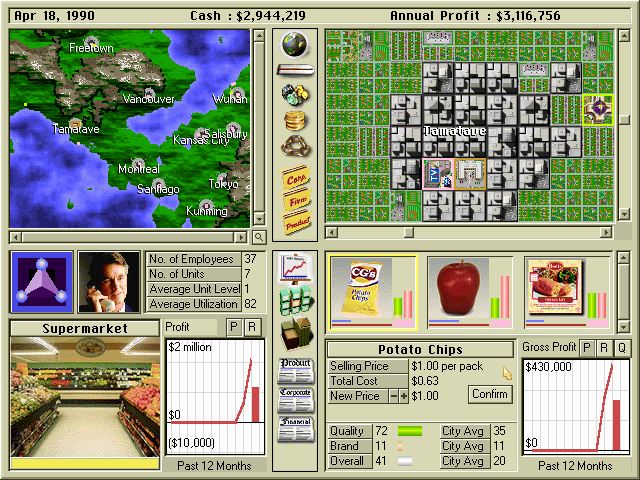
In the mid-nineties, mainstream strategy titles tried to streamline management mechanics to keep players moving fast. This simulation game did the exact opposite. Every single store unit contains internal 3x3 layout slots where you manually connect purchasing, inventory, and sales departments. Forgetting to link a single farm output to your market floor means watching inventory rot while your overhead expenses mount.
The updated graphics bumped the visual engine to 256-color SVGA at 640x480 resolution, giving you cleaner detail across regional maps and corporate ledgers. Yet no visual polish can hide the steep learning curve. The original printed manual was famously dry, offering dense economic explanations where other titles provided quick reference cards. Players who jumped in without reading the manual usually ran straight into bankruptcy within five game years.
Competing against aggressive AI CEOs leaves zero room for sloppy logistics. The computer competitors constantly check market shares, launch price wars, and buy up shares in your publicly traded company. If you lose track of your stock float, a rival firm can initiate a hostile takeover and fire you from your own front office, triggering an immediate game over.
What set this expanded version apart from the original 1995 release was its suite of custom scenarios and random world events. Scenarios like "The Emerging Dragon Scenario" tested your ability to survive rapid shifts in regional trade. Meanwhile, real-world maps spanning Asia, Europe, and the United States gave players recognizable economic geography to conquer.
Random occurrences actively disrupt long-term plans. An earthquake can wreck your manufacturing hubs, or a political revolution can instantly cut off supply lines for foreign raw materials. These mechanics force you to hold substantial cash reserves rather than reinvesting every single dollar into rapid physical expansion.
$$$***$$$ during active gameplay to grant your corporate account an instant $100 million injection.???***??? to immediately unlock and discover every product technology in the game catalog.SETD sound utility inside the game's audio folder to reconfigure hardware drivers if sound drops out.
The game is completely unyielding to modern casual expectations. The user interface relies heavily on nested tables, line graphs, and tiny icons. Micromanaging multiple production lines across four different cities quickly turns into an intense administrative exercise. If you hate tracking unit profit margins or tweaking internal transfer prices, you will bounce off this title within fifteen minutes.
Yet for players who enjoy deep economic mechanics, the depth is unmatched for an era dominated by simpler city builders. Seeing a fully integrated manufacturing network flood a city market and drive every single competitor out of business delivers a unique sense of accomplishment. Combining both releases, the franchise sold over 150,000 copies by 2000, establishing a loyal base of dedicated strategy fans.
Despite its intimidating menus, Trevor Chan created a corporate simulation that rewards careful planning over quick reflexes. If you want to test your supply chain strategy without wrestling with vintage hardware setups, you can play Capitalism Plus free in your browser right here. Boot it up, set your starting capital, and see if you can dominate the free market without going bankrupt in your first quarter.
Designer Trevor Chan built Capitalism Plus on a simple premise: a serious business simulator does not need to entertain you with fluffy animations when cold balance sheets can ruin your life instead.
You begin with an executive board, a pool of capital anywhere from $10 million to $200 million, and a mandate to build a global corporate empire. The 1997 MS-DOS release from Enlight Software Ltd. and Interactive Magic, Inc. abandons all arcade fluff. Instead, you stare down top-down city grids and complex nested sub-menus to manage every link in your supply chain.
You can mine raw iron ore, farm livestock, or buy land in cities like London or Chicago to set up retail storefronts. Over 80 commercial products exist in the simulation, ranging from simple leather shoes and cola to high-tech electronics. If your department stores run out of stock, or your farms suffer a bad season, rival CEOs will aggressively undercut your pricing and push you out of the market entirely.
The core design forces you to weigh vertical integration against sheer speed. Do you own the logging camp, the paper mill, and the retail outlets, or do you just import semi-finished goods and focus on selling high-margin hi-tech equipment? Expanding too fast leaves you vulnerable to unexpected financial drain, where a silent burn rate of negative $80,000 a year will quietly bleed your bank accounts dry before you notice the trend.

In the mid-nineties, mainstream strategy titles tried to streamline management mechanics to keep players moving fast. This simulation game did the exact opposite. Every single store unit contains internal 3x3 layout slots where you manually connect purchasing, inventory, and sales departments. Forgetting to link a single farm output to your market floor means watching inventory rot while your overhead expenses mount.
The updated graphics bumped the visual engine to 256-color SVGA at 640x480 resolution, giving you cleaner detail across regional maps and corporate ledgers. Yet no visual polish can hide the steep learning curve. The original printed manual was famously dry, offering dense economic explanations where other titles provided quick reference cards. Players who jumped in without reading the manual usually ran straight into bankruptcy within five game years.
Competing against aggressive AI CEOs leaves zero room for sloppy logistics. The computer competitors constantly check market shares, launch price wars, and buy up shares in your publicly traded company. If you lose track of your stock float, a rival firm can initiate a hostile takeover and fire you from your own front office, triggering an immediate game over.
What set this expanded version apart from the original 1995 release was its suite of custom scenarios and random world events. Scenarios like "The Emerging Dragon Scenario" tested your ability to survive rapid shifts in regional trade. Meanwhile, real-world maps spanning Asia, Europe, and the United States gave players recognizable economic geography to conquer.
Random occurrences actively disrupt long-term plans. An earthquake can wreck your manufacturing hubs, or a political revolution can instantly cut off supply lines for foreign raw materials. These mechanics force you to hold substantial cash reserves rather than reinvesting every single dollar into rapid physical expansion.
$$$***$$$ during active gameplay to grant your corporate account an instant $100 million injection.???***??? to immediately unlock and discover every product technology in the game catalog.SETD sound utility inside the game's audio folder to reconfigure hardware drivers if sound drops out.
The game is completely unyielding to modern casual expectations. The user interface relies heavily on nested tables, line graphs, and tiny icons. Micromanaging multiple production lines across four different cities quickly turns into an intense administrative exercise. If you hate tracking unit profit margins or tweaking internal transfer prices, you will bounce off this title within fifteen minutes.
Yet for players who enjoy deep economic mechanics, the depth is unmatched for an era dominated by simpler city builders. Seeing a fully integrated manufacturing network flood a city market and drive every single competitor out of business delivers a unique sense of accomplishment. Combining both releases, the franchise sold over 150,000 copies by 2000, establishing a loyal base of dedicated strategy fans.
Despite its intimidating menus, Trevor Chan created a corporate simulation that rewards careful planning over quick reflexes. If you want to test your supply chain strategy without wrestling with vintage hardware setups, you can play Capitalism Plus free in your browser right here. Boot it up, set your starting capital, and see if you can dominate the free market without going bankrupt in your first quarter.
How Capitalism Plus is played — the keys the game listens to, grouped by what they do.
Highlighted keys are mapped — hover or tap one to see what it does.
The on-screen keyboard and gamepad mapping the browser player uses on a phone, a tablet or a controller, as opposed to the real keys above. $PRO members make their own in the player and share them here; anyone can pick one to play with.
Cheat codes, console commands and memory pokes for Capitalism Plus — each one verified and attributed.
Sign in to submitaka Capitalism Plus: Die definitive Simulation der realen Wirtschaftswelt · Capitalism Plus: La reference en matiere de simulation economique et financiere
How Capitalism Plus is played — the keys the game listens to, grouped by what they do.
Highlighted keys are mapped — hover or tap one to see what it does.
The on-screen keyboard and gamepad mapping the browser player uses on a phone, a tablet or a controller, as opposed to the real keys above. $PRO members make their own in the player and share them here; anyone can pick one to play with.
Cheat codes, console commands and memory pokes for Capitalism Plus — each one verified and attributed.
Sign in to submit