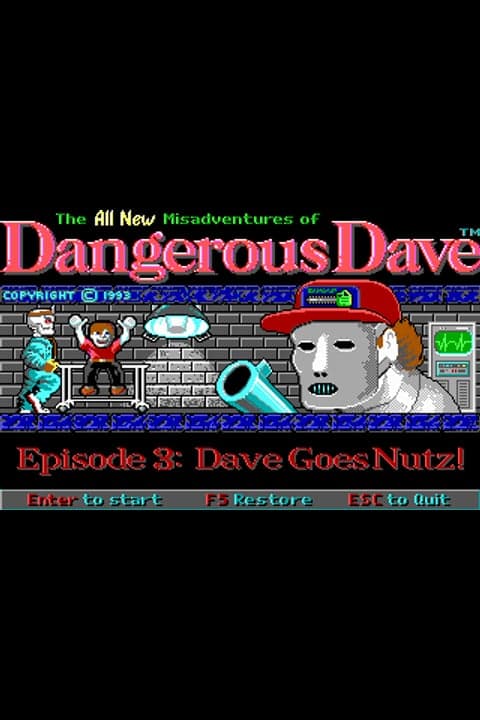
Dangerous Dave in Copyright Infringement
Running Dangerous Dave in Copyright Infringement for the first time reveals a strange sight: John Romero's crude platforming hero wandering through a cloned layout of World 1-1 from Super Mario Bros. 3. Built over a single night, this tech demo proved that a standard PC could scroll full graphics as smoothly as a dedicated home console.
A midnight hack that altered PC graphics
In September 1990, smooth horizontal scrolling on an MS-DOS machine was widely considered impossible without expensive display hardware. Most computer platformers of the era updated their views by redrawing entire frames or flipping screen pages, resulting in a jerky, stuttering motion that looked primitive next to the Nintendo Entertainment System. John Carmack cracked the problem while working at Softdisk by manipulating the EGA graphics card's panning registers and CRTC start addresses. By tricking the hardware into shifting display memory by single pixels and only redrawing tiny strips of graphics at the edges, he achieved liquid-smooth motion on standard hardware.
Carmack showed his engine to designer Tom Hall, and the pair stayed up until five in the morning on September 20 to construct a working test. Hall laboriously recreated the opening stage of Nintendo's flagship platformer tile by tile, swapping in the sprite of Dave from Romero's earlier disk-magazine game. They saved the finished program onto a 3.5-inch floppy disk, stuck a handwritten label on it that read "Run me", and left it on Romero's keyboard. When Romero loaded it up later that morning, the visual result immediately convinced the group to quit their jobs at Softdisk and form id Software.
What playing Dangerous Dave in Copyright Infringement feels like on screen
When you launch this 1990 prototype, you take control of Dave standing on green ground under a pale blue sky. You can move left or right and press the jump button to leap into the air. The movement speed is quick, and the screen glides alongside your character without a single frame of screen tearing or stutter. It feels completely distinct from the blocky page-flipping transitions common to other action games of that year.
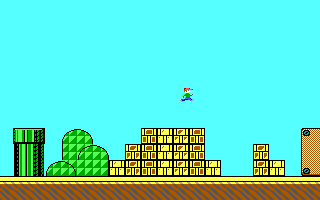
The illusion breaks down the moment you try to interact with the level structure. You can jump up and strike the floating yellow blocks decorated with question marks, but nothing comes out of them. There are no mushrooms to collect, no fire flowers to grant power-ups, and no coins to boost a score counter. The level contains zero enemies, so you never have to dodge a patrolling creature or time a jump over a hostile hazard. It is a empty playground built for a single technical test.
Dangerous Dave in Copyright Infringement showed what hardware could do
Because the main goal was to test screen motion rather than mechanics, the software strips away almost everything players take for granted in an MS-DOS game. There are no sound effects, no background music, no title sequence, and no score tracking. You walk from the starting area toward the right until you reach the end of the reconstructed stage geometry, at which point there is nowhere left to go.

The package that circulated among enthusiasts later included TED, the level editor written by Romero that allowed the team to construct tile layouts rapidly. While the demo itself offers only a few minutes of exploration, looking at how the level was put together gives clear context for how PC game development tools were evolving at the time. The software includes specific constraints that reveal its nature as a quick internal test:
- Only one side-scrolling level is available to run.
- All question mark blocks and brick structures are solid visual props with no active code behind them.
- There are no win conditions, loss states, or hazard zones that can destroy your character.
- The package includes no built-in save functions or system options.
Evaluating the demo as software rather than history
Modern players who load up this test usually agree with retro retrospectives: as an actual game, it is completely lacking. Reviews on DOSGames.com award it high marks purely for its status as a historical turning point, while openly acknowledging that the software offers almost no entertainment value past the first thirty seconds. You walk right, leap over a couple of pipes, hit a block that refuses to budge, and hit the escape key.
The team originally hoped to turn this breakthrough into a commercial deal. They polished the engine and used it to pitch an official PC conversion of Super Mario Bros. 3 directly to Nintendo. Nintendo management praised their technical work but turned the offer down, stating they had no interest in releasing their original intellectual property on non-Nintendo hardware. Rather than throwing the code away, Carmack, Hall, and Romero reworked the graphics, created a original character named Commander Keen, and published their work through Apogee Software instead.
Where to play Dangerous Dave in Copyright Infringement today
This prototype holds up exclusively as a ten-second technical demo. If you want a deep platformer with tight level design, bosses, or scoring, this is not the title to spend an evening playing. It matters because it is the exact spark that triggered the creation of one of the most famous development teams in PC history. Seeing how fluidly that camera tracks Dave across Nintendo's green fields makes it instantly clear why Romero was ready to resign on the spot after seeing it run.
You can play Dangerous Dave in Copyright Infringement online right now, free in your browser with zero setup required. Load it up, press the right arrow key, and jump into the first floating block to feel the exact pixel-smooth motion that launched id Software thirty-five years ago.