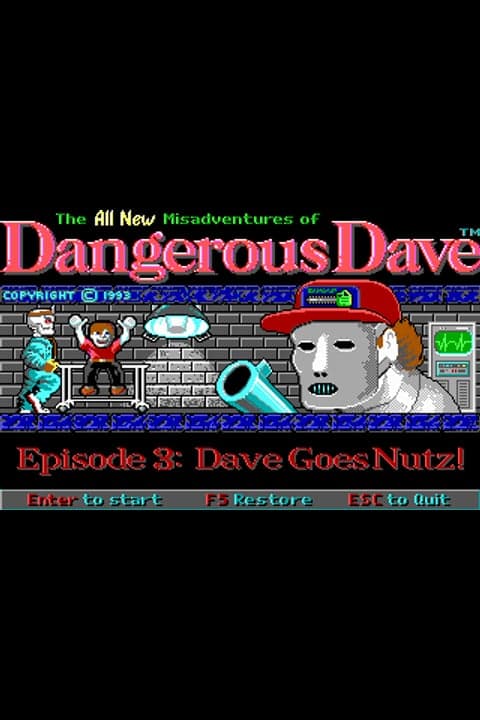
Dangerous Dave in: Dave Goes Nutz
aka Dangerous Dave 4
You will know within three screens of starting Dangerous Dave in: Dave Goes Nutz whether your muscle memory from standard side-scrollers is going to betray you. Your shotgun requires Dave to come to a complete dead stop to slide fresh shells into the breech, turning every zombie encounter in this mental hospital into a tense exercise in distance management.
The shotgun momentum in Dangerous Dave in: Dave Goes Nutz changes platforming into a dangerous rhythm game
The moment this game clicks is when you stop trying to run and gun like standard arcade heroes and start treating every corridor like a tactical queue. Dangerous Dave is on a rescue run through a twisted psychiatric hospital to save his younger brother Delbert from Dr. Nemesis, but his main tool is a weapon with strict mechanical physical habits. You can aim at upward angles to pick off threats on overhead platforms, but every shot brings you closer to an empty chamber that requires Dave to freeze in place and reload.
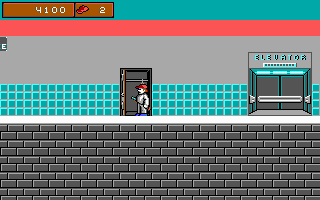
That forced pause breaks the fluid movement you might expect from an action game on PC. When a wacko on wheels comes hurtling across a tiled floor or a zombie lunges from a dark doorway, shooting too late leaves you locked in a reload animation while the hazard closes the gap. You learn to clear your chamber early, retreat two steps, let the reload finish, and only then step into the line of sight. It creates a deliberate, rhythmic pace that feels entirely distinct from its platforming peers.
Softdisk built this asylum adventure without John Romero at the helm
By the time this fourth entry hit subscriber disks, series creator John Romero had long since departed Softdisk to co-found id Software. The development fell to Softdisk's Gamer's Edge division, with level design handled by Stephen Vekovius, project management by Sean Golden, and testing by Judy Mangham. The team built the game on the engine originally created for Keen Dreams, which gave the side-scrolling movement a light, buoyant jump physics that contrasts strangely with the grit on screen.
Without Romero directing the level layouts, the design team leaning into a distinctly morbid sense of humor. The hospital walls are plastered with grim detail, and the hazard design trades fantasy traps for sharp industrial splatters. An Apple II conversion titled Dangerous Dave Goes Nutz! followed later in 1995 using the Double Dangerous Dave engine, but the 1993 MS-DOS game remains the definitive release that subscribers booted up from their monthly disk packages.
Unforgiving hazards make Dangerous Dave in: Dave Goes Nutz a test of patience
The dark trade-off in the game design is how ruthlessly the level layouts punish minor input mistakes. The controls carry a subtle momentum lag that makes fine precision jumps over instant-death traps tricky to land consistently. Later floors repeat tile sets heavily, meaning the visual novelty wears off after the first handful of stages while the difficulty spikes sharply.
Traps are frequently placed just beyond the edge of your screen or directly at the landing point of a mandatory drop, meaning your first life on any new screen is often a sacrificial scouting run. It is the kind of design where hazards seem intentionally engineered to mock your reaction times rather than test your skill. If you miss a jump by two pixels, Dave drops straight into a hazard pit, forcing a complete retry of the level structure.
How built-in cheats and Sound Blaster audio carried players through the repetition
Softdisk clearly recognized how brutal their level geometry was, because they baked a comprehensive set of debug commands directly into the release build. By holding down CapsLock along with specific key combinations, you could bypass the brutal difficulty entirely or survey the floor structures without risking your life total:
- CapsLock + G toggles God Mode for complete invincibility.
- CapsLock + I awards free items to stock your inventory.
- CapsLock + W opens a level warp menu to bypass troublesome sections.
- CapsLock + M displays current system memory usage metrics.
- CapsLock + P pauses the action screen instantly.
- CapsLock + V prints engine version information.
- CapsLock + Q executes an immediate quick quit to the command prompt.
Running the game with proper Sound Blaster hardware configured makes a huge difference to the presentation. Hearing the sharp blast of the shotgun and the chunky metallic click of Dave cycling shells through an expansion card synthesizer provided audio feedback that simple PC speaker beeps could never replicate. That tactile audio loop helped soften the blow when replaying early corridors after an unseen trap caught you off guard.
Why you should fire up Dangerous Dave in: Dave Goes Nutz free in your browser tonight
What holds up today is the weight of the shot placement and the raw tension of managing your ammo count while cornered in a hallway. What does not hold up is the mid-game visual fatigue and the sheer spitefulness of blind drops into hidden floor spikes. It is a short, punchy retro challenge best suited for anyone who wants to see how PC developers in 1993 attempted to mix horror themes with tight arcade shooting before full 3D environments took over the market.
You can play Dangerous Dave in: Dave Goes Nutz online right now directly in your browser window. Modern players often expect Dave to shoot while sprinting, so remember from your very first room that you must come to a complete stop to reload your weapon. Take your time, listen for enemy footfalls around corners, and keep the CapsLock shortcuts in mind if Dr. Nemesis's asylum traps start getting the better of your patience.
