
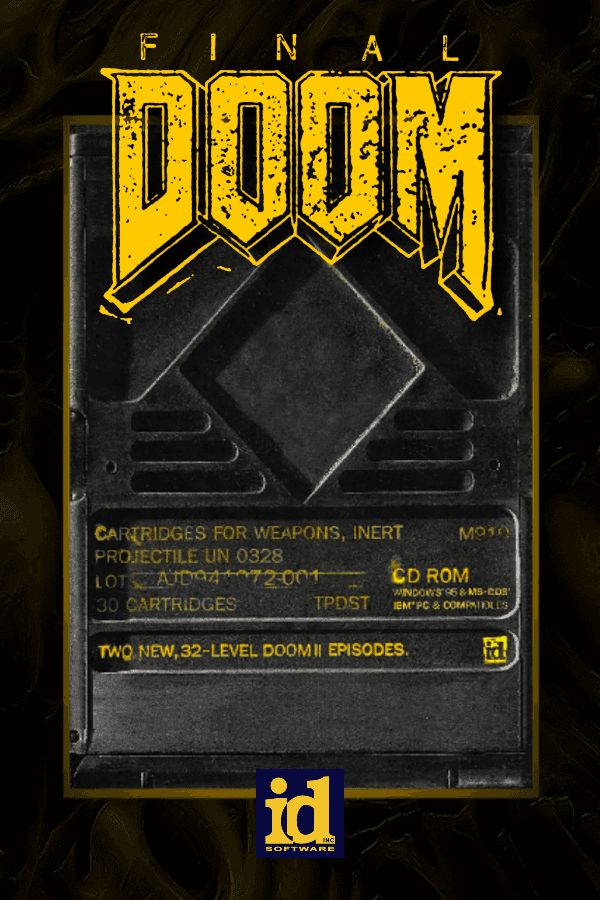

If you thought Doom II was harsh, booting up Final DOOM in 1996 was a swift reality check delivered by hitscanners from across a darkened room.
You start up Final DOOM expecting familiar room clearances, but the game immediately demands absolute precision. Enemies from Doom II return in force, including the bone-chilling screech of the Arch-vile and the unrelenting rocket salvos of the Cyberdemon boss. The base engine mechanics remain identical to the 1994 release, but the layout philosophy shifts entirely toward ruthless tactical survival.
The package contains two full 32-level campaigns: TNT: Evilution and The Plutonia Experiment. Neither set was built directly inside id Software, though the studio published the combined commercial release for MS-DOS. Instead, community modders crafted these campaigns for players who had already mastered every secret room in the original games.
Your arsenal covers the standard lineup from the chainsaw up to the BFG 9000. You still scavenge for keycards while managing meager shotgun shells and hunting for Invulnerability spheres. However, the level design turns everyday corridors into lethal choke points designed to strip away your armor seconds after loading into a map.
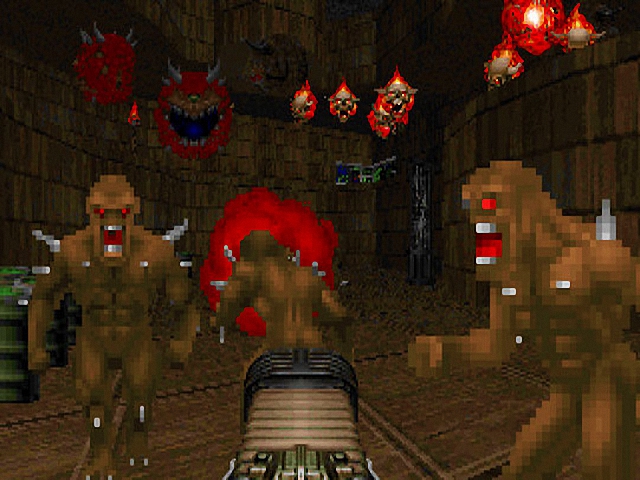
The first campaign was built by the community group TeamTNT. It leans heavily into thematic environments and maze-like geometry. Maps like MAP01: System Control and MAP02: Human BBQ set a grim mood early on, while MAP03: Power Control and MAP04: Wormhole make you work out teleporter paths and secret switches far more than standard commercial shooters.
This episode introduced a fresh soundtrack with custom MIDI tracks composed by Tom Mustaine, Jonathan El-Bizri, Josh Martel, and L.A. Sieben. The synth instrumentation gives the campaign a distinct electronic tone through a Sound Blaster card. The music builds real tension as you navigate dark corridors searching for concealed progress switches.
However, TNT: Evilution holds a notorious place in PC gaming history due to a progression bug. In original unpatched versions, MAP31 contained a missing yellow key that was completely unreachable. Players were forced to use the classic IDCLIP noclip cheat or IDKFA key cheat code just to exit the level. Outside of cheat codes, map layouts could become frustratingly obscure, forcing long backtracks through cleared hallways just to figure out which wall had opened.
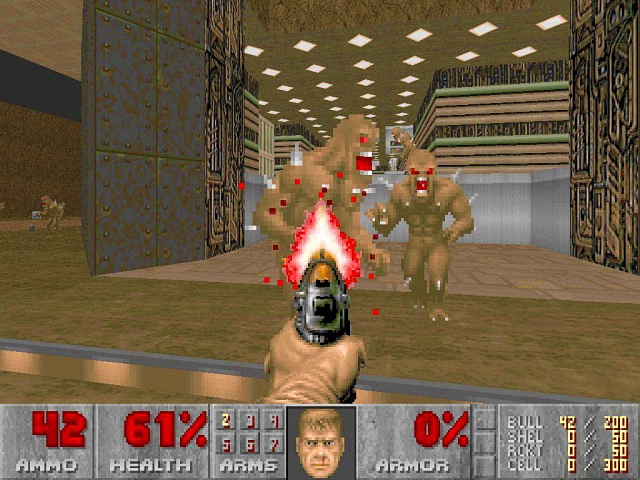
Brothers Dario and Milo Casali designed the second campaign after id Software requested additional content. The Plutonia Experiment skips slow burn exploration entirely and throws you straight into dense crossfires. It reuses the original audio tracks from earlier games, but its level layout is far more aggressive.
Plutonia relies heavily on trap placement. Opening a door or picking up a Berserk pack often triggers concealed monster closets behind you. Chaingunners sit perched on distant ledges hiding in shadow, while Arch-viles resurrect dead foes right in your line of fire. Secret stages like MAP31: Cyberden and MAP32: Go2it present brutal crowd control tests that punish hesitant movement.
I had not much sympathy for people who played on Hard and complained it was too hard.
Level designer Dario Casali famously brushed off complaints about the absurd spike in difficulty. If you choose Hurt Me Plenty or Ultra-Violence, the game expects you to know enemy attack patterns by heart. You must circle-strafe through narrow arenas while managing hitscan damage from all directions.
When this 1996 game landed in stores, critical reception was split right down the middle. Gaming magazine Computer and Video Games praised the intense challenge, declaring the series was going out with a bang. Meanwhile, French publication Joystick handed out a 77% score, and Gen4 rated it a harsh 2 out of 6.
Writing for GameSpot, reviewer Jim Varner gave the game a 4.6 out of 10 score. Many critics pointed out that free fan maps were flooding online bulletin boards for free. Paying full retail price for recycled textures and monster sprites felt hard to justify to writers who were already looking ahead to fully 3D engines.
Yet for dedicated fans of action games, the sheer craft of the map layouts mattered more than tech upgrades. Standard DOS cheat codes like IDDQD for god mode and IDCLEV for level warping allowed players to jump straight into late-game monster arenas. The precision of the combat sandbox held up even as newer engines pushed true 3D environments.
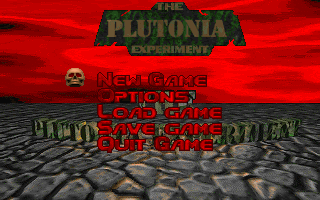
If you want a pure test of your retro shooter reflexes, the DOS version of Final DOOM still hits hard. While TNT focuses on puzzle layouts, Plutonia dumps you straight into tight ambushes packed with arch-vills and chaingunners. The controls respond instantly, the shotguns hit with real weight, and scraping through a map with single-digit health feels earned every single time.
You can play Final DOOM online, free in your browser, with nothing to install and no complex setup required. Boot up The Plutonia Experiment right now, grab your super shotgun, and see how long you survive against the first room of Chaingunners.
If you thought Doom II was harsh, booting up Final DOOM in 1996 was a swift reality check delivered by hitscanners from across a darkened room.
You start up Final DOOM expecting familiar room clearances, but the game immediately demands absolute precision. Enemies from Doom II return in force, including the bone-chilling screech of the Arch-vile and the unrelenting rocket salvos of the Cyberdemon boss. The base engine mechanics remain identical to the 1994 release, but the layout philosophy shifts entirely toward ruthless tactical survival.
The package contains two full 32-level campaigns: TNT: Evilution and The Plutonia Experiment. Neither set was built directly inside id Software, though the studio published the combined commercial release for MS-DOS. Instead, community modders crafted these campaigns for players who had already mastered every secret room in the original games.
Your arsenal covers the standard lineup from the chainsaw up to the BFG 9000. You still scavenge for keycards while managing meager shotgun shells and hunting for Invulnerability spheres. However, the level design turns everyday corridors into lethal choke points designed to strip away your armor seconds after loading into a map.
The first campaign was built by the community group TeamTNT. It leans heavily into thematic environments and maze-like geometry. Maps like MAP01: System Control and MAP02: Human BBQ set a grim mood early on, while MAP03: Power Control and MAP04: Wormhole make you work out teleporter paths and secret switches far more than standard commercial shooters.
This episode introduced a fresh soundtrack with custom MIDI tracks composed by Tom Mustaine, Jonathan El-Bizri, Josh Martel, and L.A. Sieben. The synth instrumentation gives the campaign a distinct electronic tone through a Sound Blaster card. The music builds real tension as you navigate dark corridors searching for concealed progress switches.
However, TNT: Evilution holds a notorious place in PC gaming history due to a progression bug. In original unpatched versions, MAP31 contained a missing yellow key that was completely unreachable. Players were forced to use the classic IDCLIP noclip cheat or IDKFA key cheat code just to exit the level. Outside of cheat codes, map layouts could become frustratingly obscure, forcing long backtracks through cleared hallways just to figure out which wall had opened.
Brothers Dario and Milo Casali designed the second campaign after id Software requested additional content. The Plutonia Experiment skips slow burn exploration entirely and throws you straight into dense crossfires. It reuses the original audio tracks from earlier games, but its level layout is far more aggressive.
Plutonia relies heavily on trap placement. Opening a door or picking up a Berserk pack often triggers concealed monster closets behind you. Chaingunners sit perched on distant ledges hiding in shadow, while Arch-viles resurrect dead foes right in your line of fire. Secret stages like MAP31: Cyberden and MAP32: Go2it present brutal crowd control tests that punish hesitant movement.
I had not much sympathy for people who played on Hard and complained it was too hard.
Level designer Dario Casali famously brushed off complaints about the absurd spike in difficulty. If you choose Hurt Me Plenty or Ultra-Violence, the game expects you to know enemy attack patterns by heart. You must circle-strafe through narrow arenas while managing hitscan damage from all directions.
When this 1996 game landed in stores, critical reception was split right down the middle. Gaming magazine Computer and Video Games praised the intense challenge, declaring the series was going out with a bang. Meanwhile, French publication Joystick handed out a 77% score, and Gen4 rated it a harsh 2 out of 6.
Writing for GameSpot, reviewer Jim Varner gave the game a 4.6 out of 10 score. Many critics pointed out that free fan maps were flooding online bulletin boards for free. Paying full retail price for recycled textures and monster sprites felt hard to justify to writers who were already looking ahead to fully 3D engines.
Yet for dedicated fans of action games, the sheer craft of the map layouts mattered more than tech upgrades. Standard DOS cheat codes like IDDQD for god mode and IDCLEV for level warping allowed players to jump straight into late-game monster arenas. The precision of the combat sandbox held up even as newer engines pushed true 3D environments.
If you want a pure test of your retro shooter reflexes, the DOS version of Final DOOM still hits hard. While TNT focuses on puzzle layouts, Plutonia dumps you straight into tight ambushes packed with arch-vills and chaingunners. The controls respond instantly, the shotguns hit with real weight, and scraping through a map with single-digit health feels earned every single time.
You can play Final DOOM online, free in your browser, with nothing to install and no complex setup required. Boot up The Plutonia Experiment right now, grab your super shotgun, and see how long you survive against the first room of Chaingunners.
How Final DOOM is played — the keys the game listens to, grouped by what they do.
Highlighted keys are mapped — hover or tap one to see what it does.
Set up for modern play: W A S D move, the mouse turns (this engine has no mouse look, so moving the mouse forward walks), left click fires. The arrow keys still turn. Ctrl and Alt are left free because the browser uses them (Ctrl + W closes the tab).
The on-screen keyboard and gamepad mapping the browser player uses on a phone, a tablet or a controller, as opposed to the real keys above. $PRO members make their own in the player and share them here; anyone can pick one to play with.
Cheat codes, console commands and memory pokes for Final DOOM — each one verified and attributed.
Sign in to submitCheat codes, console commands and memory pokes for Final DOOM — each one verified and attributed.
Sign in to submit