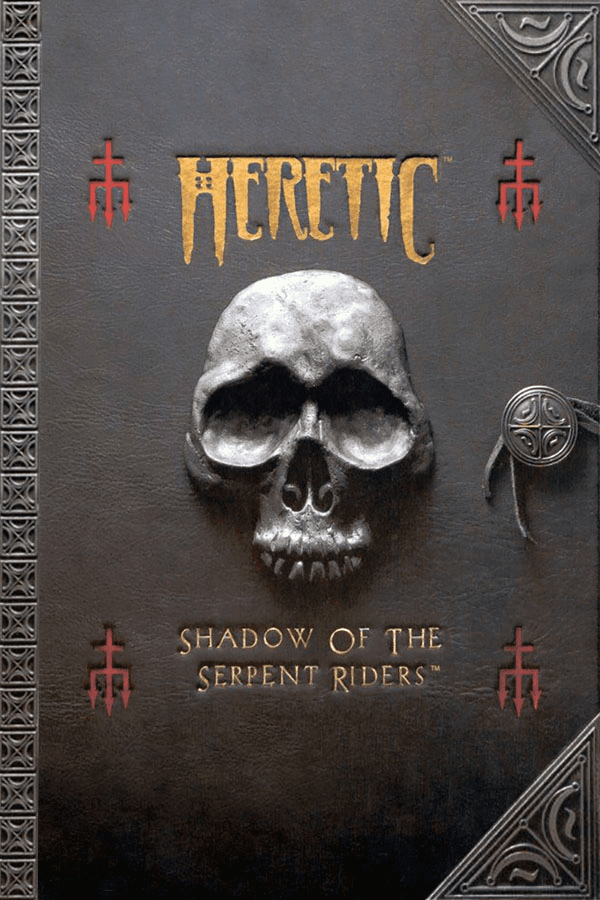
You open Heretic: Shadow of the Serpent Riders expecting a medieval coat of paint on Doom, only to find yourself flying over lava lakes and turning roaring gargoyles into squawking chickens.
When Raven Software released the original three episodes in late 1994, cynical players wrote it off as a basic reskin of id Software's hit shooter. They were not entirely wrong. You still run through labyrinthine halls, search for colored keys, and blast demonic hordes. Yet sitting down with the expanded 1996 release reveals a game that quietly reworked how first-person shooters played.
Instead of merely re-skinning weapons, director Brian Raffel and producer John Romero introduced real verticality and an inventory system. You control Corvus, an elf of the Sidhe clan fighting to avenge his slaughtered race. Armed with seven weapons ranging from a basic staff to the high-explosive Phoenix Rod, you fight through dark castles and murky swamps toward the demon sorcerer D'Sparil.
The modified id Tech 1 engine added environmental features that fundamentally altered level design. Water currents push you down rivers, wind gusts blow you off narrow ledges, and local ambient sound triggers bring the stone corridors to life.
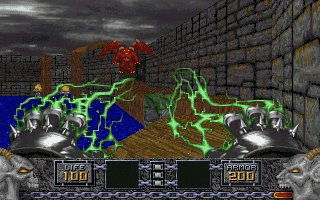
The most dramatic addition to the engine was player flight. Programmer Chris Rhinehart created the Wings of Wrath mechanic as a happy accident during development. Flying lets you soar high above enemy projectiles and reach secret ledges that would otherwise be impossible to hit.
The inventory system gave fights a layer of tactics that contemporary shooters lacked. You carry hotkeyed tools into battle and activate them whenever a corridor gets hairy:
That Tome of Power remains the star of the show. Pop it during a horde fight, and your basic Elven Wand fires three blue bolts at once while the Firemace drops giant bouncing bowling balls of death. It turns panicking defense into absolute butcher work.
If you drop into a round today, the movement still feels slick. Running speed is fast, projectiles fly clearly, and hitting an enemy with a charged weapon spray delivers a heavy hit. Gerald Brom's dark artwork gives the world a gritty look that sets it apart from typical fantasy games.
Playing the default action layout on an original rig had its share of quirks. The native MS-DOS controls assigned vertical pitch to manual keyboard keys, so aiming up and down felt clunky before modern source ports unlocked full mouselook. Sound card support was excellent, though, pushing thick MIDI tracks through Sound Blaster, Gravis UltraSound, and Roland Canvas cards.
Raven also included a sharp gag for players relying on muscle memory. Typing the Doom god-mode code iddqd instantly slays Corvus, flashing a message across the top screen: "Trying to cheat, eh? Now you die!". You have to use the official cheat code quicken instead if you want true invulnerability.
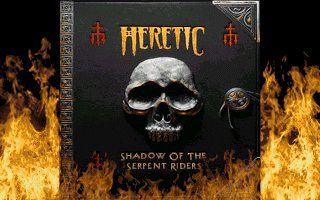
This 1996 re-release added two brand-new retail episodes, The Ossuary and The Stagnant Demesne, alongside the original trilogy. While magazines like Joystick scored the game at 91% and praised its fantasy world, long-time players quickly discovered a massive wall in these extra levels.
The expansion episodes do not add new enemy types or new weapons. Instead, they re-use the base monster lineup in brutal arrangements. You walk into narrow rooms crammed with iron liches, disciple ghosts, and maulotaurs without enough ammunition to keep them at bay.
For diehard fans, this level set is the ultimate test of resource management. For everyone else, the difficulty spike in Episode 4 feels like a punishment. If you complete those two extra chapters, you can access Episode 6, which hides three warp-only secret levels designated E6M1, E6M2, and E6M3.
Raven Software pulled off something special under publisher id Software. Rather than resting on familiar engine tech, they took risky mechanical leaps that influenced games like Hexen and Heretic II later in the decade. The weapon roster holds up, the level secrets are clever, and the inventory items give you options when a room goes sour.
The original three episodes present a fantastic campaign, even if the late-game expansion maps grind your teeth down. If you enjoy classic mid-nineties shooters, this fantasy adventure belongs right next to your annual playthroughs of Doom and Blood.
You can play 1996's Heretic: Shadow of the Serpent Riders free in your browser right now with no setup needed. Fire up your Elven Wand, pop a Tome of Power when the gargoyles corner you, and see how long your ammo holds out.
You open Heretic: Shadow of the Serpent Riders expecting a medieval coat of paint on Doom, only to find yourself flying over lava lakes and turning roaring gargoyles into squawking chickens.
When Raven Software released the original three episodes in late 1994, cynical players wrote it off as a basic reskin of id Software's hit shooter. They were not entirely wrong. You still run through labyrinthine halls, search for colored keys, and blast demonic hordes. Yet sitting down with the expanded 1996 release reveals a game that quietly reworked how first-person shooters played.
Instead of merely re-skinning weapons, director Brian Raffel and producer John Romero introduced real verticality and an inventory system. You control Corvus, an elf of the Sidhe clan fighting to avenge his slaughtered race. Armed with seven weapons ranging from a basic staff to the high-explosive Phoenix Rod, you fight through dark castles and murky swamps toward the demon sorcerer D'Sparil.
The modified id Tech 1 engine added environmental features that fundamentally altered level design. Water currents push you down rivers, wind gusts blow you off narrow ledges, and local ambient sound triggers bring the stone corridors to life.

The most dramatic addition to the engine was player flight. Programmer Chris Rhinehart created the Wings of Wrath mechanic as a happy accident during development. Flying lets you soar high above enemy projectiles and reach secret ledges that would otherwise be impossible to hit.
The inventory system gave fights a layer of tactics that contemporary shooters lacked. You carry hotkeyed tools into battle and activate them whenever a corridor gets hairy:
That Tome of Power remains the star of the show. Pop it during a horde fight, and your basic Elven Wand fires three blue bolts at once while the Firemace drops giant bouncing bowling balls of death. It turns panicking defense into absolute butcher work.
If you drop into a round today, the movement still feels slick. Running speed is fast, projectiles fly clearly, and hitting an enemy with a charged weapon spray delivers a heavy hit. Gerald Brom's dark artwork gives the world a gritty look that sets it apart from typical fantasy games.
Playing the default action layout on an original rig had its share of quirks. The native MS-DOS controls assigned vertical pitch to manual keyboard keys, so aiming up and down felt clunky before modern source ports unlocked full mouselook. Sound card support was excellent, though, pushing thick MIDI tracks through Sound Blaster, Gravis UltraSound, and Roland Canvas cards.
Raven also included a sharp gag for players relying on muscle memory. Typing the Doom god-mode code iddqd instantly slays Corvus, flashing a message across the top screen: "Trying to cheat, eh? Now you die!". You have to use the official cheat code quicken instead if you want true invulnerability.

This 1996 re-release added two brand-new retail episodes, The Ossuary and The Stagnant Demesne, alongside the original trilogy. While magazines like Joystick scored the game at 91% and praised its fantasy world, long-time players quickly discovered a massive wall in these extra levels.
The expansion episodes do not add new enemy types or new weapons. Instead, they re-use the base monster lineup in brutal arrangements. You walk into narrow rooms crammed with iron liches, disciple ghosts, and maulotaurs without enough ammunition to keep them at bay.
For diehard fans, this level set is the ultimate test of resource management. For everyone else, the difficulty spike in Episode 4 feels like a punishment. If you complete those two extra chapters, you can access Episode 6, which hides three warp-only secret levels designated E6M1, E6M2, and E6M3.
Raven Software pulled off something special under publisher id Software. Rather than resting on familiar engine tech, they took risky mechanical leaps that influenced games like Hexen and Heretic II later in the decade. The weapon roster holds up, the level secrets are clever, and the inventory items give you options when a room goes sour.
The original three episodes present a fantastic campaign, even if the late-game expansion maps grind your teeth down. If you enjoy classic mid-nineties shooters, this fantasy adventure belongs right next to your annual playthroughs of Doom and Blood.
You can play 1996's Heretic: Shadow of the Serpent Riders free in your browser right now with no setup needed. Fire up your Elven Wand, pop a Tome of Power when the gargoyles corner you, and see how long your ammo holds out.
How Heretic: Shadow of the Serpent Riders is played — the keys the game listens to, grouped by what they do.
Highlighted keys are mapped — hover or tap one to see what it does.
Set up for modern play: W A S D move, the mouse turns (this engine has no mouse look, so moving the mouse forward walks), left click fires. The arrow keys still turn. Ctrl and Alt are left free because the browser uses them (Ctrl + W closes the tab).
The on-screen keyboard and gamepad mapping the browser player uses on a phone, a tablet or a controller, as opposed to the real keys above. $PRO members make their own in the player and share them here; anyone can pick one to play with.
Cheat codes, console commands and memory pokes for Heretic: Shadow of the Serpent Riders — each one verified and attributed.
Sign in to submitHow Heretic: Shadow of the Serpent Riders is played — the keys the game listens to, grouped by what they do.
Highlighted keys are mapped — hover or tap one to see what it does.
Set up for modern play: W A S D move, the mouse turns (this engine has no mouse look, so moving the mouse forward walks), left click fires. The arrow keys still turn. Ctrl and Alt are left free because the browser uses them (Ctrl + W closes the tab).
The on-screen keyboard and gamepad mapping the browser player uses on a phone, a tablet or a controller, as opposed to the real keys above. $PRO members make their own in the player and share them here; anyone can pick one to play with.
Cheat codes, console commands and memory pokes for Heretic: Shadow of the Serpent Riders — each one verified and attributed.
Sign in to submit
Heretic: Shadow of the Serpent Riders1996 · this page