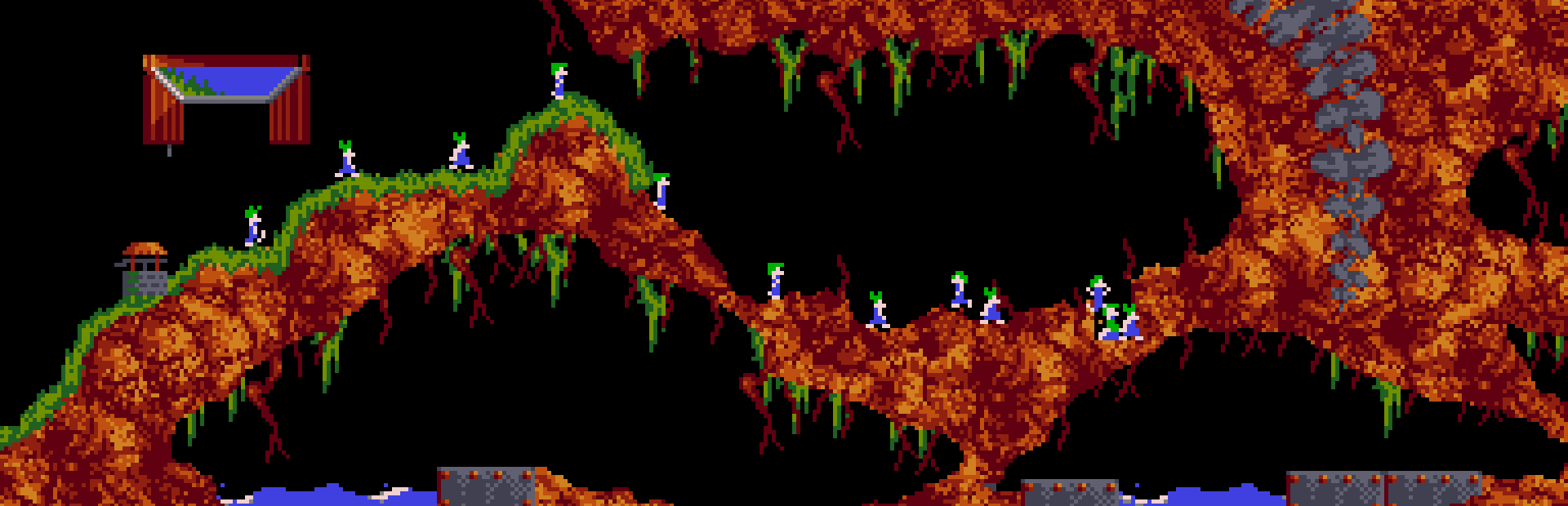


Lemmings
Streaming build
Checking storage…282 MB
Preload in background
When Lemmings hit the PC in 1991, it forced players to manage a horde of suicidal green-haired critters who would happily stride off a cliff unless you personally gave them a job to do.
Herding brainless wanderers through lethal obstacle courses
Most strategy and puzzle games on early PCs put you in direct command of an army, a spaceship, or a single nimble hero. DMA Design Limited flipped that idea upside down by handing you zero control over the creatures themselves. The little wanderers emerge one by one from a trapdoor in the ceiling, blindly marching forward at a steady pace until they hit a wall, fall into pit, or drop into boiling lava. Your job is not to move them, but to click a reticle over an individual walker and assign a limited role that alters the surrounding landscape or redirects the pack.
That subtle shift in control turned level design into a exercise in emergency traffic management. In the first few stages, saving the required percentage of your flock is simple enough. You make one turn around by building a wall, make another dig a hole through a dirt block, and construct a flimsy staircase over a gap. But as the drop rate speeds up and the hazards multiply, the screen quickly dissolves into terrifying chaos.
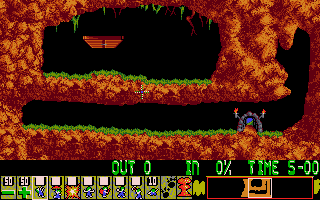
The brutal jump from simple Fun to total Mayhem
The campaign splits its 120 stages across four distinct difficulty categories: Fun, Tricky, Taxing, and Mayhem. The early stages in the Fun section act as a forgiving tutorial where you learn how each skill interacts with the terrain. You get a generous supply of Builders who throw up angled wooden ramps, Bashers who punch horizontal tunnels, Diggers who drill straight down, and Miners who cut diagonal shafts down through stone.
Once you clear the preliminary levels, the generous safety margins evaporate. By the time you reach Taxing and Mayhem, the game demands millimeter accuracy and split-second clicks. You might be handed only two Builders and a single Bomber to bypass three massive chasms and a deadly trap, requiring you to execute trick assignments while three dozen creatures bounce back and forth in a tight space. The difficulty spike in the upper levels is notorious, shifting the experience from clever pathfinding into a nerve-wracking test of mouse accuracy.
The mechanics rely on eight specific utility roles that modify worker behavior or terrain:
- Climber: Allows an individual to scale sheer vertical walls.
- Floater: Equips a tiny umbrella to survive lethal long drops.
- Blocker: Stands in place with outstretched arms to turn companions around.
- Builder: Constructs a diagonal stair path made of twelve individual wooden planks.
- Basher: Carves a horizontal tunnel through diggable walls.
- Miner: Chips away a diagonal path downwards through rock.
- Digger: Drills a wide vertical hole directly down through the floor.
- Bomber: Triggers a five-second ticking clock before exploding to destroy nearby walls and floor.
How tiny Deluxe Paint sprites grew into a PC phenomenon
The origin story of the original 1991 DOS release is one of the most famous accidents in British gaming history. While DMA Design animator Mike Dailly was working on graphics for the shooter Walker, he created a small 8x8 pixel walking animation in Deluxe Paint to demonstrate how small screen characters could still look fluid. The rest of the team started experimenting with ways to destroy the tiny figures on screen, which instantly revealed a surprisingly hilarious game loop.
Psygnosis Limited published the title with an unexpected soundtrack composed of public domain classical arrangements alongside original tracks by Tim Wright and Brian Johnston. Hearing Mozart or the traditional "Can-Can" chirping out of a AdLib or Sound Blaster card while a line of mindless marchers plunges into a pit gave the game an uncanny, darkly funny mood. Even if you only had an old PC Speaker, the sharp beep sounds when assigning tasks added a memorable layer of personality.
Overcrowded pixels, missing saves, and the armageddon button
For all its brilliance, playing the classic release today exposes a few infuriating friction points. Selecting a single target out of a dense, overlapping mob of thirty characters is genuinely painful. You will routinely misclick and assign your last valuable staircase builder to the wrong walker, watching your entire strategy collapse because two sprites occupied the exact same pixel for a fraction of a second. The game offers no undo button, forcing you to restart the entire level over a single missed mouse click.
Progression relies entirely on a four-letter level password system instead of standard save files, which was frustrating even then. Yet the developers included one feature that alleviated the rage of a ruined run: the nuke button. Represented by a double-clicked icon on the control bar, the armageddon command places a tiny countdown clock over every single creature on screen. Five seconds later, your entire population explodes into harmless confetti particles, offering a satisfying reset when a puzzle goes completely off the rails.
Play Lemmings free in your browser right now
The appeal of this classic rests on a simple truth: directing a clueless crowd is far more chaotic and satisfying than controlling a single hero. If you want to experience the classic Lemmings MS-DOS game without digging out old floppy disks, you can play Lemmings online free in your browser right here. There is nothing to install and no complex software setup required. Fire up the first level, get your crosshair mouse hand ready, and see how many marchers you can keep alive before reaching for the nuke button.
How Lemmings is played — the keys the game listens to, grouped by what they do.
- Action
- Interface
- Left click — Select skill / Assign skill
- Right click — Select walker only
Highlighted keys are mapped — hover or tap one to see what it does.
Mouse drivers must be loaded prior to starting the game. Additional command line options exist to bypass setup prompts for graphics/sound options.
Players' controls
Touch and gamepad controls
The on-screen keyboard and gamepad mapping the browser player uses on a phone, a tablet or a controller, as opposed to the real keys above. $PRO members make their own in the player and share them here; anyone can pick one to play with.
Make your own touch controlsPRO
- 1Open the editorSign in below, then pick what to make. The game starts with the editor open over it.
- 2Place your keysAdd keys and drag them where your thumbs rest, or map a controller's buttons. Test plays the game with them; Save keeps them, and you play with them from then on.
- 3Share themShare them right after saving in the game, or name and share them here. Players vote, and the best become this game's controls for everyone.
Go PROSee how it worksSign in+20 XP for sharing · +50 XP if yours become the game's own
- The game's own controlsKeyboardGamepadWhat every player starts with.In use
2 screenshots
From the archive
No reviews yet
Tell the community what you think of Lemmings. Reviews are public and tied to your username.
No archived manuals for Lemmings yet
No manuals archived for this title yet. Sign in to upload the first scan.
Cheat codes, console commands and memory pokes for Lemmings — each one verified and attributed.
Sign in to submitNo cheats yet for this title
Know a working cheat, poke or trainer? Add it with the button above. Moderators check every entry before it goes live.
No archived soundtrack for Lemmings yet
No soundtrack archived for this title yet. Sign in to upload the first rip.
No save states for Lemmings yet
No save states for this title yet. Sign in to share one.
Discussions
Sign in to post- Threads0
- Total posts0
- Online now6
Community · Lemmings
Who's contributing, and what's new
- Reviews0
- Threads0
- Uploadsapproved0
- Contributors0
Recent activity
Nothing here yet
Reviews, discussion threads and approved uploads appear here as members add them.