


By translating the classic march of green-haired lemmings into volumetric block worlds, Lemmings 3D turned a clean 2D spatial puzzle into an exercise in spatial navigation and constant camera micromanagement.
Every level starts with the same familiar trapdoor opening above a drop, but the immediate problem in Lemmings 3D is that you can no longer see the whole stage at once. Built by Clockwork Games Limited instead of original series developer DMA Design, this 1995 entry kept the foundational toolset: bashers chop horizontally, diggers tunnel straight down, blockers stop the herd in their tracks, and floater parachutes save them from lethal plummets. To handle the extra dimension, the design adds a critical new role: the turner, a skill that forces any lemming that touches it to turn 90 degrees right or left. When a procession of fifty tiny creatures comes marching down a narrow ledge, placing a turner at the exact pixel before a lethal drop into bubbling yellow mud is terrifyingly tense.
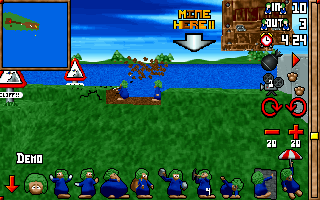
The core issue is that 3D space makes execution far more awkward than the 2D originals. Instead of clicking directly on a lemming mid-stride across a single screen, you are forced to jump between four fixed, orbiting cameras or drop into a first-person "virtual lemming" view to figure out where a path actually leads. Because the camera system does not let you tilt up or down or shift your elevation, it is easy to misjudge an overhang, miss a turn instruction, and watch your entire pack walk blindly off a cliff while you fight the view. It changes the test from pure logical planning to a battle against interface latency.
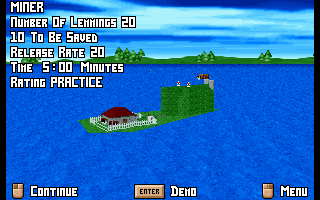
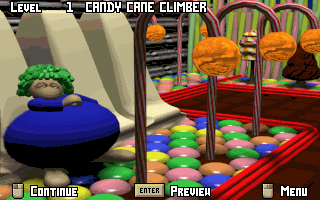
The campaign spans 80 main stages (with some counts reaching up to 100 levels depending on game modes and releases), split across four distinct themes: Ancient Egypt, Candy, Army, and Computer or Circus environments. The design relies entirely on environmental hazards rather than direct enemies. A level like "Oh No! More Pyramids!" presents a grid of blocky ramps, narrow walkways, and floating rainclouds that strike anything underneath them with fatal lightning bolts. Early stages feel forgiving enough while you master basic turning logic, but the difficulty spikes erratically. Middle-tier stages occasionally drop impossible geometry on you, only for late-game maps to demand surprisingly simple solutions once you locate the single hidden turn block.
When plans fall completely apart, you are left with the traditional nuclear option: blowing up your stuck lemmings to clear path obstructions. The developers recorded over 30 distinct voice samples for these last requests, meaning every failed run ends with a chorus of tiny "Oh No!" squeaks before they pop into dust. That dark humor helps cushion the blow when a camera hitch ruins a twenty-minute construction effort.
When published by Psygnosis Limited in 1995, response to the game fractured almost entirely on tolerance for interface overhead. PC Gamer US named it their Best Puzzle Game of 1995, falling in love with the sheer depth of its block-stacking logic. Console ports on the PlayStation and Sega Saturn had a harder time, with critics complaining that shifting camera angles under strict countdown clocks made stage management feel cumbersome. If you played it on a PC back then, you likely remember hearing the full General MIDI music tracks blaring out of a Sound Blaster card while wrestling with multi-layered menu icons just to select a digger skill.
Looking back alongside other puzzle games from 1995, the design is both clever and stubborn. The transition to polygonal terrain added valid spatial puzzles that 2D sprites simply could not support, but it traded away the instant, fluid control that made the original games so addictive. Today, dedicated fans even maintain an open-source reimplementation called LOAP to keep the game engine running natively on modern rigs, proving that the brutal satisfaction of solving these blocky mazes still holds a grip on patient players.
If you like planning your moves carefully and do not mind wrestling with rigid 90s camera controls, the DOS original offers plenty of meat to chew on. The puzzle construction itself is fair, even if the view occasionally obscures a critical drop or wall depth. Anyone curious about how developers attempted to drag classic 2D formulas into the third dimension at the dawn of real-time 3D acceleration will find a solid piece of software to test their patience against.
You can play Lemmings 3D free in your browser right here on this page, running the complete MS-DOS game with full sound and music support directly in your browser window. Once the level loads up, drop into the first stage, practice placing a couple of turners right in front of the entry point, and get a feel for cycling through all four camera perspectives before attempting the longer, multi-tiered stages. Just remember to keep an eye on your countdown timer while you scout the layout.

By translating the classic march of green-haired lemmings into volumetric block worlds, Lemmings 3D turned a clean 2D spatial puzzle into an exercise in spatial navigation and constant camera micromanagement.
Every level starts with the same familiar trapdoor opening above a drop, but the immediate problem in Lemmings 3D is that you can no longer see the whole stage at once. Built by Clockwork Games Limited instead of original series developer DMA Design, this 1995 entry kept the foundational toolset: bashers chop horizontally, diggers tunnel straight down, blockers stop the herd in their tracks, and floater parachutes save them from lethal plummets. To handle the extra dimension, the design adds a critical new role: the turner, a skill that forces any lemming that touches it to turn 90 degrees right or left. When a procession of fifty tiny creatures comes marching down a narrow ledge, placing a turner at the exact pixel before a lethal drop into bubbling yellow mud is terrifyingly tense.
The core issue is that 3D space makes execution far more awkward than the 2D originals. Instead of clicking directly on a lemming mid-stride across a single screen, you are forced to jump between four fixed, orbiting cameras or drop into a first-person "virtual lemming" view to figure out where a path actually leads. Because the camera system does not let you tilt up or down or shift your elevation, it is easy to misjudge an overhang, miss a turn instruction, and watch your entire pack walk blindly off a cliff while you fight the view. It changes the test from pure logical planning to a battle against interface latency.

The campaign spans 80 main stages (with some counts reaching up to 100 levels depending on game modes and releases), split across four distinct themes: Ancient Egypt, Candy, Army, and Computer or Circus environments. The design relies entirely on environmental hazards rather than direct enemies. A level like "Oh No! More Pyramids!" presents a grid of blocky ramps, narrow walkways, and floating rainclouds that strike anything underneath them with fatal lightning bolts. Early stages feel forgiving enough while you master basic turning logic, but the difficulty spikes erratically. Middle-tier stages occasionally drop impossible geometry on you, only for late-game maps to demand surprisingly simple solutions once you locate the single hidden turn block.
When plans fall completely apart, you are left with the traditional nuclear option: blowing up your stuck lemmings to clear path obstructions. The developers recorded over 30 distinct voice samples for these last requests, meaning every failed run ends with a chorus of tiny "Oh No!" squeaks before they pop into dust. That dark humor helps cushion the blow when a camera hitch ruins a twenty-minute construction effort.

When published by Psygnosis Limited in 1995, response to the game fractured almost entirely on tolerance for interface overhead. PC Gamer US named it their Best Puzzle Game of 1995, falling in love with the sheer depth of its block-stacking logic. Console ports on the PlayStation and Sega Saturn had a harder time, with critics complaining that shifting camera angles under strict countdown clocks made stage management feel cumbersome. If you played it on a PC back then, you likely remember hearing the full General MIDI music tracks blaring out of a Sound Blaster card while wrestling with multi-layered menu icons just to select a digger skill.
Looking back alongside other puzzle games from 1995, the design is both clever and stubborn. The transition to polygonal terrain added valid spatial puzzles that 2D sprites simply could not support, but it traded away the instant, fluid control that made the original games so addictive. Today, dedicated fans even maintain an open-source reimplementation called LOAP to keep the game engine running natively on modern rigs, proving that the brutal satisfaction of solving these blocky mazes still holds a grip on patient players.

If you like planning your moves carefully and do not mind wrestling with rigid 90s camera controls, the DOS original offers plenty of meat to chew on. The puzzle construction itself is fair, even if the view occasionally obscures a critical drop or wall depth. Anyone curious about how developers attempted to drag classic 2D formulas into the third dimension at the dawn of real-time 3D acceleration will find a solid piece of software to test their patience against.
You can play Lemmings 3D free in your browser right here on this page, running the complete MS-DOS game with full sound and music support directly in your browser window. Once the level loads up, drop into the first stage, practice placing a couple of turners right in front of the entry point, and get a feel for cycling through all four camera perspectives before attempting the longer, multi-tiered stages. Just remember to keep an eye on your countdown timer while you scout the layout.
How Lemmings 3D is played — the keys the game listens to, grouped by what they do.
Highlighted keys are mapped — hover or tap one to see what it does.
Run SETUP.EXE from the DOS prompt to configure system, graphics, and sound options.
The on-screen keyboard and gamepad mapping the browser player uses on a phone, a tablet or a controller, as opposed to the real keys above. $PRO members make their own in the player and share them here; anyone can pick one to play with.
Cheat codes, console commands and memory pokes for Lemmings 3D — each one verified and attributed.
Sign in to submitHow Lemmings 3D is played — the keys the game listens to, grouped by what they do.
Highlighted keys are mapped — hover or tap one to see what it does.
Run SETUP.EXE from the DOS prompt to configure system, graphics, and sound options.
The on-screen keyboard and gamepad mapping the browser player uses on a phone, a tablet or a controller, as opposed to the real keys above. $PRO members make their own in the player and share them here; anyone can pick one to play with.
Cheat codes, console commands and memory pokes for Lemmings 3D — each one verified and attributed.
Sign in to submit
Lemmings 3D1995 · this page