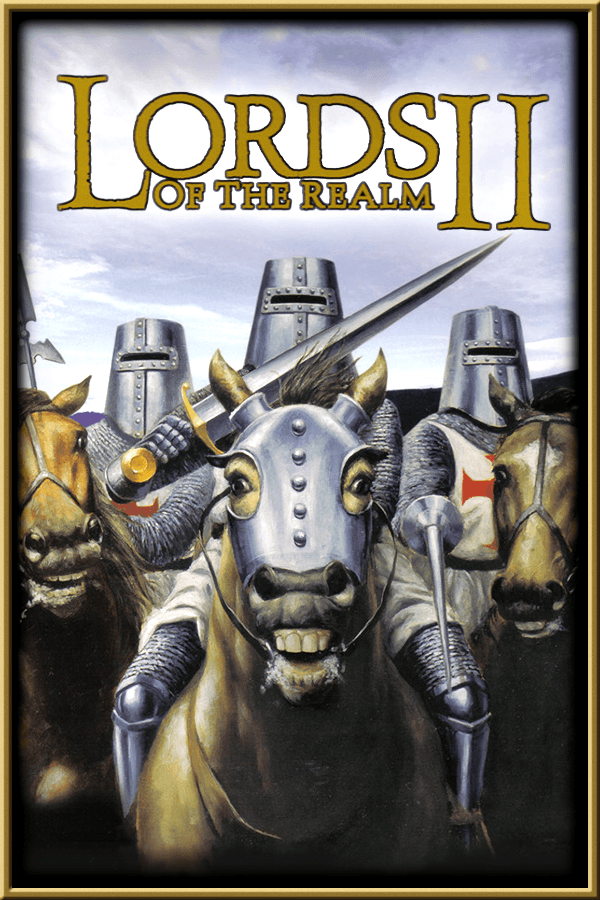

Lords of the Realm II asks you to manage medieval crop rotations and peasant rations, then hands you a tactical map where siege engines drop wall sections directly onto your own archers.
Before you ever lay siege to an enemy castle, you are managing population numbers and field allocations. Every season requires balancing grain production against cattle herds while assigning enough body count to blacksmiths and timber harvesting. If you pull too many farmers into weapon workshops, your workforce starves, tax revenues collapse, and health metrics plunge across your counties.
The core tension comes from limited hands. Your fields need workers, your blacksmiths need iron and wood, and your army needs recruits drawn straight from that same labor pool. Dragging hundreds of peasants into a hastily raised militia leaves your fields untended, setting up a brutal famine three seasons later. A single bad winter can ruin a campaign far more efficiently than an enemy army.
Your AI rivals bring distinct personalities to this economic tug of war. The Baron aggressively expands his domain, while the Bishop relies on heavy taxation and church influence. The Knight focuses on heavy cavalry, and the Countess tends to build up defensive strongholds. Balancing trade, castle construction, and army equipment against these four distinct playstyles keeps the turn-based strategic map constant and demanding.
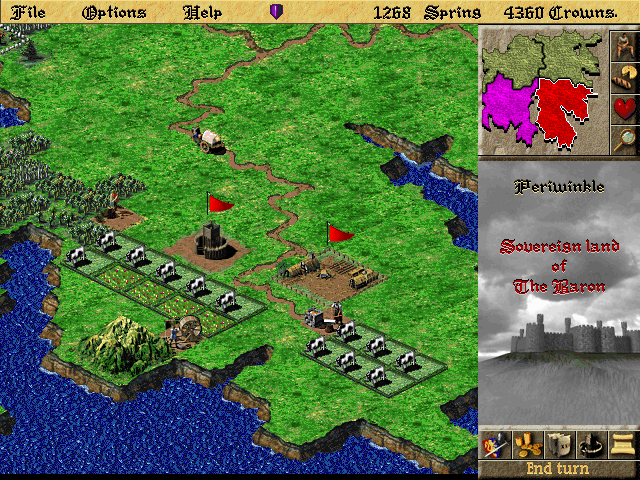
When armies meet, the game shifts from a turn-based map to real-time tactical combat. Blacksmiths craft specific gear like pikes, maces, bows, crossbows, and knight armor from gathered iron and wood. Unit types rely on a rock-paper-scissors dynamic where knight armor resists arrows, but pikes easily stop heavy horse charges.
Combat loses its polish during castle sieges. Troop movement in tight bottlenecks turns into chaotic clusters, making precise tactical control frustratingly unreliable. Units frequently ignore direct movement commands or wander into archer range while attempting to navigate broken castle walls or narrow drawbridges. When assaulting a stone keep, your line of battle often devolves into an unmanageable crowd.
Speed controls also complicate tactical combat. At default game speeds, battle encounters feel twitchy and hyperactive, forcing players to constantly pause to issue basic orders. Yet despite these control quirks, landing a siege engine hit on a crowded wall section delivers immediate satisfaction. You can also hear unit voice lines like "Slaughter THESE villagers m'lord?" during battle maneuvers.
Designed by David Lester alongside Chris Beatrice, Simon Bradbury, and Eric Ouellette, the game refined the rougher edges of its predecessor. The development team at Impressions Games made economic management far more accessible without sacrificing core depth. Shortly after completing this project and its expansion, several key designers left to form Firefly Studios, carrying these exact castle-building concepts into future titles.
The audio presentation gave the game incredible personality on PCs equipped with a Sound Blaster card. Composer Keith Zizza provided a fantastic medieval soundtrack alongside memorable sound design. The rival lords routinely interrupt campaign turns with voiced taunts, including the Baron shouting "There can be only one!" when declaring war. These audio details set the original 1996 release published by Sierra On-Line, Inc. apart from contemporary titles.
Here is what you have to manage inside each county during every seasonal turn:
The strategic layer works because economic mistakes carry real consequences. Balancing weapon production against county health creates a loop that rewards long-term planning over quick tactical rushes. The turn-based economy holds up far better than the jittery real-time battle map.
If you want to experience classic strategy tactics history, the combat pathfinding will test your patience during large castle assaults. However, the economic management and county building remain rock solid. Strategy fans looking for a rewarding medieval simulator will find plenty of depth here.
You can play Lords of the Realm II online right now. You can run this classic Lords of the Realm II MS-DOS game free in your browser without setting up complex configuration files. New players often over-tax their population early on to afford quick armies, so focus first on crop management and keeping your peasants healthy before attempting to conquer your neighboring counties.
Lords of the Realm II asks you to manage medieval crop rotations and peasant rations, then hands you a tactical map where siege engines drop wall sections directly onto your own archers.
Before you ever lay siege to an enemy castle, you are managing population numbers and field allocations. Every season requires balancing grain production against cattle herds while assigning enough body count to blacksmiths and timber harvesting. If you pull too many farmers into weapon workshops, your workforce starves, tax revenues collapse, and health metrics plunge across your counties.
The core tension comes from limited hands. Your fields need workers, your blacksmiths need iron and wood, and your army needs recruits drawn straight from that same labor pool. Dragging hundreds of peasants into a hastily raised militia leaves your fields untended, setting up a brutal famine three seasons later. A single bad winter can ruin a campaign far more efficiently than an enemy army.
Your AI rivals bring distinct personalities to this economic tug of war. The Baron aggressively expands his domain, while the Bishop relies on heavy taxation and church influence. The Knight focuses on heavy cavalry, and the Countess tends to build up defensive strongholds. Balancing trade, castle construction, and army equipment against these four distinct playstyles keeps the turn-based strategic map constant and demanding.
When armies meet, the game shifts from a turn-based map to real-time tactical combat. Blacksmiths craft specific gear like pikes, maces, bows, crossbows, and knight armor from gathered iron and wood. Unit types rely on a rock-paper-scissors dynamic where knight armor resists arrows, but pikes easily stop heavy horse charges.
Combat loses its polish during castle sieges. Troop movement in tight bottlenecks turns into chaotic clusters, making precise tactical control frustratingly unreliable. Units frequently ignore direct movement commands or wander into archer range while attempting to navigate broken castle walls or narrow drawbridges. When assaulting a stone keep, your line of battle often devolves into an unmanageable crowd.
Speed controls also complicate tactical combat. At default game speeds, battle encounters feel twitchy and hyperactive, forcing players to constantly pause to issue basic orders. Yet despite these control quirks, landing a siege engine hit on a crowded wall section delivers immediate satisfaction. You can also hear unit voice lines like "Slaughter THESE villagers m'lord?" during battle maneuvers.
Designed by David Lester alongside Chris Beatrice, Simon Bradbury, and Eric Ouellette, the game refined the rougher edges of its predecessor. The development team at Impressions Games made economic management far more accessible without sacrificing core depth. Shortly after completing this project and its expansion, several key designers left to form Firefly Studios, carrying these exact castle-building concepts into future titles.
The audio presentation gave the game incredible personality on PCs equipped with a Sound Blaster card. Composer Keith Zizza provided a fantastic medieval soundtrack alongside memorable sound design. The rival lords routinely interrupt campaign turns with voiced taunts, including the Baron shouting "There can be only one!" when declaring war. These audio details set the original 1996 release published by Sierra On-Line, Inc. apart from contemporary titles.
Here is what you have to manage inside each county during every seasonal turn:
The strategic layer works because economic mistakes carry real consequences. Balancing weapon production against county health creates a loop that rewards long-term planning over quick tactical rushes. The turn-based economy holds up far better than the jittery real-time battle map.
If you want to experience classic strategy tactics history, the combat pathfinding will test your patience during large castle assaults. However, the economic management and county building remain rock solid. Strategy fans looking for a rewarding medieval simulator will find plenty of depth here.
You can play Lords of the Realm II online right now. You can run this classic Lords of the Realm II MS-DOS game free in your browser without setting up complex configuration files. New players often over-tax their population early on to afford quick armies, so focus first on crop management and keeping your peasants healthy before attempting to conquer your neighboring counties.
How Lords of the Realm II is played — the keys the game listens to, grouped by what they do.
Highlighted keys are mapped — hover or tap one to see what it does.
Key remapping is not available in-game; remapping requires external utilities such as DOSBox Mapper.
The on-screen keyboard and gamepad mapping the browser player uses on a phone, a tablet or a controller, as opposed to the real keys above. $PRO members make their own in the player and share them here; anyone can pick one to play with.
Cheat codes, console commands and memory pokes for Lords of the Realm II — each one verified and attributed.
Sign in to submitHow Lords of the Realm II is played — the keys the game listens to, grouped by what they do.
Highlighted keys are mapped — hover or tap one to see what it does.
Key remapping is not available in-game; remapping requires external utilities such as DOSBox Mapper.
The on-screen keyboard and gamepad mapping the browser player uses on a phone, a tablet or a controller, as opposed to the real keys above. $PRO members make their own in the player and share them here; anyone can pick one to play with.
Cheat codes, console commands and memory pokes for Lords of the Realm II — each one verified and attributed.
Sign in to submit