


In Populous, you shape entire landscapes tile by tile just to give a handful of pixelated peasants enough room to build a mud hut.
The tile-flattening loop that launched Populous
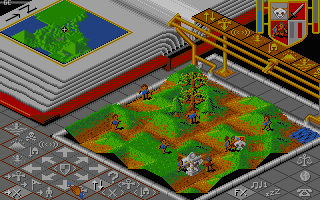
The moment Populous clicks is when you realize you are not managing a city, but farming land for divine currency. Every single world starts identically: a tiny isometric patch of wilderness, a lone follower, and an opponent deity doing the exact same thing across the map. Your primary interaction is disarmingly simple: raise a block of dirt or lower one to create flat terrain. Flat ground allows your followers to upgrade their homes from crude tents to sprawling castles, and bigger buildings breed more people, generating the mana you need to cast world-altering miracles.
When you fire up the MS-DOS game, the interface hitches you to a top-down isometric view where every land adjustment costs divine energy. If you flatten terrain efficiently, your population explodes, filling your power meter. If you waste mana lifting jagged mountain peaks that nobody can live on, your opponent's devout masses will quickly overwhelm your small tribe. It creates an addictive, rapid-fire rhythm of clicking, flattening, and watching tiny wooden structures spring up out of the earth.
Divine powers, knights, and the map 100 difficulty wall
Once your power reservoir fills up, the game shifts from landscape gardening to outright sabotage. You can drop a swamp in the middle of a bustling enemy farming quarter, drag down low-lying coastlines with floods, or summon a volcano to spew unbuildable rock right over their prime real estate. If you prefer a direct assault, you can convert your supreme leader into a Knight. This juggernaut marches through enemy turf, absorbing strength from your own civilians as he passes them and burning enemy settlements to the ground until someone puts him down.
Yet for all its variety across 500 distinct levels, the core design hides a notorious wall. Designers Peter Molyneux and Glenn Corpes built a massive world progression, but map names like "Genesis" and "Badacon" quickly give way to extreme friction. Around map 100, the difficulty spikes brutally; enemy expansion outpaces you while terrain becomes hostile and jagged. Without direct control over individual followers, watching your AI units wander aimlessly into enemy quicksand while you scramble to click unlabelled icons on the HUD can turn a winning streak into pure frustration.
How Lego blocks and office rivalries built a classic
The physical creation of the game was as experimental as its mechanics. Before writing code, the team at Bullfrog prototyped terrain height and land manipulation using physical Lego bricks on a tabletop. When programming began in C, early multiplayer testing relied on connecting two Amiga computers in the office with an RS-232 serial cable. Molyneux later admitted he subtly altered the game balance code during development just to ensure he would consistently beat Corpes in their daily matches.
That chaotic development extended right up to the commercial deadline set by publisher Electronic Arts. Hours before the 24-hour bug testing window closed, Molyneux realized he had completely forgotten to program an end-game victory sequence. He spent twelve straight hours coding a final screen from scratch so the game could ship. Despite the last-minute crunch, the title went on to sell over four million copies worldwide, running on everything from standard PC speakers to high-end Roland sound hardware, AdLib cards, and Tandy audio set-ups.
The flaw in the 500-world divine plan
Contemporary reviewers in 1989 showered the game with praise. Magazines like ACE awarded it a staggering 963 rating, highlighting the elegance of its land manipulation mechanics. However, dissenting critics at the time, such as Games International, pointed out the flipside: a 2 out of 5 review cited how repetitive the core loop becomes once the initial novelty of terraforming wears off. Modern players often echo that exact criticism.
Because you lack direct unit commands, you spend vast stretches of late-game matches managing landscape micro-adjustments while helpless to stop a wandering enemy knight. The user interface, packed with tiny graphic buttons that lack text labels, forces plenty of trial and error before you memorize which icon raises land and which one triggers an earthquake. If you lose focus for twenty seconds, an enemy flood can wipe out three dozen castles, leaving you with zero mana and no easy way to recover.
Key features that define the strategic options in every match include:
- Land Raising and Lowering: The fundamental terraforming mechanic used to build flat territory for settlements or create impassable cliffs.
- Swamps and Quicksand: Target hazards dropped in high-traffic zones to instantly drown passing enemy marchers.
- Volcanoes: Destructive land-builders that disrupt enemy town clusters by raising jagged, unbuildable rock spires.
- Knight Conversion: Sacrificing your leader to create an autonomous super-unit that razes enemy villages.
- Armageddon: The ultimate spell that flattens the entire world and forces all surviving followers into a final battle to the death.
Play Populous online and try your hand at divine power
If you want to experience where the genre started, you can play Populous online right now in your browser. There is nothing to install and no controls to configure; the game loads straight into the original MS-DOS interface ready for mouse or keyboard input.
When you start your first world, focus entirely on leveling the terrain around your starting hut before worrying about attacking. Keep raising and lowering the dirt until you have a wide, unbroken plain, and watch how quickly your followers upgrade their huts into high-capacity castles. Once your mana bar starts rising, pick a spot near the enemy settlement and drop your first swamp to see how easily a small land adjustment turns the tide of battle.