
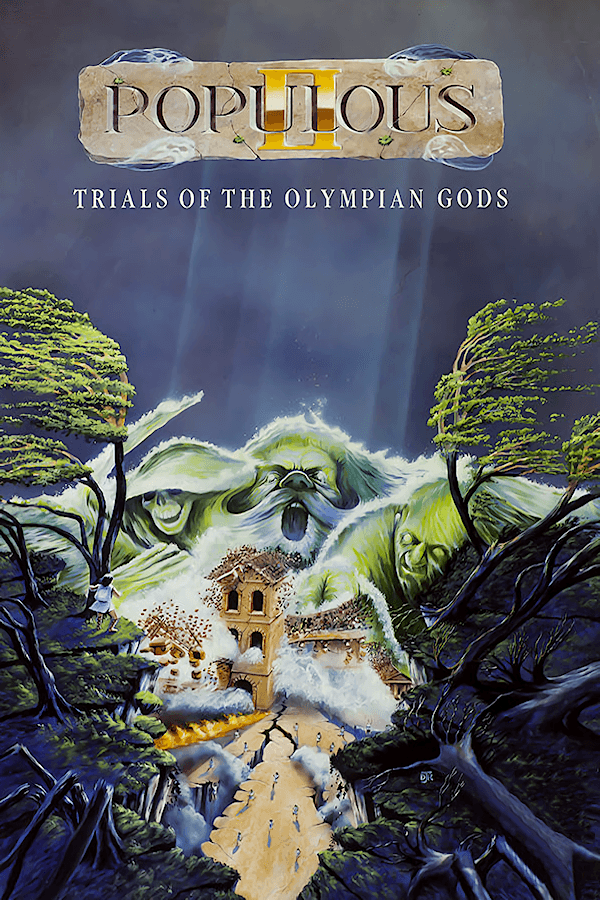
In Populous II: Trials of the Olympian Gods, you spend your opening minutes furiously clicking green isometric dirt to flatten a hillside so your pixelated worshipers can put up a hut. As one of Zeus's illegitimate offspring, your job is to conquer over a thousand maps and defeat 32 Greek deities, turning simple terrain manipulation into a full-scale divine arms race.
What happens when you sit down with Populous II: Trials of the Olympian Gods
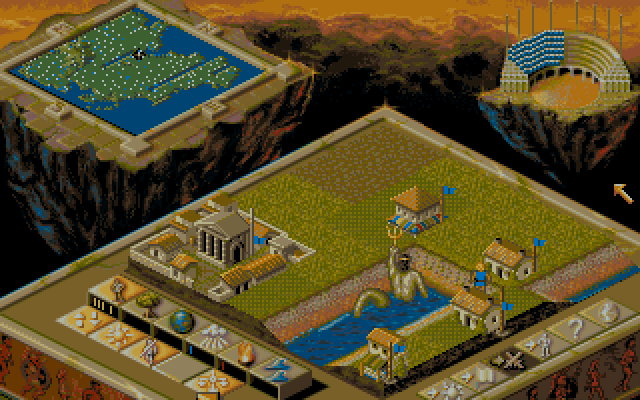
The core loop hits you immediately when a map loads. You view the world from an isometric perspective, staring down at tiny villagers who wandering aimlessly until you alter the ground beneath their feet. Left-clicking raises the land and right-clicking lowers it, creating flat areas where your people automatically build houses, expand into towns, and breed more followers.
Your ultimate goal in every match is to crush the rival god's population, but you do not control individual people directly. Instead, you plant a papal magnet on the map to guide your flock toward fresh territory or into direct battle with enemy worshipers. As your population grows and upgrades their housing from simple tents to stone towers, they generate mana, fuel you spend on casting godly powers.
Managing this cycle creates a constant trade-off between domestic engineering and active warfare. You can spend your mana smoothing out fields to maximize population growth, or save it up to drop a devastating spell directly on an enemy settlement just as their numbers begin to surge.
Thirty divine spells turn simple landscape architecture into chaos
Where the original title gave you a limited toolkit of land shifts and basic disasters, this sequel expands your arsenal to 30 unique powers divided across six elemental schools:
- Earth: create impassable mountains, cause earthquakes, or drop lethal swamps across enemy paths.
- Wind: whip up destructive tornadoes that tear through buildings and throw villagers across the map.
- Water: raise sea levels or flood entire valleys to wash away low-lying enemy settlements.
- Vegetation: grow thick forests across flat land and set them ablaze to ignite surrounding towns.
- Fire: rain down burning rocks and cast lightning bolts directly onto opposing structures.
- People: convert enemy worshipers to your faith or transform individual followers into powerful classical heroes.
By knighting a leader, you can summon famous figures like Heracles, Perseus, Odysseus, Adonis, or Helen of Troy. Each hero marches toward the enemy temple autonomously, using specialized abilities to slaughter common troops and burn down buildings along the way.
Why Peter Molyneux rewrote the engine instead of shipping an expansion
Designer Peter Molyneux originally intended to ship a simple data disk with new levels, but he opted for a complete engine rewrite to expand what the hardware could handle. Working alongside co-designer Glenn Corpes, producer Joss Ellis, and artists Gary Carr and Paul McLaughlin, the team at Bullfrog Productions, Ltd. overhauled the visuals to feature sharper graphics and digitized sound effects composed by Charles Callet.
The series' signature terraforming mechanic actually came from an early programming limitation. Molyneux once admitted that he created the land-flattening system simply because he could not code pathfinding smart enough to get little pixelated people to navigate around irregular natural coastlines. Turning the terrain into clean grid blocks solved the pathing problem while creating an entirely new style of strategy.
When published by Electronic Arts, Inc. in 1991, the game also included direct head-to-head multiplayer. Two players could connect their PCs via serial link cable, dial-up modem, or local network to wage real-time deity wars against each other.
Where Populous II: Trials of the Olympian Gods stumbles across its massive campaign
Despite all the new powers, the single-player campaign suffers from serious pacing problems. You have to work your way through a massive ladder of matches, yet the first seven or eight opponents put up almost no real fight. These early gods act so passively that you spend hours flattening land and waiting for your population to grow without ever feeling threatened, making the start of a new campaign feel tedious.
The interface choices also introduced new frustrations. Bullfrog stripped out many of the keyboard shortcuts present in the original game, forcing you to rely almost entirely on the mouse to click tiny menu icons while managing rapid terraforming on the map. In the heat of a fast-paced battle, hunting for power icons on the screen panel costs valuable seconds compared to pressing a quick hotkey.
If you want to experience the classic strategy / tactics balance without grinding through a hundred identical maps, custom single matches offer the best pacing. Setting up a direct match against a higher-tier god bypasses the early campaign slowness and drops you right into the chaotic spellcasting battles.
How to play Populous II: Trials of the Olympian Gods online today
Combining forest fires with summoned windstorms makes this Electronic Arts simulation hit harder than almost anything else on the block. I still load up a custom match just to knight a follower into Heracles, flood an enemy valley, and drop lightning bolts on the survivors as they try to rebuild.
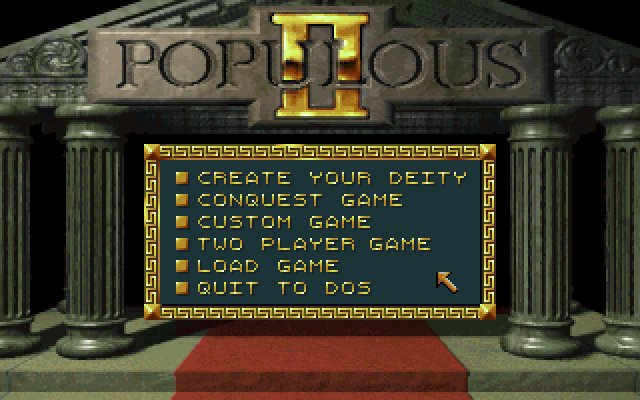
You can play Populous II: Trials of the Olympian Gods free in your browser right now, with no setup or installation needed. Launch this classic Populous II: Trials of the Olympian Gods MS-DOS game directly in your browser tab, pick a high-tier spell category, and see how fast you can turn a peaceful valley into a swampy disaster area before Zeus catches on.