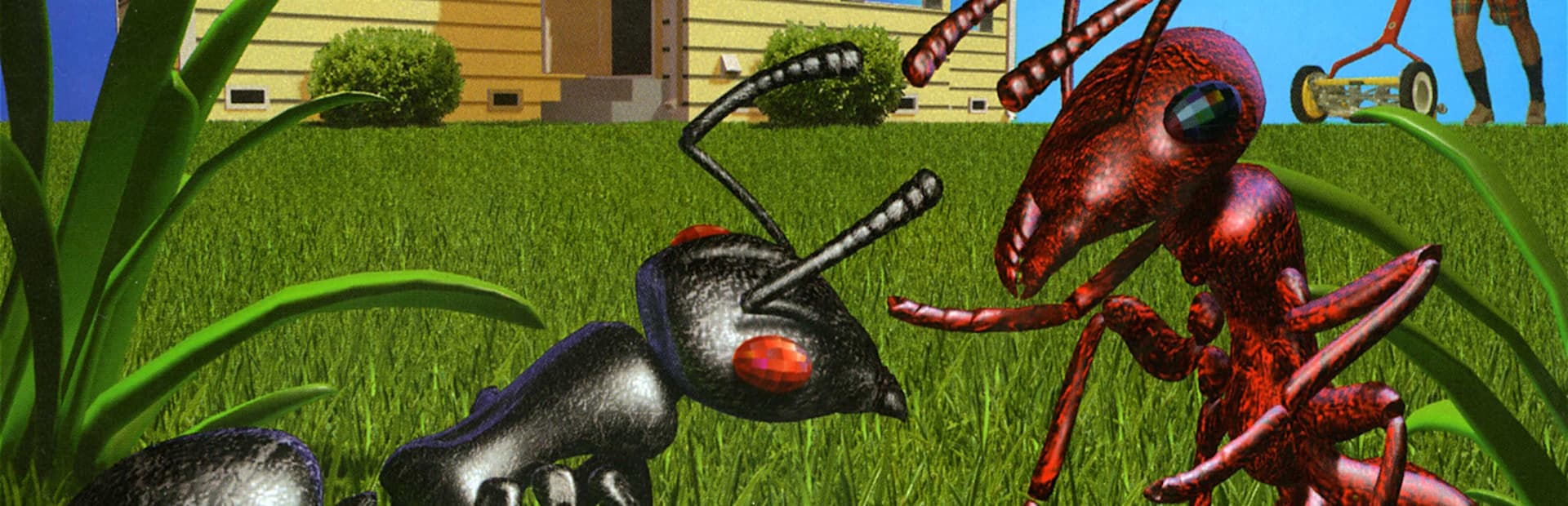

SimAnt trades the city-building high view of earlier Maxis titles for the dirt-level life of a single worker ant defending its nest, gathering green food bits, and trying not to get squished by a passing lawn mower.
Will Wright brings ant biology directly to the MS-DOS screen
Most strategy releases from 1991 tasked you with managing empires or commandos, but designer Will Wright took his cues from scientist E. O. Wilson's research on social insects. Instead of playing an omniscient general floating above the battlefield, your main avatar in SimAnt is a single yellow-tinted black ant wandering through underground tunnels and suburban grass. You dig burrows, drag food pellets back to the queen, and drop chemical pheromone markers to guide your colony mates toward fresh resources.
That bottom-up perspective drastically alters how you plan your expansion. Because your fellow black ants rely entirely on the scent trails you leave behind, a single wrong turn can send your foraging workers straight into the jaws of a enemy red ant nest or under the heavy heel of the home owner. If your personal ant dies to a stray raindrop or an aggressive spider, your mind simply transfers into a new worker back at the nest, assuming the colony still has the larvae to spawn one.
Commanding troops, stealing food, and piloting spiders
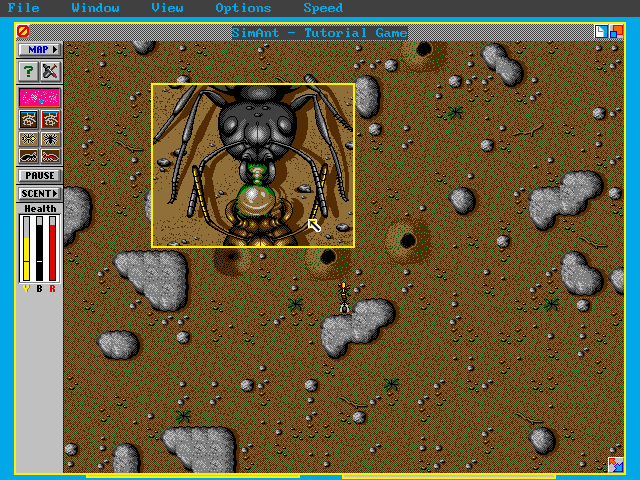
The core loop of the full campaign spreads across a suburban yard divided into a grid of overhead tiles. Your ultimate goal is to conquer every patch of grass, infiltrate the house, and drive out both the human family and their domestic pets. Achieving that requires a strict balance between digging nest infrastructure, feeding your egg-laying queen, and raising soldier ants to fend off the red colony sharing your lawn.
To win localized battles, you must master the simple army commands that assemble surrounding workers into an aggressive swarm. The simulation keeps track of several competing hazards and mechanics across the map:
- Resource foraging, where you carry green food dots and ant larvae to sustain your egg-laying queen.
- Pheromone management, allowing you to lay down attractant trails or drop erroneous scents to confuse enemy forces.
- Environmental dangers, ranging from drowning in sudden rain drops to getting shredded by the suburban lawn mower.
- Predators like ant lions and spiders, which will actively harvest any wandering workers who stray too far from the group.
If managing your yellow worker gets tiring, the game packs in an amusing secret menu option called "Change Bodies." Selecting this lets you hijack the mind of the local spider, allowing you to manually chase down red ants across the green blades of grass and devour them yourself.
Where the simulation stumbles and gives red ants the breaks
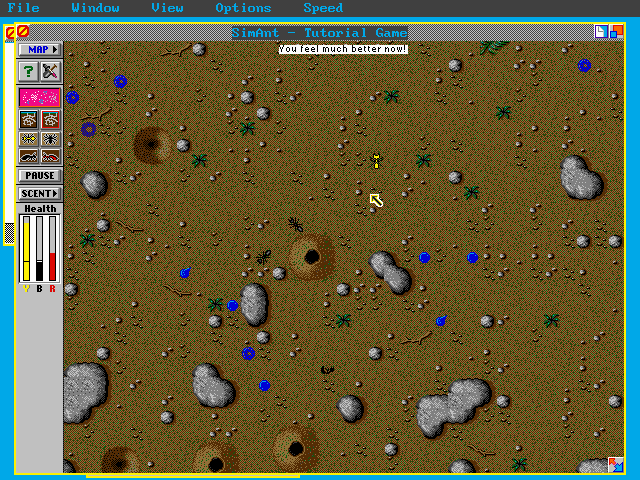
The concept was clever, but the actual controls in the MS-DOS game prove frustrating if you jump in without thumbing through the manual. Moving your lead ant precisely while dragging larvae or placing scent trails relies on an awkward mix of keyboard inputs and mouse clicks. Modern players often complain about the audio design as well, specifically how the PC speaker and early sound card tunes loop short melodies that stick in your head long after you exit to DOS.
Balance is another area where the design shows its age. Reviewers at the time pointed out that the underlying systems occasionally give the red ants all the breaks, granting the computer AI rapid population booms out of nowhere. A bad run can leave you pinned inside your central chamber with zero food, watching your queen starve while red soldiers flood the main entrance tunnel. For players who run into an impossible corner, typing the secret cheat code just grants ten fertilized queens on the spot, while typing jenn grants your entire black colony unlimited health.
Maxis proves that experimental sandbox ideas can sell
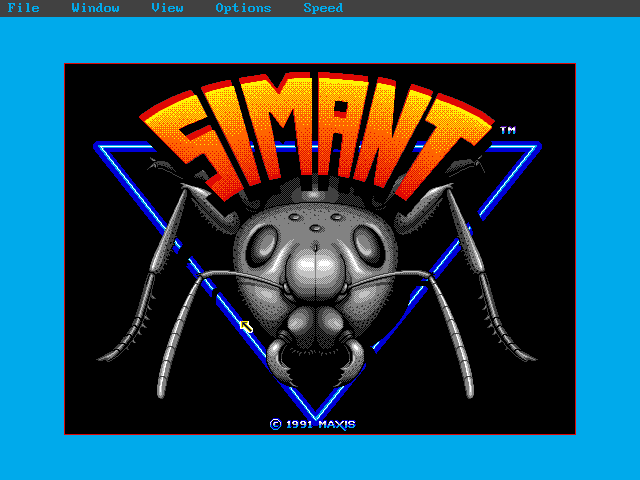
Despite its punishing random moments, this strange biology sim became a genuine commercial success, selling over 100,000 copies and grabbing a Codie award in 1992 for Best Simulation Game. Published by Maxis Software Inc., it proved that gaming audiences were eager for simulation titles that stepped outside traditional city planners or flight simulators. The release included a sandbox Experimental Game mode, letting players erect artificial mazes, drop barriers, and spray heavy insecticides just to observe how the virtual colony reacted.
Sound card support was unusually thorough for 1991 games, offering tailored audio drivers for the SoundBlaster, AdLib, Roland MT-32, and Tandy Sound chips. Hearing the crunch of a spider attack through a Roland board gave the dirt world a distinct punch that basic PC speakers simply could not replicate. It was a sharp piece of software design, proving that complex real-world biological systems could make for solid interactive play.
Play SimAnt free in your browser right now
You can play SimAnt online today directly through your web browser, with full sound card emulation and quick save access ready from the start. Taking over your first yard tile only takes a few seconds, though remembering to keep your queen fed while avoiding the lawn mower takes a bit of practice. Fire up the MS-DOS release right here, gather your first trail of green food, and see if you have what it takes to evict the humans from their own house.