


Screenshot×31w ago
In Ugh!, you take the stick of a pedal-powered wooden helicopter to run a prehistoric taxi service, hauling cavemen across jagged single-screen levels to line your pockets for a wedding ring.
The physics of a pedal-powered taxi
You start hovering above a lake with nothing but a set of spinning rotors, a flight stick, and a stamina bar that drops the second you touch the pedals. Controlling the helicopter is an immediate exercise in managing momentum and gravity. You do not push a button to go up and down cleanly. Instead, you tap to pedal harder for lift, cut the power to sink, and pray you do not hit a cliff wall with too much speed.
Passengers walk out of cliffside caves and yell their intended destinations across the screen. To pick one up, you have to bring your machine down gently on their platform. Drop too fast and you smash your craft to pieces. Hover poorly and land on top of the caveman, and you send him tumbling into the water below. He can swim, but every second spent fishing him out drains your clock and your legs.
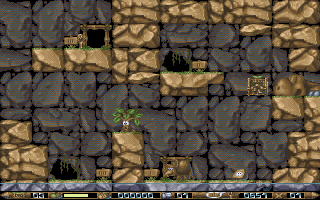
The core loop keeps you moving constantly between platforms, balancing speed against delicate landings. To restore your stamina, you can pick up a rock, hover above a fruit tree, and drop the stone into the branches to shake loose food. Eating the falling fruit keeps your legs moving, but taking your eyes off the flight line for a snack usually means drifting straight into an outcrop.
Dinosaurs, stone physics, and trial-by-error difficulty
The environment actively works against your tiny flying machine across 69 single-screen levels. A stray flying pterosaur will sweep across the viewport without warning, forcing you to adjust your altitude mid-transit. Land too close to a sleeping triceratops, and the beast instantly rouses, charging your fragile airframe before you can spin the rotors back up to speed.
You can defend yourself by dropping rocks on hostiles to knock them out cold, but precision bombing while managing inertia is a tall order. The game ramps up quickly through tighter cave networks and shorter time limits. It shares a basic DNA with the classic arcade title Space Taxi, but the added weight of your vehicle makes every maneuver feel precarious.
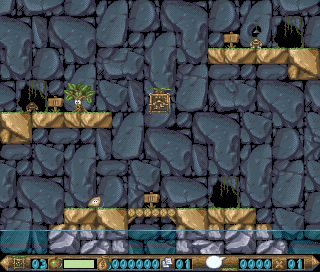
The heavy physics and instant-death crashes divided reviewers at launch. Amiga Format handed it an 88% score for its responsive controls and visual humor, while CU Amiga slammed it with a 58%, citing frustrating collisions. The punishment for a bad angle is severe. Touch a wall with your rotor blades, and your cab instantly disintegrates, costing you a precious life.
The code behind the caves
Developer EGOSOFT GmbH, credited as Ego Software in its early days, released this action platformer through Play Byte in 1992. Designers Peter Schmitz and Björn Roy built a tight, reaction-based puzzle shooter that found a massive audience on Commodore disk drives and MS-DOS setups. On PC, the game offered 256-color VGA graphics paired with clean FM synth audio through an AdLib card.
Without a battery save feature, the development team opted for a classic password system to save progress. The developers tucked a clever bit of personality into these passcodes. The level codes for the single-player campaign are all song titles by the gothic rock band Christian Death. If you play the two-player cooperative mode, the level codes switch over to song titles by the industrial band Current 93.

Shareware distribution through local BBS boards and magazine cover disks gave the game a long second life. While it lacks modern quality-of-life features like mid-level checkpoints, its underlying flight model remains satisfying to master once you stop crashing into the scenery.
How Ugh! holds up today
The core mechanics are brutal, but the game avoids feeling cheap once you learn how to handle gravity. The main design flaw is the punishment for failure. Losing your last life on a high-numbered level means booting back to the password screen and retyping a obscure song title just to try again. The timer on later levels can also feel suffocatingly tight.
- 69 distinct single-screen levels filled with hazards
- Physics-driven flight model built on gravity and inertia
- Two-player co-op mode for simultaneous flight
- Passcodes hidden as obscure underground band tracks
If you enjoy classic arcade games that demand light touches and strict precision, this prehistoric cab simulation is well worth an evening. The inertia mechanics feel unique compared to standard side-scrollers from the early nineties.
You can play Ugh! free in your browser right now without setting up an old MS-DOS environment. The pedal controls and flight weight are something you have to feel for yourself to appreciate, especially when trying to land on a ledge without squishing a customer.
How Ugh! is played — the keys the game listens to, grouped by what they do.
- Action
Highlighted keys are mapped — hover or tap one to see what it does.
Keyboard input mapping is incomplete based on available notes. Level codes are entered via typing.
Players' controls
Touch and gamepad controls
The on-screen keyboard and gamepad mapping the browser player uses on a phone, a tablet or a controller, as opposed to the real keys above. $PRO members make their own in the player and share them here; anyone can pick one to play with.
Make your own touch controlsPRO
- 1Open the editorSign in below, then pick what to make. The game starts with the editor open over it.
- 2Place your keysAdd keys and drag them where your thumbs rest, or map a controller's buttons. Test plays the game with them; Save keeps them, and you play with them from then on.
- 3Share themShare them right after saving in the game, or name and share them here. Players vote, and the best become this game's controls for everyone.
Go PROSee how it worksSign in+20 XP for sharing · +50 XP if yours become the game's own
- The game's own controlsKeyboardGamepadWhat every player starts with.In use
No reviews yet
Tell the community what you think of Ugh!. Reviews are public and tied to your username.
No archived manuals for Ugh! yet
No manuals archived for this title yet. Sign in to upload the first scan.
Cheat codes, console commands and memory pokes for Ugh! — each one verified and attributed.
Sign in to submitNo cheats yet for this title
Know a working cheat, poke or trainer? Add it with the button above. Moderators check every entry before it goes live.
No archived soundtrack for Ugh! yet
No soundtrack archived for this title yet. Sign in to upload the first rip.
No save states for Ugh! yet
No save states for this title yet. Sign in to share one.
Discussions
Sign in to post- Threads0
- Total posts0
- Online now6
Community · Ugh!
Who's contributing, and what's new
- Reviews0
- Threads0
- Uploadsapproved3
- Contributors1
Recent activity