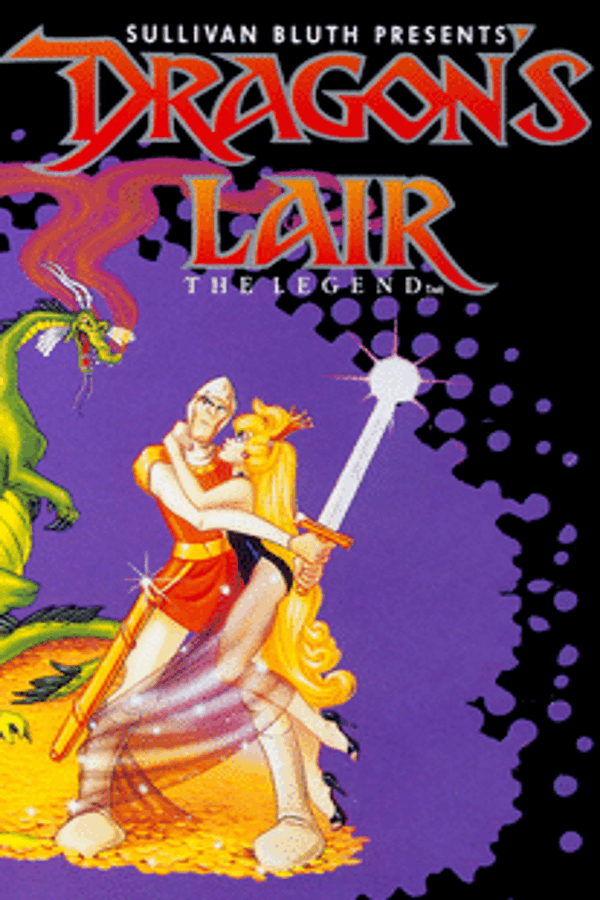
Dragon's Lair: Escape From Singe's Castle
Playing Dragon's Lair: Escape From Singe's Castle feels like steering a classic cartoon equipped with a razor-thin margin for error. After slaying the beast and rescuing Princess Daphne, Dirk the Daring has to get out of the fortress alive using quick reflexes and endless trial and error.
Surviving the aftermath of dragon slaying
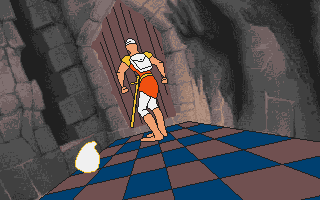
You start the adventure right after the original game ends. Dirk has slain Singe the dragon and retrieved Princess Daphne, but getting out of the fortress proves just as deadly as getting in. The screen displays smooth Don Bluth animation, and your job is to guess which direction key or attack button keeps Dirk alive for another three seconds.
The action pulls no punches from the start. In one sequence, you guide Dirk as he tumbles through roaring rapids inside a wooden barrel. In another scene, you ride a magical horse through collapsing corridors or attempt to maneuver through a twisted labyrinth. You spend every sequence watching Dirk's positioning and reacting the second an obstacle shifts toward him.
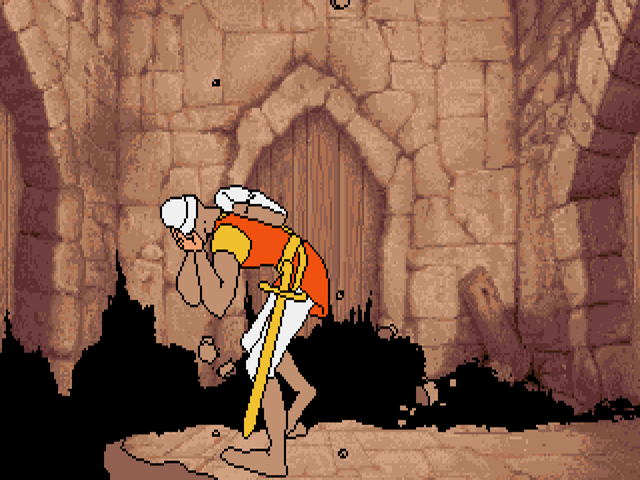
The core interactive system relies entirely on timing. Press right a fraction of a second too late while fleeing a throne room trap, and you get a quick animation of Dirk disintegrating, squishing, or falling into a pit. You do not move Dirk freely around the screen. You trigger the next branch of pre-rendered animation by supplying the precise command at the exact frame the game demands.
Why Dragon's Lair: Escape From Singe's Castle exists on floppy disk
When the original arcade hit came to home PCs in 1989, floppy disks simply could not hold all the LaserDisc footage. The developers had to chop Don Bluth's animation in half just to fit the code onto multi-disk sets. Sullivan Bluth Interactive Media, Inc. and ReadySoft Incorporated held onto the remaining animation sequences until this follow-up arrived in 1991.
This release functions as the second half of the original arcade cabinet. Instead of inventing new footage, the team took the leftover action sequences from 1983 and structured them into a fresh escape narrative. That history explains why the castle layouts feel just as wild and disconnected as the first entry.
Because floppy disks remained tight on space, the DOS release compressed visual frames as hard as it could. You got authentic Don Bluth character animation on a home computer monitor, but the sacrifice was interactive depth. The controls had to remain strict choices between four directions and a sword button, since the software could only branch to a few specific video clips per room.
Trial, error, and hard-to-read copy protection
The main obstacle to finishing the game is its total lack of visual mercy. Without explicit onscreen prompts, you have to guess whether Dirk should jump left, dodge right, or swing his sword. Most players died dozens of times on a single scene simply trying to figure out what input the game wanted.
To make matters more forgiving than the arcade original, this PC version added optional helper features. You could enable a helper arrow to flash on screen right when an input was required. It also included difficulty settings and save features, which spared players from replaying the entire story after losing their final life.
Even getting past the title screen back in 1991 was a puzzle of its own. The game shipped with a physical copy protection sheet printed in faint, light-colored ink that was nearly impossible to read under normal ambient lighting. If you misread a code off that paper, Dirk's escape ended before it even began.
The design choices created a specific rhythm for anyone playing on PC hardware:
- Watch a scene unfold without any visible prompt until an obstacle appears.
- Guess the required movement key or sword attack before the lethal hit lands.
- Watch Dirk die instantly if your input timing misses by a few milliseconds.
- Memorize the sequence order through continuous repetition until you reach the exit.
How the floppy release compares to other action titles
Compared to standard platformers or adventure games of the early nineties, this title operates entirely on sensory presentation. Games like Prince of Persia gave you direct frame-by-frame control over jumping and sword fighting. Here, you play the director of a cartoon who only gets to shout directions at crucial junctures.
That mechanical trade-off split players down the middle. If you wanted deep mechanical control, the linear reaction prompts felt shallow and repetitive. If you wanted to see arcade-quality hand-drawn animation running on an IBM-compatible PC speaker or Sound Blaster setup, nothing else came close to matching this visual style.
The sound design helped pull you into the chaos. Hearing Dirk's panicked yelps and the heavy clank of armor through PC sound cards gave the simple key presses real weight. Every room brought a new absurd creature or sudden trap that made you want to push forward just to see the next animation loop.
Play Dragon's Lair: Escape From Singe's Castle free in your browser right now
If you want to experience this piece of animated arcade history, you do not need to hunt down vintage diskettes or struggle with faint copy protection sheets. You can enjoy the MS-DOS version of Dragon's Lair: Escape From Singe's Castle online right here in your web browser, completely free with nothing to install and no extra setup required.
Load it up, turn on the helper arrows if you want a fair fighting chance, and try your hand at guiding Dirk through the barrel rapids sequence. It only takes ten minutes of play to understand why players in 1991 willingly memorized every single death scene just to reach the end credits.