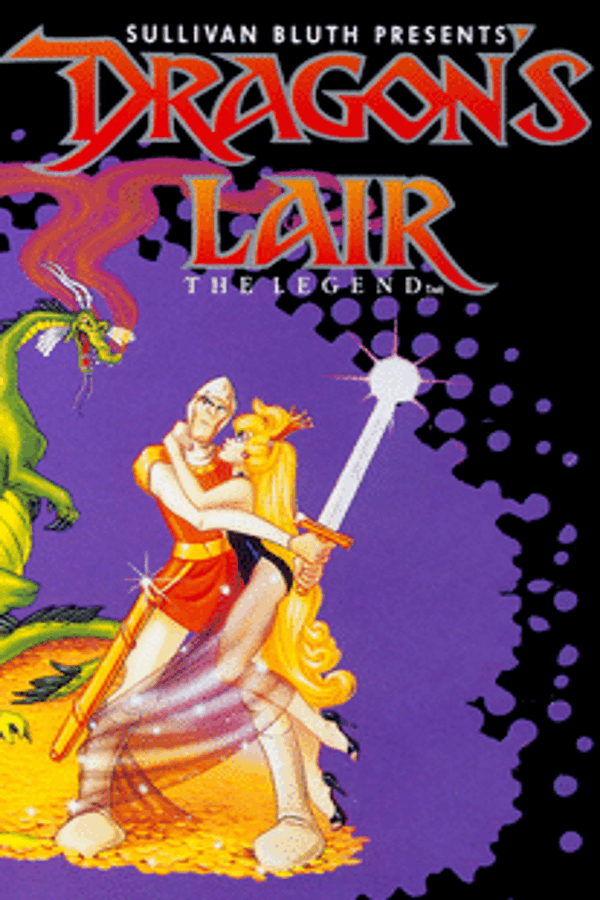
Dragon's Lair III: The Curse of Mordread
Playing Dragon's Lair III: The Curse of Mordread demands lightning-fast reflexes and endless patience as you steer Dirk the Daring through time-hopping cartoon death traps to rescue Princess Daphne from a vengeful witch.
What Dragon's Lair III: The Curse of Mordread asks from your joystick
The moment you launch the game, you are thrown straight into Don Bluth's animated chaos without a single tutorial or safety net. The plot kicks off when the evil witch Mordread, sister of the wizard Mordroc, uses her magical staff to shrink Dirk's entire castle into a tiny orb and snatch Princess Daphne. To get her back, you must leap through dimensional rifts that transport Dirk across bizarre historical and fairytale settings, starting with a hazardous drop into Wonderland where Dirk shrinks down to fit the terrain.
Every single room is a quick-time puzzle disguised as a Saturday morning cartoon sequence. You do not get to wander around or explore freely; instead, you watch a scene play out in real time and hit a direction or the fire button at the precise split second required. Press up to make Dirk leap over a trap, or jab right to swing his sword at an incoming monster. Make the correct move, and the animation carries straight on to the next hazard. Get the timing wrong by even a fraction of a second, and you are immediately treated to one of Dirk's exaggerated death animations before being kicked back to try again.
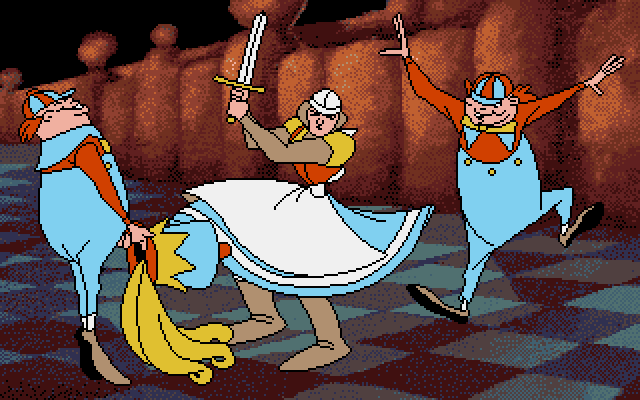
No flashes on screen and pure trial-and-error gameplay
What drives most players up the wall is the total absence of visual feedback. Unlike modern reaction-heavy action titles that highlight buttons or display obvious arrows, this 1992 MS-DOS adventure leaves you completely in the dark. There are no on-screen prompts telling you which button to press or when to press it, turning almost every new screen into an exercise in brute-force memorization. You will die repeatedly on every single scene simply working out whether the game wanted you to dodge left, jump backward, or draw your sword.
When ReadySoft Incorporated released this installment, home computer conversions were already struggling under tight technical constraints. Because the floppy-disk PC versions could not hold the massive file sizes of arcade LaserDisc hardware, several animated transitions were trimmed down or omitted entirely. That compression makes the reaction windows feel even tighter, as the visual cues that warned arcade veterans of upcoming danger are sometimes shortened or absent, leaving you to guess your way through scenes by pure muscle memory.
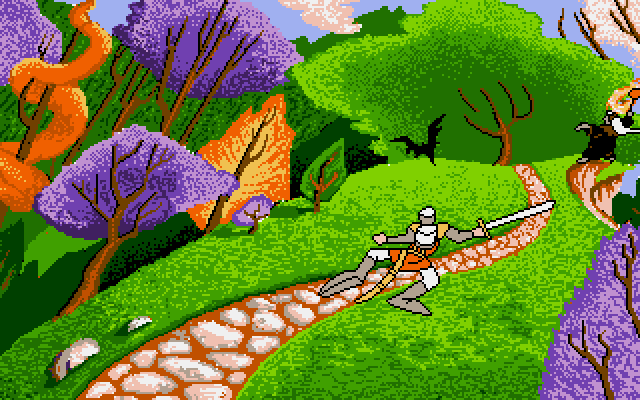
Recycled arcade roots and giant piano keys
Despite the Roman numeral in the title, this release is not a fully original arcade project built from scratch. Designers Tony Bozek and David Quesnelle, working with Don Bluth Multimedia, Inc., assembled the adventure largely by rescuing unreleased animation sequences. Much of the game consists of stages meant for Dragon's Lair II: Time Warp that had been left on the cutting room floor during earlier home conversions because floppy disks simply lacked the storage space. The developers also included a fully restored "Blackbeard the Pirate" stage, an animated sequence originally cut from the arcade machines before making its way into this collection.
The resulting stage list feels like a wild, unpredictable reel of cartoon set pieces:
- Wonderland: A surreal stage where Dirk shrinks down to dodge oversized hazards and giant creature attacks.
- The Pirate Ship: The restored Blackbeard sequence, full of swinging ropes, crumbling wooden decks, and sword duels against undead sailors.
- Beethoven's Piano: A bizarre, rhythm-focused stage where Dirk scrambles across gigantic piano keys while avoiding slamming hammers and musical notes.
- Father Time's Castle: The climax of Dirk's journey, packed with temporal traps and mechanical clockwork guardians guarding Mordread's lair.
Accompanied by a lively synthesized score composed by Shawn Moore, the visual presentation remains incredible to look at, provided you can keep Dirk alive long enough to see the next frame. When Amiga Action reviewed the computer release in issue 41, they awarded it a score of 74%, admiring the gorgeous artwork from Don Bluth Studios while noting that as an actual game, it plays more like an animated choose-your-own-adventure book than a deep action title.
How Dragon's Lair III holds up today
If you judge it purely on traditional game mechanics, the design is unquestionably punishing. The interaction boils down to memorizing a strict sequence of inputs for each scene, meaning there is zero room for improvisation or creative play. Yet, as a piece of interactive animation history, it holds a unique appeal. Watching Don Bluth's character animation fluidly react to your split-second decisions captures a distinct era of early nineties interactive media that few other titles attempted.
Anyone who enjoys classic dragon-slaying adventure games or laserdisc-style quick-time challenges will find plenty to appreciate here. The satisfaction comes from finally mastering a sequence that killed you ten times in a row, stringing together five perfect moves, and watching Dirk smoothly escape a trap that seemed impossible a few minutes earlier.
You can test your timing and play Dragon's Lair III: The Curse of Mordread online right now, running the full Dragon's Lair III: The Curse of Mordread free in your browser with no installation needed. When you start your run, focus closely on Dirk's body language and the environment in the very first scene. A subtle shift in his stance or a flash in the background is usually your only hint to press a direction before the fatal blow lands!