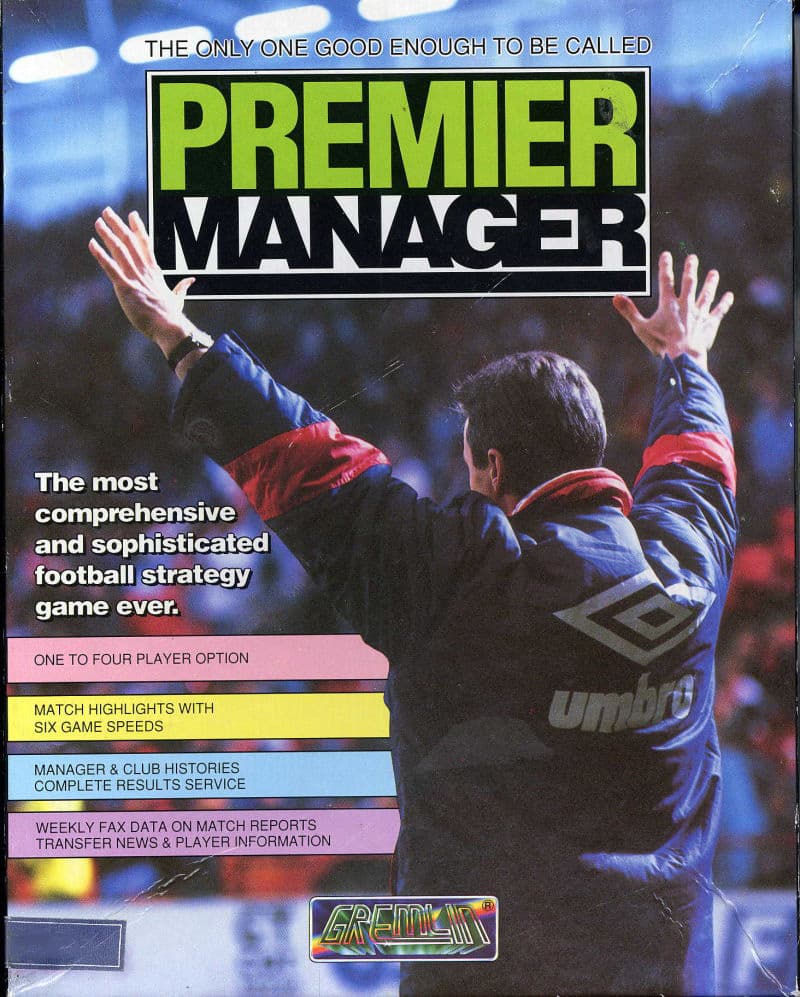
If you want to take a non-league squad to European glory, Premier Manager drops you straight into the stress of ticket pricing, bank overdrafts, and granular tactical micromanagement.
Starting at the bottom of the English football ladder
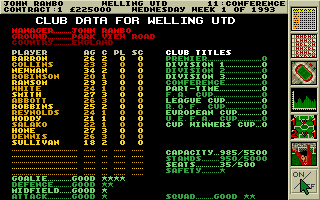
When you start a campaign in Premier Manager, you do not get to pick a world-class squad packed with international stars. Developer Realms of Fantasy forces you to begin in the fifth tier of English football, managing a team in the Conference League. Your goal is to drag that club all the way up through the divisions, reaching the top flight and claiming trophies like the FA Cup and UEFA Cup.
You can stick with your initial club or attempt to earn contract offers from bigger teams as your reputation grows. Achieving that upward mobility requires balancing team performance with strict financial management. If you overspend on squad depth early on, bank interest will destroy your budget before your players ever see promotion.
The original 1993 MS-DOS release converted the interface from the earlier Amiga version while keeping the core simulation model intact. Publisher Gremlin Interactive built the experience around quick navigation between distinct management menus. You move from financial ledgers directly to training screens, making quick adjustments before each fixture.
Tactical options in Premier Manager go deeper than expected
On the pitch, match preparation is about far more than picking eleven names. The game gives you 18 standard formations to choose from, but the real control comes from fine-tuning player instructions. You can tweak tackling intensity, adjust passing length and height, and dictate shooting range across nearly 500 total tactical combinations.
Your team strategy must adapt to the opposition's weaknesses. If you face a side with poor physical stats, setting high tackling intensity can force errors. If you dump long balls up the middle against heavy central defenders, your attacks will stall. Winning matches consistently demands regular squad maintenance across multiple operational areas:
- Setting weekly training routines to build squad stamina and individual skill ratings.
- Hiring specialized backroom staff, including coaches and scouts, to identify talent.
- Managing medical facilities to ensure proper treatment for injured stars.
- Adjusting player duties to limit fatigue during congested fixture schedules.
Balancing stadium upgrades and financial ruin in Premier Manager
Managing the financial books is just as demanding as setting pitch tactics. The transfer market lets you buy and sell players based on broad skill ratings, but you compete directly against AI managers who actively bid for the same targets. Negotiating contract renewals before deals expire prevents your best players from walking away on free transfers.
To keep the club solvent, you handle ticket prices, secure commercial sponsorship deals, and take out bank loans when cash flow dries up. You have an overdraft facility available for emergency spending, but exceeding your limit puts your job in immediate jeopardy. Investing revenue back into the club allows you to expand stadium capacity and upgrade safety facilities, which increases crowd capacity and raises matchday income over time.
Before you even reach the main menu on original hardware, the game presents a physical copy protection system. You have to look up numbers on a cardboard code wheel included in the box to clear the security screen. Original players still remember misplacing that wheel and getting locked out of their own game.
When match day slows to a crawl
The match engine itself is where the system design shows its age. You can play multiplayer matches with up to four players in turn-based rotation, with everyone's games running alongside each other. You have the ability to make tactical changes and substitutions mid-match as you watch the action unfold on screen.
Match speed is the real hurdle when you come back to this one today. During match simulation, the system deactivates mouse input entirely, forcing you to rely on keyboard inputs. Individual matches take roughly five minutes to run their course, and without a built-in fast-forward button, a full season drags on for hours.
Compared to rival sports management titles from the same year, the statistical engine holds up well, but the interface speed drags down the pacing. If you make a mistake in your tactical setup, you have to sit through five full minutes of match updates before you can fix it in the post-match menus.
Where to play Premier Manager online today
Despite the slow match engine, this simulation laid the groundwork for a major management franchise, leading directly to successful sequels like Premier Manager 2 and Premier Manager 3. The combination of non-league football progression, stadium construction, and deep tactical sliders gives early PC sports games fans plenty to chew on. It punishes reckless financial spending instantly, teaching you to respect the bottom line before you chase big-money transfers.
You can play Premier Manager free in your browser right now, with no extra setup required. New players often try to rush their budget straight into transfer fees on day one, but your first move should always be setting ticket prices and securing solid sponsorship deals to keep your overdraft safe. Jump straight into the Conference League and see if you can take a small-town club all the way to European glory.
How Premier Manager is played — the keys the game listens to, grouped by what they do.
- Movement
- Interface
- Left click — Select item / navigate menus
- Right click — Continue / confirm action
Highlighted keys are mapped — hover or tap one to see what it does.
If playing without a mouse, select "Keyboard" during INSTALL to use cursor keys, Space (left click), and Enter (right click).
Players' controls
Touch and gamepad controls
The on-screen keyboard and gamepad mapping the browser player uses on a phone, a tablet or a controller, as opposed to the real keys above. $PRO members make their own in the player and share them here; anyone can pick one to play with.
Make your own touch controlsPRO
- 1Open the editorSign in below, then pick what to make. The game starts with the editor open over it.
- 2Place your keysAdd keys and drag them where your thumbs rest, or map a controller's buttons. Test plays the game with them; Save keeps them, and you play with them from then on.
- 3Share themShare them right after saving in the game, or name and share them here. Players vote, and the best become this game's controls for everyone.
Go PROSee how it worksSign in+20 XP for sharing · +50 XP if yours become the game's own
- The game's own controlsKeyboardGamepadWhat every player starts with.In use
2 screenshots
From the archive
No gameplay video yet
No gameplay video for Premier Manager yet. Sign in to add one.
No reviews yet
Tell the community what you think of Premier Manager. Reviews are public and tied to your username.
No archived manuals for Premier Manager yet
No manuals archived for this title yet. Sign in to upload the first scan.
Cheat codes, console commands and memory pokes for Premier Manager — each one verified and attributed.
Sign in to submitNo cheats yet for this title
Know a working cheat, poke or trainer? Add it with the button above. Moderators check every entry before it goes live.
No archived soundtrack for Premier Manager yet
No soundtrack archived for this title yet. Sign in to upload the first rip.
No save states for Premier Manager yet
No save states for this title yet. Sign in to share one.
Discussions
Sign in to post- Threads0
- Total posts0
- Online now6
Community · Premier Manager
Who's contributing, and what's new
- Reviews0
- Threads0
- Uploadsapproved0
- Contributors0
Recent activity
Nothing here yet
Reviews, discussion threads and approved uploads appear here as members add them.