Steel Panthers
Steel Panthers gives you direct command of individual WWII tanks, anti-tank guns, and infantry squads across hex-grid battlefields where moving into the wrong line of sight means immediate enemy snapshot fire.
Grigsby and Brors built tactical combat down to the single shell
When designers Gary Grigsby and Keith Brors began work in May 1994 alongside producer Tom Wahl, they shifted focus away from broad theater maps. Released in 1995 by Strategic Simulations, the game puts you in command of battalion, company, or platoon-level forces on hex grids.
Instead of shuffling abstract military corps across a continent, you control individual tanks, armored transport vehicles, and infantry squads of eight to twelve men. Specialist forces like snipers operate as independent single-man units. You pick your forces from dozens of World War II nations across the Eastern Front, Western Front, and Pacific Theatre.
The campaign package offers historical battles including Normandy and Operation Market Garden across eight structured campaigns and 60 preset scenarios. If you finish those, a random campaign generator and a complete scenario editor provide custom battlefields with tailor-made landscapes and force lists.
Managing line of sight and snapshot fire will make or break your assault
Sitting down with this classic Steel Panthers MS-DOS game means adapting to turn-based rules that punish careless movement. While you order your units across the hex grid during your turn, enemy forces in concealment will snapshot fire automatically the instant you enter their line of sight.
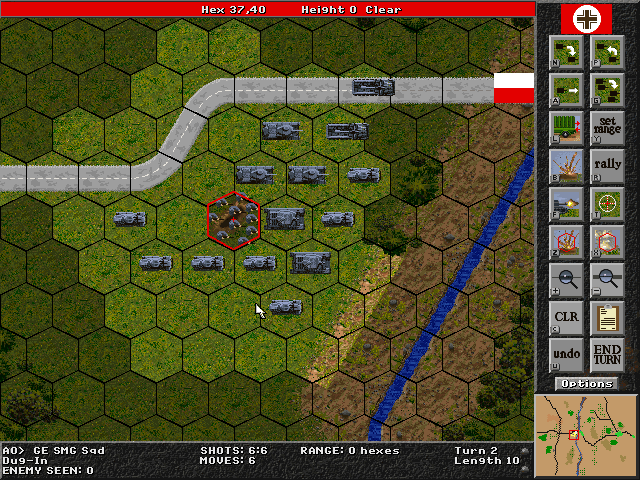
Every turn presents a tough balance between advancing forward and keeping your units alive. Tactical success relies on several core actions during your phase:
- Moving vehicles carefully to prevent exposing thin side or rear armor to concealed anti-tank guns.
- Directing target fire while keeping track of individual unit ammunition reserves.
- Loading infantry into halftracks and ordering them to disembark near objective points.
- Requesting off-board artillery barrages and tactical air strikes against fortified lines.
- Executing the Rally command to restore suppressed soldiers and revive unit morale.
Suppression accumulates rapidly when units come under shellfire. Suppressed squads refuse orders and pin down until your command unit successfully rallies them back into action.
High ambition met noticeable AI quirks and a messy manual
The release became a major commercial success for a tactical wargame. It sold over 85,000 copies in its initial run and eventually topped 130,000 units overall. SuperVGA graphics displayed persistent battlefield damage like cratered dirt roads, burning armor wrecks, and smoking terrain, accompanied by digitized engine growls and artillery explosions alongside a soundtrack by Rick Rhodes.
The original launch had notable issues. Computer AI behaved predictably over long campaigns, often leaving enemy forces vulnerable to easy flanking attacks. Players also needed early official patches from Strategic Simulations to eliminate launch bugs.
Documentation was another sore point. Printed manual pages left out essential reference tables, forcing players to open a README text file in the game directory to read vital data. Period magazines noted the balance of high detail and flaws, with GameSpot calling it dangerously addictive despite predictable AI, while Computer Games Strategy Plus dubbed it a gem in the rough, Maximum Magazine rated it 3 out of 5 stars, and Interactive Entertainment CD-ROM Magazine named it their 1995 Military Sim of the Year.
Why the combat decision loop still holds up today
The AI has plenty of weaknesses, but the underlying tactical mechanics still work. The built-in encyclopedia features digitized photographs and technical data for historical military hardware, helping you calculate effective armor thickness against incoming anti-tank fire.
Within the wider realm of top-down strategy and tactics releases, managing troop morale and command radii creates real friction. Pushing an armored column down a narrow road without scout infantry often ends in sudden destruction from hidden gun positions.
The success of the original game led to direct sequels designed by Grigsby and Brors, including Steel Panthers II: Modern Battles in 1996 and Steel Panthers III: Brigade Command 1939 - 1999 in 1997. Matrix Games later expanded the engine into Steel Panthers: World at War in 2000, confirming the long-term impact of this tactical design.
How to play Steel Panthers online right now
The tactical tension of managing WWII armor and infantry is ready to play without installing anything. You can play Steel Panthers online right here in your web browser. Load a custom scenario, order an infantry squad into cover, and test your defensive line against an oncoming tank rush.