
Steel Panthers III: Brigade Command - 1939-1999
aka Steel Panthers III: Brigadekommando - 1939-1999 · Steel Panthers III: Ordres aux Brigades - 1939-1999
Streaming build
Checking storage…515 MB
Preload in background
If you boot up Steel Panthers III: Brigade Command - 1939-1999 expecting to micro-manage single tanks, your entire formation will be wiped out before you finish your first turn.
What changed when Steel Panthers III: Brigade Command - 1939-1999 shifted to brigade scale
Designing a tactical wargame around single vehicle tracking works brilliantly when you are handling a company or a small task force. Designers Gary Grigsby and Keith Brors decided to pull the camera back for this 1997 release, zooming out to a operational scale where hexes measure 200 yards across and units represent whole infantry companies or vehicle platoons. That shift fundamentally alters what the engine demands from you. Instead of worrying about whether one specific Sherman has line of sight past a farm house, you are issuing orders to whole battalions across massive battlefields.
The core turn-based hex mechanics remain familiar to anyone who played the earlier titles, but the management chain is much stricter. Leaders at the brigade, battalion, and formation level sit on the map with their own ratings, directly affecting how fast pinned troops recover and how reliably off-map artillery land on target. If your headquarters units get caught out in the open by enemy air strikes or long-range direct fire, your command structure breaks down rapidly, leaving your forward units stranded without support.
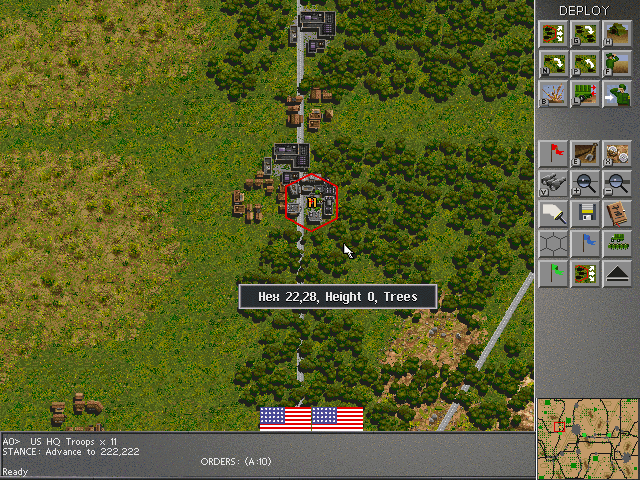
The brutal reality of managing military hardware across sixty years
The sheer volume of hardware packed into Strategic Simulations, Inc.'s engine is absurd. The game covers major world conflicts between 1939 and 1999, incorporating military equipment from 40 different nations. A battle in the North African desert during World War II plays nothing like a scenario set during the Vietnam War or a modern Cold War clash. The tactical toolbox expands dramatically as you advance through the decades, introducing direct-command attack helicopters, surface-to-air missiles, and devastating air strikes armed with napalm or cluster bombs.
Managing these forces requires juggling specific weapon capabilities against high-lethality counters across 40 standalone scenarios and 6 full campaigns. Modern battlefields in particular are terrifyingly fast-paced: precision-guided munitions will obliterate an armored column caught in the open before you can even establish smoke screens. The game also shipped with a custom map editor and a random campaign generator, giving hard-headed strategists endless room to test custom force setups.
Where the DOS visual interface starts to fail the commander
The decision to build this release as an MS-DOS game running on a modified version of the Steel Panthers II 2D engine cut both ways. On the performance side, an 80486DX 33 MHz processor with 8 MB of RAM could handle complex combat calculations and run specialized digital sound effects for ambient gunfire and artillery impacts. However, pushing that graphic engine to represent brigade-level conflicts leads to serious clarity issues on modern displays. At the maximum 800x600 resolution, combat units frequently turn into tiny green dots scattered across hexes, making it frustratingly difficult to spot specific platoons even with the zoom feature turned on.
Critics were split on release. CNET Gamecenter hailed it as one of the best wargames on any system, but computer wargaming writer Jim Cobb noted in Computer Gaming World that it fell short of the definitive statements set by its predecessors. Much of that frustration stemmed from how little the visual presentation had evolved. It felt like a modest upgrade sold at full price, lacking a native multiplayer mode at launch and leaving players to wrestle with identical-looking terrain tiles across wildly different eras.
- 40 historical scenarios spanning 1939 to 1999
- 6 campaigns featuring major World War II, Cold War, and modern conflicts
- Military forces and hardware represented for 40 real-world nations
- Operational scale with 200-yard hexes and platoon-level units
- Random battle generator and scenario map editor included
Why fans kept the engine alive long after SSI moved on
After finishing the project, Grigsby and Brors left SSI to join TalonSoft, splitting up the original team. Yet the engine they built was too solid to vanish. Matrix Games eventually acquired rights to the system, leading to Steel Panthers: World at War in 2000, while fan communities built dedicated updates like WinSPWW2 and WinSPMBT to fix interface flaws and run the game smoothly on modern Windows. It connects classic micro-tactics directly to high-level operational command within the strategy tactics genre.
If you want to play Steel Panthers III: Brigade Command - 1939-1999 MS-DOS game hardware was originally required for, you do not need to hunt down an old 486 or configure vintage sound cards today. You can play Steel Panthers III: Brigade Command - 1939-1999 online right now, running free in your browser with no setup required. Beginners often treat their HQ units like standard combat tanks; when you take your first turn, keep your commanders safely behind your line of forward scouts so your communications stay intact when the artillery starts falling.
How Steel Panthers III: Brigade Command - 1939-1999 is played — the keys the game listens to, grouped by what they do.
- Action
- Interface
- Left click — Select or move unit to hex
- Shift + Left click — Deploy or select stacked units
Highlighted keys are mapped — hover or tap one to see what it does.
Documentation for all keyboard commands is incomplete in available text sources. Control relies primarily on the mouse.
Players' controls
Touch and gamepad controls
The on-screen keyboard and gamepad mapping the browser player uses on a phone, a tablet or a controller, as opposed to the real keys above. $PRO members make their own in the player and share them here; anyone can pick one to play with.
Make your own touch controlsPRO
- 1Open the editorSign in below, then pick what to make. The game starts with the editor open over it.
- 2Place your keysAdd keys and drag them where your thumbs rest, or map a controller's buttons. Test plays the game with them; Save keeps them, and you play with them from then on.
- 3Share themShare them right after saving in the game, or name and share them here. Players vote, and the best become this game's controls for everyone.
Go PROSee how it worksSign in+20 XP for sharing · +50 XP if yours become the game's own
- The game's own controlsKeyboardGamepadWhat every player starts with.In use
2 screenshots
From the archive
No gameplay video yet
No gameplay video for Steel Panthers III: Brigade Command - 1939-1999 yet. Sign in to add one.
No reviews yet
Tell the community what you think of Steel Panthers III: Brigade Command - 1939-1999. Reviews are public and tied to your username.
No archived manuals for Steel Panthers III: Brigade Command - 1939-1999 yet
No manuals archived for this title yet. Sign in to upload the first scan.
Cheat codes, console commands and memory pokes for Steel Panthers III: Brigade Command - 1939-1999 — each one verified and attributed.
Sign in to submitNo cheats yet for this title
Know a working cheat, poke or trainer? Add it with the button above. Moderators check every entry before it goes live.
No archived soundtrack for Steel Panthers III: Brigade Command - 1939-1999 yet
No soundtrack archived for this title yet. Sign in to upload the first rip.
No save states for Steel Panthers III: Brigade Command - 1939-1999 yet
No save states for this title yet. Sign in to share one.
Discussions
Sign in to post- Threads0
- Total posts0
- Online now6
Community · Steel Panthers III: Brigade Command - 1939-1999
Who's contributing, and what's new
- Reviews0
- Threads0
- Uploadsapproved0
- Contributors0
Recent activity
Nothing here yet
Reviews, discussion threads and approved uploads appear here as members add them.