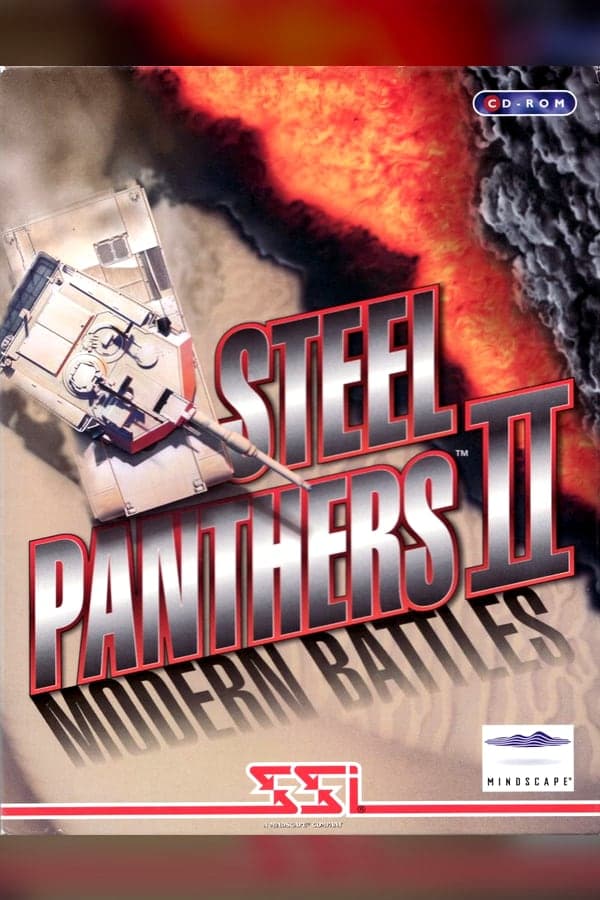
Commanding a modern tank company in Steel Panthers II - Modern Battles means learning very quickly that engagement ranges have outgrown human eyesight, and a single planning error on turn one will turn an entire armored advance into burning scrap.
Gary Grigsby traded World War II mud for modern guided missiles
When designer Gary Grigsby and programmer Keith Brors set out to follow up their celebrated 1995 tactical wargame, they faced a fundamental design problem. World War II armor duels were mostly about armor thickness, gun caliber, and flank maneuvering within clear sightlines. Modern warfare from 1950 onward introduced anti-tank guided missiles, heavy artillery rockets, thermal sights, cluster munitions, and air support that could erase an entire platoon from miles away before anyone heard an engine knock.
Produced by Carl C. Norman for SSI (Strategic Simulations, Inc.), the project shifted the focus to modern combined-arms combat spanning half a century. To handle the increased combat lethalities, the team updated the core engine with SuperVGA graphics, digitized combat video, directional facing for units, and dedicated tracking for guided missiles. Maurie Manning handled the visual assets while composers Danny Pelfrey and Rick Rhodes supplied the audio backplate, giving the tactical map a colder, more clinical atmosphere than its predecessor.
The result was a 1996 strategy title that completely altered how you managed hexes. In this classic SSI / Mindscape release, line of sight was no longer just about seeing the enemy vehicle across a ridge line. It was about knowing whether their missile launcher had already locked onto your command track from three screens away.
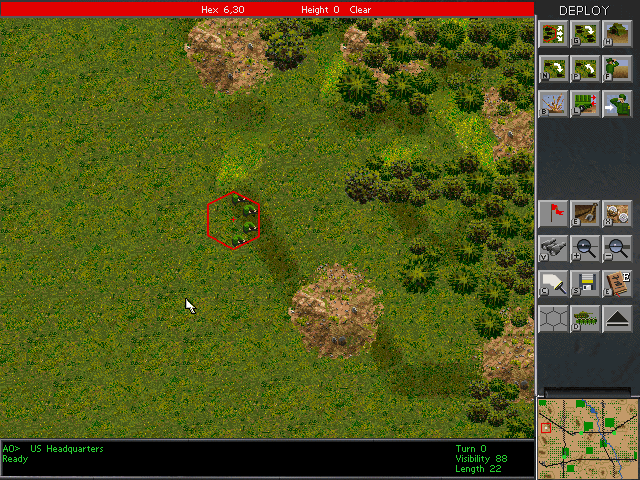
The brutal reality of modern artillery and long-range engagement
Playing the game forces you to adjust to immense lethal reach. You act as a field commander managing individual infantry squads, missile teams, and main battle tanks up to battalion and brigade sizes. Winning requires capturing objective hexes while keeping your point losses lower than the enemy's. The unit database spans over 50 individual tank designs and more than 400 weapon systems across 52 standalone scenarios and six distinct campaigns.
The decision loop is tight and unforgiving. On any given turn, you have to choose between pushing recon forward, locking down a sightline with static anti-tank teams, or committing off-map heavy artillery assets. What makes the turn-based structure tense is the total lack of fog-of-war mercy when moving armor into the open. A bad turn usually looks like this: you advance a platoon of Patton tanks down a clear highway, fail to spot an infantry squad armed with Sagger missiles hidden in a tree line, and watch three of your four tanks explode before you can even issue a fire order.
The historical scope spans several major conflicts and speculative late-twentieth-century operations:
- The Korean War (1950), featuring classic armor engagements and early jet support.
- The Golan Heights (1973), pitting Israeli tank forces against overwhelming Syrian armaments.
- Operation Desert Storm (1991), dominated by modern thermal imaging and heavy air strikes.
- A hypothetical 1980 Warsaw Pact invasion through the Fulda Gap in Germany.
- Hypothetical late-1990s fictional clashes involving U.S. forces in Okinawa against China and Japan.
Steel Panthers II - Modern Battles paid for its scope with broken scenarios
Despite critical praise from magazines like Computer Gaming World, which handed down a 4.5 out of 5 score, contemporary reviewers pointed out obvious signs that the game was rushed to store shelves. Computer Games Strategy Plus gave it 3 out of 5, pointing directly at messy interface glitches. Headquarters information displays often mislabeled active units, and scout helicopters were bizarrely cataloged under off-map artillery call-in menus. If you relied on the UI text without checking unit icons directly, you could easily waste an air strike call on a light observation chopper.
The campaign balance suffered from equally bizarre oversight. In the 1973 Golan Heights campaign, the game mechanics prevent Israeli defensive forces from digging into fortifications on turn one. Syrian heavy artillery opens the first turn with catastrophic rocket barrages that wipe out your armor before you get to click a single unit. Meanwhile, trying to play the Iraqi campaign in Desert Storm presents a wall of American air power and long-range fire that borders on unplayable frustration.
In the hypothetical Fulda Gap scenario, buy points for American forces are dialed so low that players struggle to afford basic artillery coverage alongside adequate tank platoons. You are left trying to stop massive Warsaw Pact armored waves with little more than light recon and hopes. I found that winnable battles frequently turned into desperate retries simply because the initial point budget refused to match the operational objective on screen.
A wargame built on deep simulation outlives its UI rough edges
For all its UI mistakes and balance spikes, the underlying military engine offered something few tactical wargames possessed in 1996. The depth of unit stat tracking was staggering. Armor penetration values were calculated based on impact angle, explosive types, missile tracking rates, and optic quality. That mechanical depth explains why author Rusel DeMaria noted it as a major commercial hit, supported by strong public curiosity about tank combat following the Gulf War.
The original Steel Panthers engine proved so robust that fans kept modifying and expanding it for decades. Its core codebase eventually gave birth to long-standing community projects like winSPWW2 and Steel Panthers: Main Battle Tank, maintained by Camo Workshop and Matrix Games. If you enjoy deep tactical strategy / tactics games, the raw simulation depth here remains impressive, even if the menus take some patience to navigate.
What holds up best today is the pure lethal tension of modern battlefields. Unlike World War II strategy games where heavy tanks could bounce shots and trade blows for several turns, modern anti-tank weapons mean whoever fires first usually wins the hex. What does not hold up is the manual labor of micromanaging troop facings on busy maps, alongside scenario layouts that force immediate retreats on turn one.
Jump straight into the command vehicle
If you want to experience tactical cold war combat without scouring auction sites for old floppy disks, you can play Steel Panthers II - Modern Battles online, free in your browser right now. This complete Steel Panthers II - Modern Battles MS-DOS game release loads straight into your browser window with standard keyboard and mouse controls fully mapped, meaning there is nothing to install and no custom system configuration required.
For a quick ten-minute test of your tactical reflexes, launch a standalone modern scenario, purchase a mixed platoon of main battle tanks and missile infantry, and try holding a bridgehead against incoming jet fighters and heavy artillery. You can play Steel Panthers II - Modern Battles free in your browser right this second and see if your defensive perimeter survives the first round of rocket artillery.