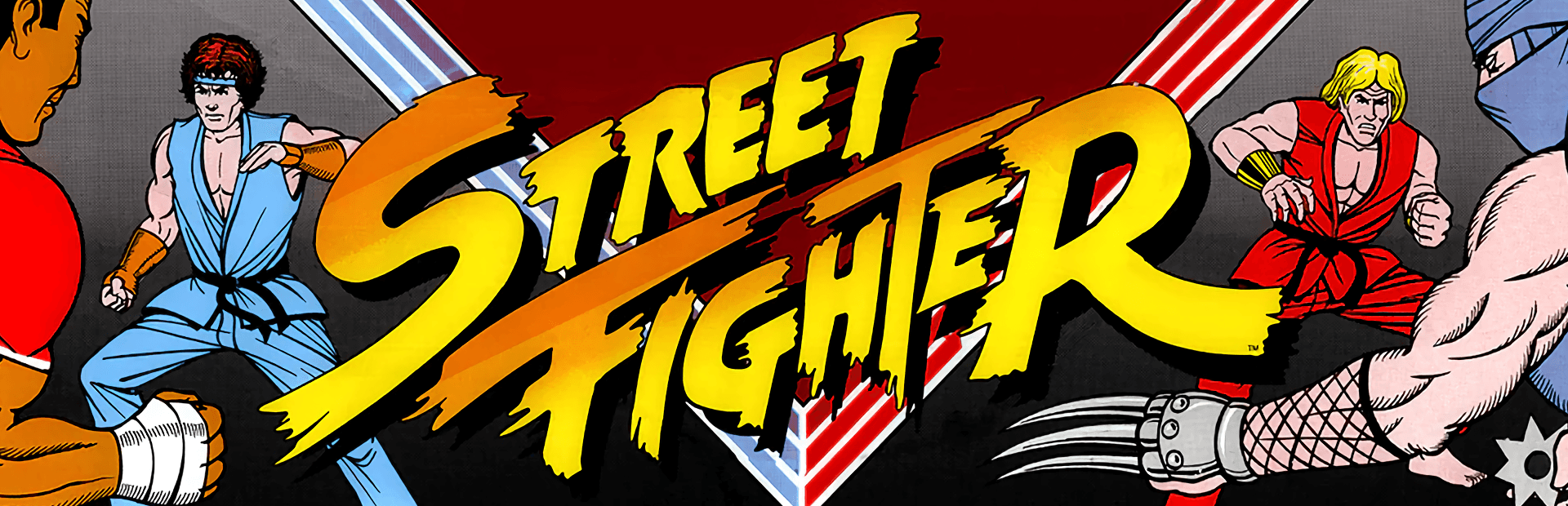
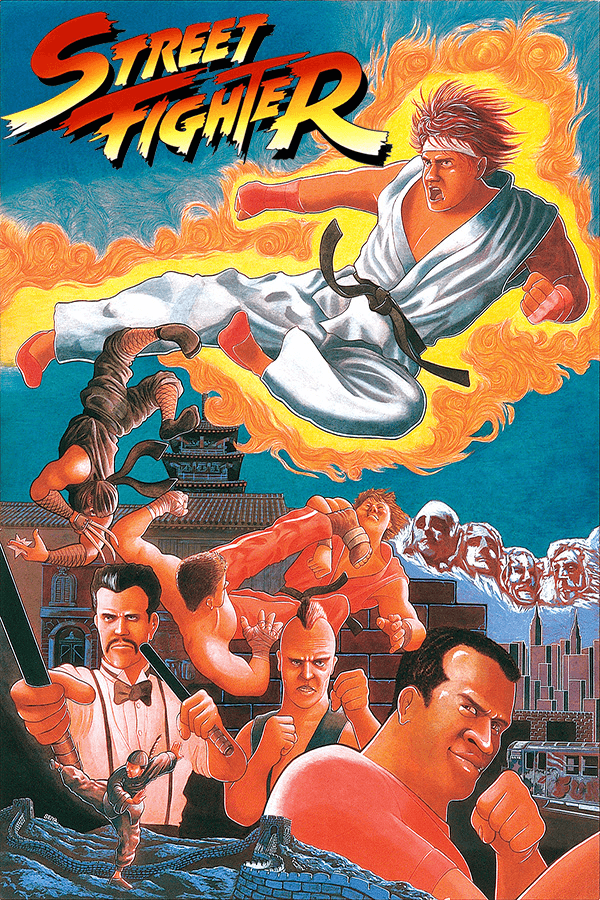

The original 1988 Capcom release of Street Fighter set the template for head-to-head fighting games, but porting its arcade action to MS-DOS created a famously brutal experience.
Before standardizing the six-button layout in arcades, Takashi Nishiyama and Hiroshi Matsumoto wanted a game where execution mattered more than basic button mashing. Inspired by Kung-Fu Master boss fights and martial arts manga, they introduced special command inputs like quarter-circle stick motions for the Hadoken and dragon punch motions for the Shoryuken. In arcades, pulling off a single Dragon Punch could take off a third of an opponent's health bar.
When Hi-Tech Expressions and Micro Talent brought the game to PC hardware in 1988, that design philosophy collided with early computer keyboards. PC games of the late eighties lacked standard gamepads, forcing players to use awkward keyboard layouts or the numeric keypad. What was a test of timing in arcades became an exercise in frustration on a DOS machine.
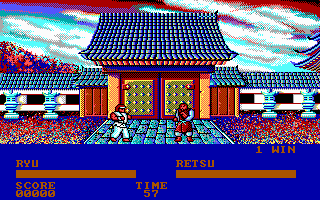
You play as the wandering martial artist Ryu, traveling across five territories: Japan, the USA, England, China, and Thailand. Each location presents two opponents before you can move on to the next region. In two-player mode, a single duel between Ryu and Ken determines who gets to take on the global tournament campaign.
Playing this action game on a numeric keypad feels like steering a heavy wagon down a muddy hill. The key registations lag behind your fingers, turning snappy martial arts inputs into sluggish desperation. Missing a diagonal keypress usually leaves Ryu standing completely still while your opponent punishes you.
Special moves suffer even worse under this setup. Throwing a fireball or landing a hurricane kick requires precise directional registration that the DOS engine rarely captures accurately. Half the time you execute a motion, your character simply stands in place or delivers a slow jab instead of the intended special attack.
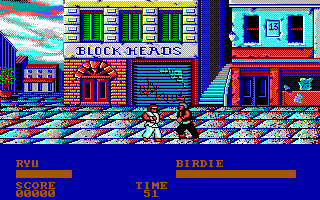
The hit detection adds another layer of unpredictability to every fight. Sweeps and jump kicks often pass directly through an enemy sprite without dealing damage, only for a weak punch from the computer to hit you from across the screen. Battles with aggressive opponents like Gen or Eagle turn into chaotic survival tests where luck matters as much as timing.
Between countries, you enter bonus stages where Ryu smashes objects like wooden boards and ice blocks for bonus points. These brief breaks give your fingers a rest, though even breaking boards requires wrestling with sluggish inputs. Passing a bonus round offers a brief respite before the difficulty spikes again in the next country.
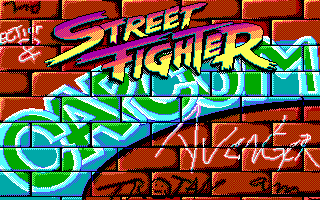
Visually, the DOS conversion attempts to translate the side-view character sprites from the arcade board, but the translation has visible rough edges. Solid, bright blue borders frame the main screen playfield, shrinking the visible arena. The character animations look stiff compared to their arcade counterparts, making light punches feel heavy and heavy kicks look awkward.
Audio is another area where the port strips away atmospheric detail. While Yoshihiro Sakaguchi composed an energetic score for the arcade original, the standard PC speaker setup in this port offers almost no music during fights. You fight in near silence, accompanied only by dry blips for punches, clicks for kicks, and static bursts for special moves.
The roster includes characters who would later become famous in the Alpha series, including Adon, Gen, and Birdie. Facing Sagat as the final boss in Thailand highlights every issue with the PC port. His Tiger Shot projectiles leave almost no room for error, and defeating him without reliable special moves requires endless patience and tight blocking.
Looking back at 1988, this release shows the raw ingredients that took over arcades three years later. The world tour setup, the familiar character lineup, and the basic idea of special move inputs are all sitting right here in their earliest forms.
Here is what you will encounter when you sit down with this version today:
As an action game to play for fun today, the DOS conversion is a tough sell. The stiff movement, missing music, and unreliable collision detection make standard matches a chore. If you want to sample this release, treat it as a curious artifact showing how home PC conversions struggled with arcade execution in the late eighties.
You can play Street Fighter online free in your browser right on this page with no extra setup required. It loads the classic DOS environment directly in your web browser, allowing you to experience the original tournament ladder without hunting for vintage hardware.
If you want to survive your first trip through Japan against Retsu and Geki, map your controls to comfortable keys before starting. Modern players often expect the smooth move execution of later sequels, but in this early edition, single light attacks and careful spacing are your safest tools. Jump in, test your patience against Sagat, and see where the fighting genre began.
The original 1988 Capcom release of Street Fighter set the template for head-to-head fighting games, but porting its arcade action to MS-DOS created a famously brutal experience.
Before standardizing the six-button layout in arcades, Takashi Nishiyama and Hiroshi Matsumoto wanted a game where execution mattered more than basic button mashing. Inspired by Kung-Fu Master boss fights and martial arts manga, they introduced special command inputs like quarter-circle stick motions for the Hadoken and dragon punch motions for the Shoryuken. In arcades, pulling off a single Dragon Punch could take off a third of an opponent's health bar.
When Hi-Tech Expressions and Micro Talent brought the game to PC hardware in 1988, that design philosophy collided with early computer keyboards. PC games of the late eighties lacked standard gamepads, forcing players to use awkward keyboard layouts or the numeric keypad. What was a test of timing in arcades became an exercise in frustration on a DOS machine.

You play as the wandering martial artist Ryu, traveling across five territories: Japan, the USA, England, China, and Thailand. Each location presents two opponents before you can move on to the next region. In two-player mode, a single duel between Ryu and Ken determines who gets to take on the global tournament campaign.
Playing this action game on a numeric keypad feels like steering a heavy wagon down a muddy hill. The key registations lag behind your fingers, turning snappy martial arts inputs into sluggish desperation. Missing a diagonal keypress usually leaves Ryu standing completely still while your opponent punishes you.
Special moves suffer even worse under this setup. Throwing a fireball or landing a hurricane kick requires precise directional registration that the DOS engine rarely captures accurately. Half the time you execute a motion, your character simply stands in place or delivers a slow jab instead of the intended special attack.

The hit detection adds another layer of unpredictability to every fight. Sweeps and jump kicks often pass directly through an enemy sprite without dealing damage, only for a weak punch from the computer to hit you from across the screen. Battles with aggressive opponents like Gen or Eagle turn into chaotic survival tests where luck matters as much as timing.
Between countries, you enter bonus stages where Ryu smashes objects like wooden boards and ice blocks for bonus points. These brief breaks give your fingers a rest, though even breaking boards requires wrestling with sluggish inputs. Passing a bonus round offers a brief respite before the difficulty spikes again in the next country.
Visually, the DOS conversion attempts to translate the side-view character sprites from the arcade board, but the translation has visible rough edges. Solid, bright blue borders frame the main screen playfield, shrinking the visible arena. The character animations look stiff compared to their arcade counterparts, making light punches feel heavy and heavy kicks look awkward.

Audio is another area where the port strips away atmospheric detail. While Yoshihiro Sakaguchi composed an energetic score for the arcade original, the standard PC speaker setup in this port offers almost no music during fights. You fight in near silence, accompanied only by dry blips for punches, clicks for kicks, and static bursts for special moves.
The roster includes characters who would later become famous in the Alpha series, including Adon, Gen, and Birdie. Facing Sagat as the final boss in Thailand highlights every issue with the PC port. His Tiger Shot projectiles leave almost no room for error, and defeating him without reliable special moves requires endless patience and tight blocking.
Looking back at 1988, this release shows the raw ingredients that took over arcades three years later. The world tour setup, the familiar character lineup, and the basic idea of special move inputs are all sitting right here in their earliest forms.
Here is what you will encounter when you sit down with this version today:
As an action game to play for fun today, the DOS conversion is a tough sell. The stiff movement, missing music, and unreliable collision detection make standard matches a chore. If you want to sample this release, treat it as a curious artifact showing how home PC conversions struggled with arcade execution in the late eighties.
You can play Street Fighter online free in your browser right on this page with no extra setup required. It loads the classic DOS environment directly in your web browser, allowing you to experience the original tournament ladder without hunting for vintage hardware.
If you want to survive your first trip through Japan against Retsu and Geki, map your controls to comfortable keys before starting. Modern players often expect the smooth move execution of later sequels, but in this early edition, single light attacks and careful spacing are your safest tools. Jump in, test your patience against Sagat, and see where the fighting genre began.
How Street Fighter is played — the keys the game listens to, grouped by what they do.
Highlighted keys are mapped — hover or tap one to see what it does.
Execution speed is sensitive to hardware CPU speed; slowing the game down in an emulator may be necessary to input attacks properly.
The on-screen keyboard and gamepad mapping the browser player uses on a phone, a tablet or a controller, as opposed to the real keys above. $PRO members make their own in the player and share them here; anyone can pick one to play with.
Cheat codes, console commands and memory pokes for Street Fighter — each one verified and attributed.
Sign in to submitHow Street Fighter is played — the keys the game listens to, grouped by what they do.
Highlighted keys are mapped — hover or tap one to see what it does.
Execution speed is sensitive to hardware CPU speed; slowing the game down in an emulator may be necessary to input attacks properly.
The on-screen keyboard and gamepad mapping the browser player uses on a phone, a tablet or a controller, as opposed to the real keys above. $PRO members make their own in the player and share them here; anyone can pick one to play with.
Cheat codes, console commands and memory pokes for Street Fighter — each one verified and attributed.
Sign in to submit
