Super Street Fighter II
Checking…
- 1this week
If you played Super Street Fighter II on PC back in 1996, you probably spent more time wrestling with awkward keyboard bindings than landing clean dragon punches.
The four new challengers were not enough to save a late DOS conversion
You boot the game, choose Ryu on the character select screen, and wait for the match to begin. The intro music plays through your sound card, but the graphics look distinctly squished compared to the arcade cabinet. Once the fight starts, pressing down, down-forward, forward, and punch requires precise hand gymnastics on a standard desktop keyboard.
Capcom built a massive roster for this entry in the series. The game added four new world warriors to the original twelve fighters: Cammy, Fei Long, Dee Jay, and T. Hawk. Each brought a distinct fighting style and standard arcade stage, raising the total roster to sixteen characters.
Despite that larger cast, this port struggled from the moment it reached store shelves. Rozner Labs Software Group handled the porting duties for this Capcom release. By the time it arrived, PC owners were already accustomed to smoother arcade conversions.
Trying to throw a fireball on a standard PC keyboard
Playing a quarter-circle motion on numeric keypads or arrow keys was always a compromise. Executing special moves meant wrestling with ghosting keys that refused to register three inputs at once. A game built for six arcade buttons simply did not feel natural on standard office peripherals.
To give solo players and groups extra replay value, the programmers packed in several distinct match structures alongside the main arcade mode:
- Elimination Group Battle for classic king-of-the-hill champion matches.
- Point Battle where players fight across rounds to earn the highest total score.
- Eight-man double elimination tournament to run custom brackets with friends.
- Challenge mode to chase high scores or set speedrun records against CPU opponents.
The multiplayer options were technically impressive for a 1990s action game. You could fight head-to-head on a single screen or connect two PCs together through a null-modem serial cable or dial-up phone link. Finding a friend with the right cable configuration, however, was a hurdle most teenagers never cleared.
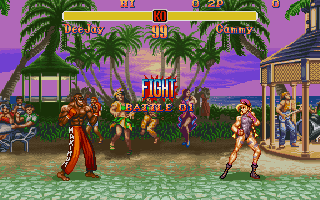
Downscaled VGA graphics and flat sound card audio
The visual concessions hurt the overall presentation. Arcade units ran on Capcom's custom CPS-2 hardware, which pushed vivid backgrounds and high frame rates. This MS-DOS release relied on basic 320x200 VGA graphics modes, forcing the developers to downscale character sprites and trim animation frames.
The audio suffered a similar hit during translation. Instead of rich arcade sampling, the sound output defaulted to standard Sound Blaster MIDI tunes and compressed voice clips. Heavy attacks lacked physical weight, and special move callouts sounded thin and muffled through desktop speakers.
Because the framerate dipped below console standards, timed combos felt sluggish. German magazine PC Action handed the game a brutal 15% score upon release, while Power Play scored it at 35%. Computer Gaming World was barely more forgiving, rating the conversion at 40%.
Super Street Fighter II came out after its own superior arcade sequel
The biggest mystery surrounding this port was its late release date. Retailers stocked this standard release in late 1996, long after Super Street Fighter II Turbo had already landed on DOS in 1995. Releasing the non-Turbo edition later made very little sense to consumers.
Publisher Capcom U.S.A. tried to sweeten the deal at retail with a physical Bonus Pack. That big-box store edition bundled the floppy disks with a specialized six-button PC gamepad. It even tossed in a VHS tape of the 1994 live-action movie starring Jean-Claude Van Damme.
That box set is a strange package for collectors today. Yet even a free controller and a movie tape could not hide the sluggish action on screen. The underlying fighting mechanics were solid, but the engine felt completely out of step with 1996 PC software.
Fire up this arcade fighter directly in your web browser
This port shows how late-stage DOS fighting games had to compromise on standard computer hardware. While visual downgrades and slow frame rates stopped it from matching the arcade original, digging through the extra menu modes and full sixteen-character roster is still worth a look.
You can play Super Street Fighter II free in your browser right now with no setup needed. Jump straight into the character select screen, pick Dee Jay or Cammy, and see if your modern keyboard skills are sharp enough to throw a Hadouken on the first try.
Players' controls
Touch and gamepad controls
The on-screen keyboard and gamepad mapping the browser player uses on a phone, a tablet or a controller, as opposed to the real keys above. $PRO members make their own in the player and share them here; anyone can pick one to play with.
Make your own touch controlsPRO
- 1Open the editorSign in below, then pick what to make. The game starts with the editor open over it.
- 2Place your keysAdd keys and drag them where your thumbs rest, or map a controller's buttons. Test plays the game with them; Save keeps them, and you play with them from then on.
- 3Share themShare them right after saving in the game, or name and share them here. Players vote, and the best become this game's controls for everyone.
Go PROSee how it worksSign in+20 XP for sharing · +50 XP if yours become the game's own
- The game's own controlsNone yet: played with a real keyboard only.In use
2 screenshots
From the archive
No gameplay video yet
No gameplay video for Super Street Fighter II yet. Sign in to add one.
No reviews yet
Tell the community what you think of Super Street Fighter II. Reviews are public and tied to your username.
No archived manuals for Super Street Fighter II yet
No manuals archived for this title yet. Sign in to upload the first scan.
Cheat codes, console commands and memory pokes for Super Street Fighter II — each one verified and attributed.
Sign in to submitNo cheats yet for this title
Know a working cheat, poke or trainer? Add it with the button above. Moderators check every entry before it goes live.
No archived soundtrack for Super Street Fighter II yet
No soundtrack archived for this title yet. Sign in to upload the first rip.
No save states for Super Street Fighter II yet
No save states for this title yet. Sign in to share one.
Discussions
Sign in to post- Threads0
- Total posts0
- Online now6
Community · Super Street Fighter II
Who's contributing, and what's new
- Reviews0
- Threads0
- Uploadsapproved0
- Contributors0
Recent activity
Nothing here yet
Reviews, discussion threads and approved uploads appear here as members add them.