
Playing Warlords II Deluxe means spending hours weighing whether your vector of movement leaves a border city exposed to a surprise hero drop, or if you can afford to send your knight exploring ancient ruins for a magic sword. It takes the clean expansion loop of medieval turn-based warfare and spreads it across sixty distinct maps.
When SVGA upgrades transformed Warlords II Deluxe
In the mid-1990s, Australian developer SSG Strategic Studies Group Pty Ltd. faced a clear problem. Their turn-based strategy hit Warlords II had established a loyal fanbase, but players wanted higher visual resolution, richer sound, and direct access to tools that would let them craft their own fantasy campaigns. Selling standalone scenario disks felt increasingly outdated as CD-ROM drives became standard equipment on gaming PCs.
The studio responded in 1995 by assembling a complete overhaul built specifically for 256-color SVGA displays. Designers Steve Fawkner, Roger Keating, Ian Trout, and Gregor Whiley packaged the core game together with its separate map construction kit. Instead of swapping floppy disks or dealing with limited color palettes, players gained native support for Sound Blaster audio cards, expanded digital music tracks, and an integrated editor capable of changing terrain tiles, unit sprites, and city graphics.
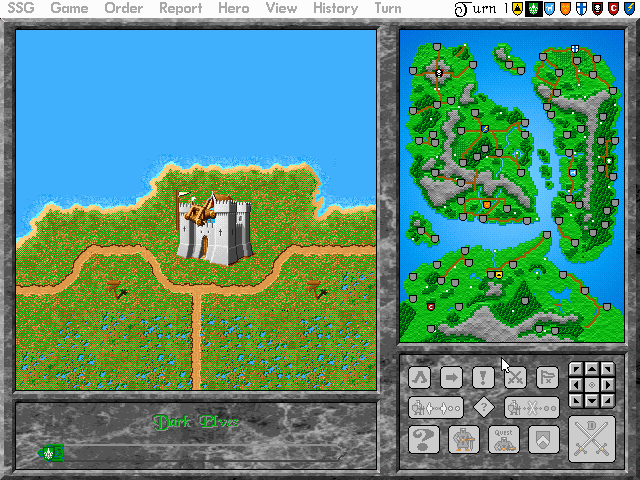
For players who had already purchased the earlier release and its expansion disks, buying the repackaged box felt like paying twice for the same underlying mechanics. Yet for anyone jumping in fresh, having sixty preset scenarios spanning medieval kingdoms, futuristic wasteland wars, and historical battlefields in a single package created an immediate draw.
Stacking dragons and raiding ruins on every turn
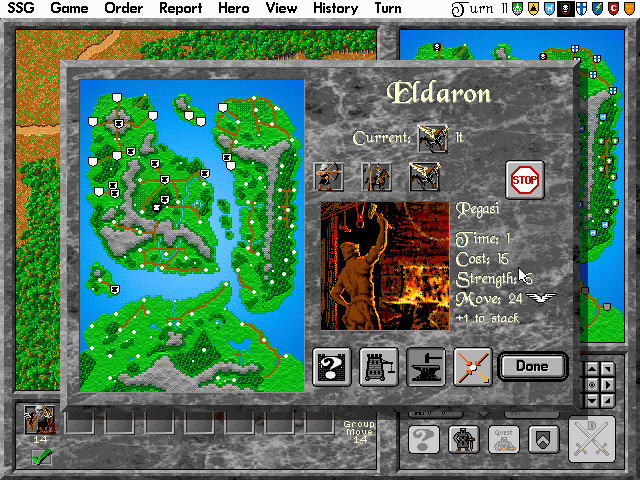
At its core, this turn-based strategy game revolves around spatial control and production efficiency. Up to eight factions fight for dominance across maps covered in forests, hills, and ocean straits. Cities generate gold each turn, which you spend drafting armies that range from humble light infantry to heavy cavalry, pegasi, and giant green dragons. Each army stack holds up to eight units, and moving a balanced group across rough terrain requires careful planning to prevent fast troops from stranding slower siege engines.
Heroes drive the strategic variety that sets campaigns apart. They appear at your capital offering their services for a fee, bringing unique combat buffs and the ability to undertake side-quests. Sending a knight into an unexplored ruin on the edge of the fog of war might reward you with a powerful artifact or a group of giant allies. It can just as easily kill your hero outright, leaving a key defensive border completely unprotected while enemy armies gather outside your gates.
Combat resolves automatically when opposing stacks meet on the map, running down the line unit by unit based on hit points, defense values, and terrain bonuses. This auto-calculated system keeps large multiplayer matches moving quickly, but the random number generator introduces brutal swings. Watching a high-value army die to low-tier militia because the digital dice went cold creates genuine tension, leading many solo players to save their progress right before attacking a target.
Computer generals and the cheat code fix
The primary weakness of the package sits squarely with its artificial intelligence. Computer opponents expand steadily on smaller maps, but on large geography they consistently struggle with long-term troop logistics. An AI leader will frequently leave rich interior cities minimally guarded while shuffling small, fragmented forces back and forth along mountain passes without launching a concentrated assault.
Players quickly discovered that the basic difficulty settings do not improve the strategy used by computer players. Instead, the game relies on artificial modifiers. Typing in the infamous "I am the greatest" difficulty toggle forces every single non-player faction into a permanent state of war against you while granting them income boosts and reduced production costs. Rather than playing against a smarter opponent, you are suddenly fighting off endless swarms on six fronts simultaneously.
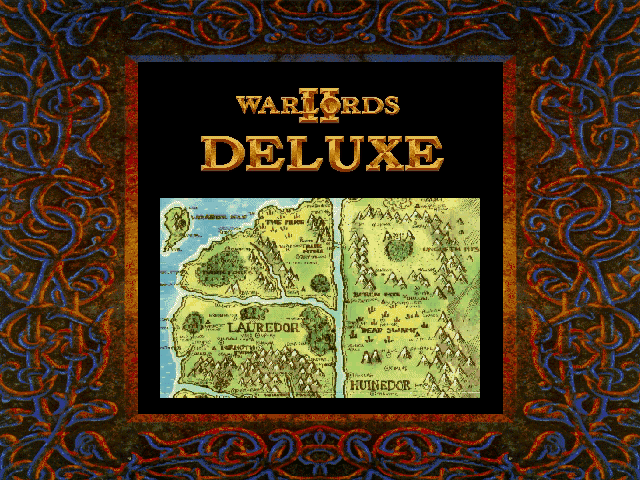
Because the AI leaves much to be desired, the design works best against human minds. Before reliable internet play took over, fans set up grueling hot-seat sessions around a single monitor or sent turn files back and forth via email attachments. Play-By-E-Mail (PBEM) campaigns could last for months, with players carefully analyzing movement ranges before saving their file and emailing the updated state to the next general on the roster.
To keep multi-front wars competitive, experienced generals follow a strict set of operational principles during every campaign movement phase:
- Group slow units with high-value leaders to maximize defensive modifiers during enemy turns.
- Prioritize ruin exploration early, accepting hero risks when potential artifact rewards outweigh raw unit production.
- Garrison coastal settlements heavily to prevent enemy heroes from landing naval transports behind your main army line.
- Focus city production on rapid mobility units when expanding into wide, clear grassland terrain.
Why Warlords II Deluxe stays dangerously playable online today
While the computer intelligence cannot match a modern strategy engine, the crisp vector-style movement, deep customization tools, and quick turn speed keep the campaign loop easy to get hooked on. You can build a custom scenario from scratch, change the unit stats to match your favorite fantasy setting, and start taking turns within minutes. The whole package hits a sweet spot for 1990s PC strategy, balancing accessibility with deep map control decisions.
You can play Warlords II Deluxe free in your browser right now, with full keyboard support and no registration needed. Jump into a custom world, recruit a hero on turn one, and send them straight into the nearest set of unexplored ruins to see if they return with a magical war hammer or get eaten by swamp monsters.